Department of Experimental Oncology, IEO, European Institute of Oncology IRCCS, 20139 Milan, Italy.
Department of Oncology and Hemato-Oncology, University of Milan, 20122 Milan, Italy.
Cells. 2022 Feb 7;11(3):577. doi: 10.3390/cells11030577.
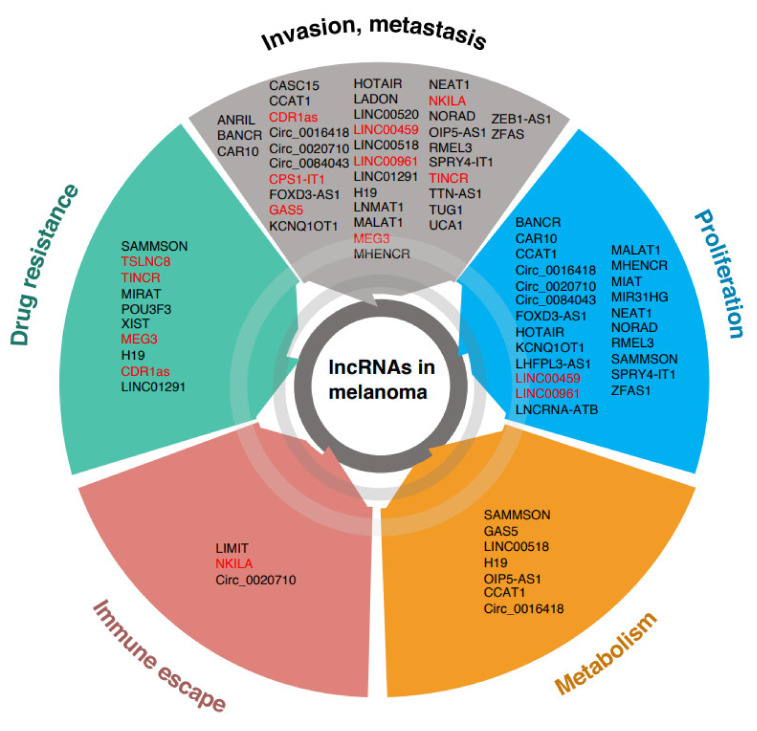
Long non-coding RNAs (lncRNAs) are key regulators of numerous intracellular processes leading to tumorigenesis. They are frequently deregulated in cancer, functioning as oncogenes or tumor suppressors. As they act through multiple mechanisms, it is not surprising that they may exert dual functions in the same tumor. In melanoma, a highly invasive and metastatic tumor with the propensity to rapidly develop drug resistance, lncRNAs play different roles in: (i) guiding the phenotype switch and leading to metastasis formation; (ii) predicting the response of melanoma patients to immunotherapy; (iii) triggering adaptive responses to therapy and acquisition of drug resistance phenotypes. In this review we summarize the most recent findings on the lncRNAs involved in melanoma growth and spreading to distant sites, focusing on their role as biomarkers for disease diagnosis and patient prognosis, or targets for novel therapeutic approaches.
长链非编码 RNA(lncRNA)是导致肿瘤发生的众多细胞内过程的关键调节剂。它们在癌症中经常失调,作为癌基因或肿瘤抑制因子发挥作用。由于它们通过多种机制发挥作用,因此它们在同一肿瘤中可能发挥双重作用也就不足为奇了。在黑色素瘤中,lncRNA 发挥不同的作用:(i)指导表型转换并导致转移形成;(ii)预测黑色素瘤患者对免疫疗法的反应;(iii)引发对治疗的适应性反应并获得耐药表型。在这篇综述中,我们总结了与黑色素瘤生长和扩散到远处部位相关的 lncRNA 的最新发现,重点介绍了它们作为疾病诊断和患者预后的生物标志物,或作为新型治疗方法的靶点的作用。