Niu Jianli, Sareli Candice, Mayer Daniel, Visbal Alvaro, Sareli Aharon
Office of Human Research, Memorial Healthcare System, Hollywood, FL 33021, USA.
Adult Critical Care Service, Memorial Healthcare System, Hollywood, FL 33021, USA.
J Clin Med. 2022 Jan 28;11(3):700. doi: 10.3390/jcm11030700.
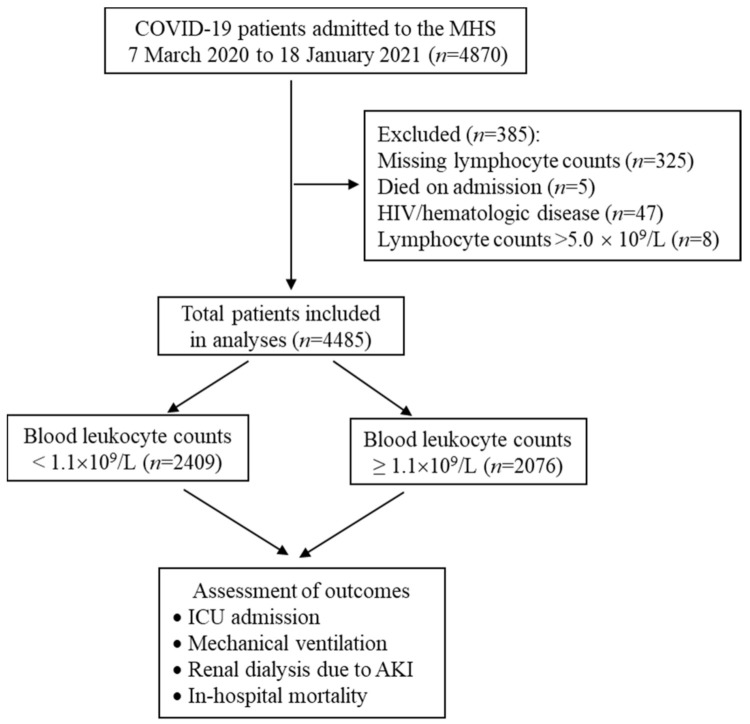
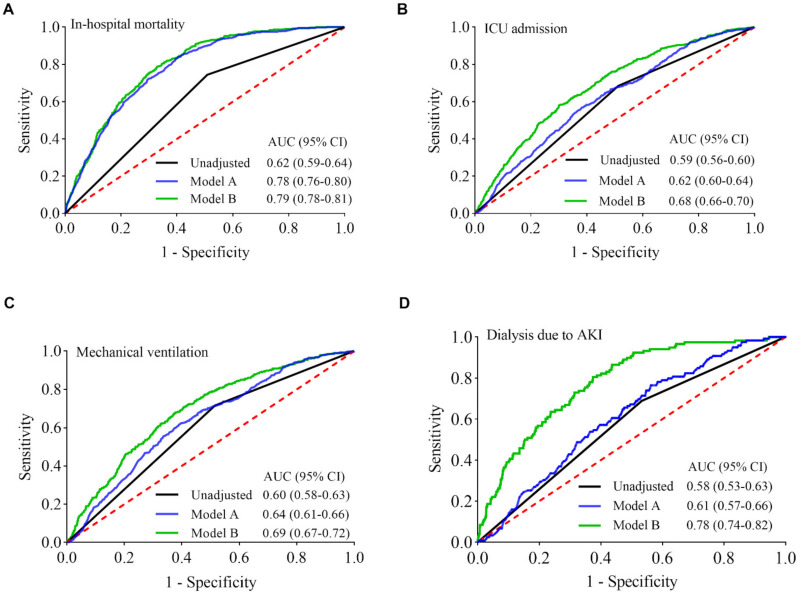
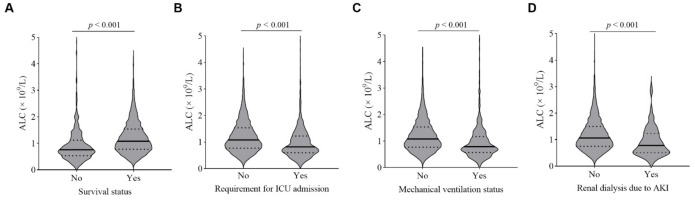
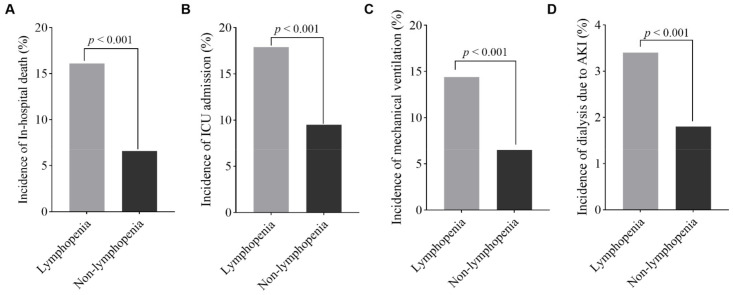
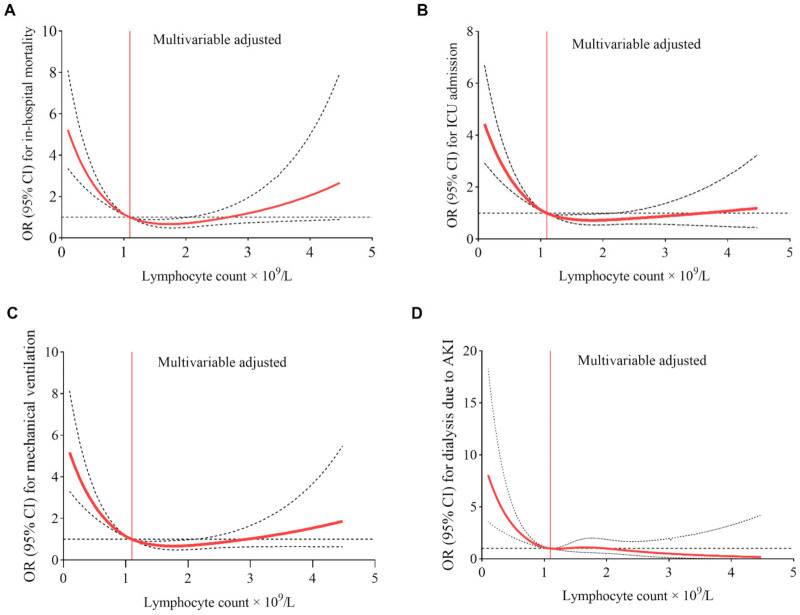
Lymphopenia is commonly present in patients with COVID-19. We sought to determine if lymphopenia on admission predicts COVID-19 clinical outcomes. A retrospective chart review was performed on 4485 patients with laboratory-confirmed COVID-19, who were admitted to the hospital. Of those, 2409 (57.3%) patients presented with lymphopenia (absolute lymphocyte count < 1.1 × 10/L) on admission, and had higher incidences of ICU admission (17.9% versus 9.5%, < 0.001), invasive mechanical ventilation (14.4% versus 6.5%, < 0.001), dialysis (3.4% versus 1.8%, < 0.001) and in-hospital mortality (16.6% versus 6.6%, < 0.001), with multivariable-adjusted odds ratios of 1.86 (95% confidence interval [CI], 1.55-2.25), 2.09 (95% CI, 1.69-2.59), 1.77 (95% CI, 1.19-2.68), and 2.19 (95% CI 1.76-2.72) for the corresponding outcomes, respectively, compared to those without lymphopenia. The restricted cubic spline models showed a non-linear relationship between lymphocyte count and adverse outcomes, with an increase in the risk of adverse outcomes for lower lymphocyte counts in patients with lymphopenia. The predictive powers of lymphopenia, expressed as areas under the receiver operating characteristic curves, were 0.68, 0.69, 0.78, and 0.79 for the corresponding adverse outcomes, respectively, after incorporating age, gender, race, and comorbidities. In conclusion, lymphopenia is a useful metric in prognosticating outcomes in hospitalized COVID-19 patients.
淋巴细胞减少症在新冠肺炎患者中普遍存在。我们试图确定入院时的淋巴细胞减少症是否能预测新冠肺炎的临床结局。对4485例实验室确诊的新冠肺炎住院患者进行了回顾性病历审查。其中,2409例(57.3%)患者入院时出现淋巴细胞减少症(绝对淋巴细胞计数<1.1×10⁹/L),其入住重症监护病房(ICU)(17.9%对9.5%,P<0.001)、有创机械通气(14.4%对6.5%,P<0.001)、透析(3.4%对1.8%,P<0.001)和院内死亡率(16.6%对6.6%,P<0.001)的发生率更高,与无淋巴细胞减少症的患者相比,相应结局的多变量调整优势比分别为1.86(95%置信区间[CI],1.55 - 2.25)、2.09(95%CI,1.69 - 2.59)、1.77(95%CI,1.19 - 2.68)和2.19(95%CI 1.76 - 2.72)。受限立方样条模型显示淋巴细胞计数与不良结局之间存在非线性关系,淋巴细胞减少症患者中淋巴细胞计数越低,不良结局风险越高。在纳入年龄、性别、种族和合并症后,淋巴细胞减少症对相应不良结局的预测能力,以受试者工作特征曲线下面积表示,分别为0.68、0.69、0.78和0.79。总之,淋巴细胞减少症是预测住院新冠肺炎患者结局的一个有用指标。