Huma Therapeutics Limited, London, United Kingdom.
INDEX Group, Department of Science, Innovation, Technology, and Entrepreneurship, University of Exeter, Exeter, United Kingdom.
PLoS One. 2021 Mar 4;16(3):e0247461. doi: 10.1371/journal.pone.0247461. eCollection 2021.
COVID-19 clinical presentation is heterogeneous, ranging from asymptomatic to severe cases. While there are a number of early publications relating to risk factors for COVID-19 infection, low sample size and heterogeneity in study design impacted consolidation of early findings. There is a pressing need to identify the factors which predispose patients to severe cases of COVID-19. For rapid and widespread risk stratification, these factors should be easily obtainable, inexpensive, and avoid invasive clinical procedures. The aim of our study is to fill this knowledge gap by systematically mapping all the available evidence on the association of various clinical, demographic, and lifestyle variables with the risk of specific adverse outcomes in patients with COVID-19.
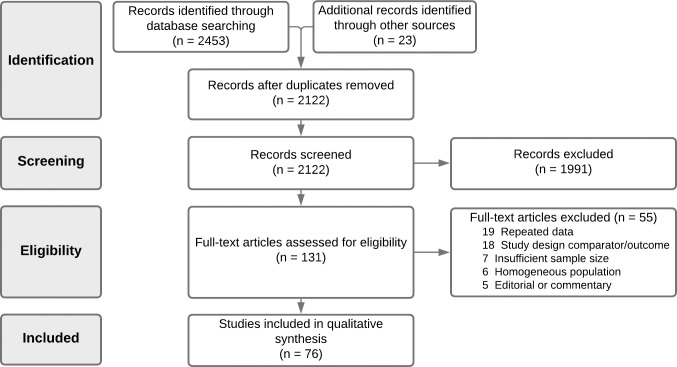
The systematic review was conducted using standardized methodology, searching two electronic databases (PubMed and SCOPUS) for relevant literature published between 1st January 2020 and 9th July 2020. Included studies reported characteristics of patients with COVID-19 while reporting outcomes relating to disease severity. In the case of sufficient comparable data, meta-analyses were conducted to estimate risk of each variable.
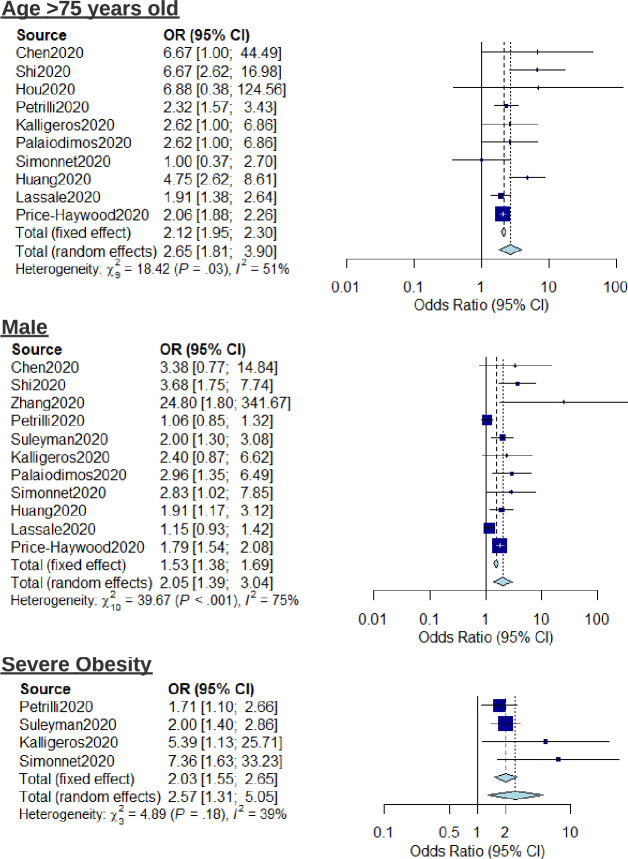
Seventy-six studies were identified, with a total of 17,860,001 patients across 14 countries. The studies were highly heterogeneous in terms of the sample under study, outcomes, and risk measures reported. A large number of risk factors were presented for COVID-19. Commonly reported variables for adverse outcome from COVID-19 comprised patient characteristics, including age >75 (OR: 2.65, 95% CI: 1.81-3.90), male sex (OR: 2.05, 95% CI: 1.39-3.04) and severe obesity (OR: 2.57, 95% CI: 1.31-5.05). Active cancer (OR: 1.46, 95% CI: 1.04-2.04) was associated with increased risk of severe outcome. A number of common symptoms and vital measures (respiratory rate and SpO2) also suggested elevated risk profiles.
Based on the findings of this study, a range of easily assessed parameters are valuable to predict elevated risk of severe illness and mortality as a result of COVID-19, including patient characteristics and detailed comorbidities, alongside the novel inclusion of real-time symptoms and vital measurements.
COVID-19 的临床表型存在异质性,从无症状到重症病例不等。虽然有许多早期出版物涉及 COVID-19 感染的危险因素,但样本量小和研究设计的异质性影响了早期发现的整合。迫切需要确定使患者易患 COVID-19 重症的因素。为了快速广泛地进行风险分层,这些因素应该易于获得、价格低廉且避免侵入性的临床操作。我们的研究旨在通过系统地绘制所有关于各种临床、人口统计学和生活方式变量与 COVID-19 患者特定不良结局风险之间关联的现有证据,来填补这一知识空白。
使用标准化方法进行系统评价,在 2020 年 1 月 1 日至 2020 年 7 月 9 日期间,在两个电子数据库(PubMed 和 SCOPUS)中搜索相关文献。纳入的研究报告了 COVID-19 患者的特征,同时报告了与疾病严重程度相关的结局。在有足够可比数据的情况下,进行荟萃分析以估计每个变量的风险。
确定了 76 项研究,涉及来自 14 个国家的 1786001 名患者。这些研究在研究样本、结局和报告的风险测量方面存在很大的异质性。提出了大量 COVID-19 的危险因素。常见的 COVID-19 不良结局报告变量包括患者特征,如年龄>75 岁(OR:2.65,95%CI:1.81-3.90)、男性(OR:2.05,95%CI:1.39-3.04)和严重肥胖(OR:2.57,95%CI:1.31-5.05)。活动性癌症(OR:1.46,95%CI:1.04-2.04)与严重结局的风险增加相关。一些常见的症状和生命体征(呼吸频率和 SpO2)也提示风险升高。
基于本研究的发现,一系列易于评估的参数可用于预测 COVID-19 重症和死亡率升高的风险,包括患者特征和详细的合并症,以及实时症状和生命体征的新纳入。