Al-Hadeethi Yas, Sayyed M I, Barasheed Abeer Z, Ahmed Moustafa, Elsafi Mohamed
Department of Physics, Faculty of Science, King Abdulaziz University, Jeddah 21589, Saudi Arabia.
Lithography in Devices Fabrication and Development Research Group, Deanship of Scientific Research, King Abdulaziz University, Jeddah 21589, Saudi Arabia.
Materials (Basel). 2022 Jan 21;15(3):789. doi: 10.3390/ma15030789.
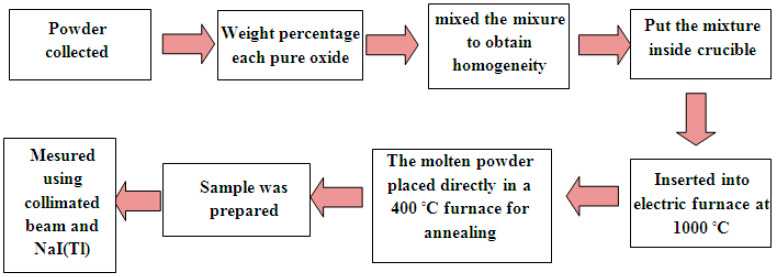
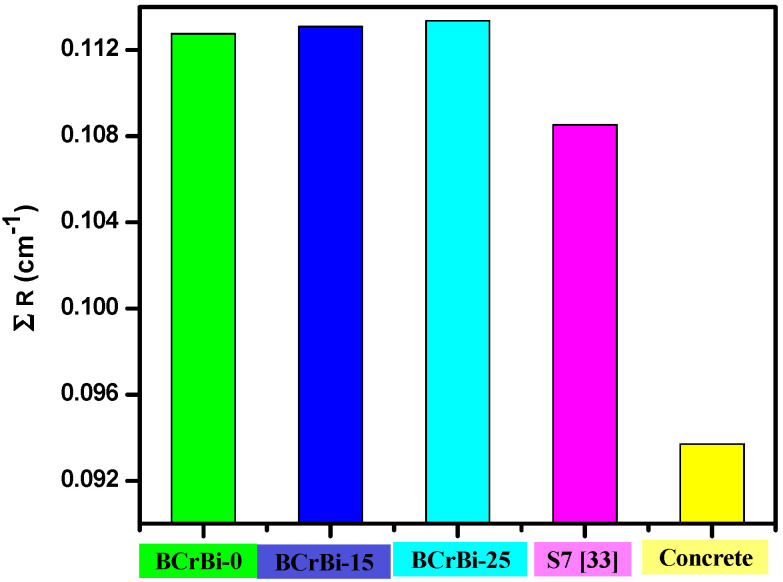
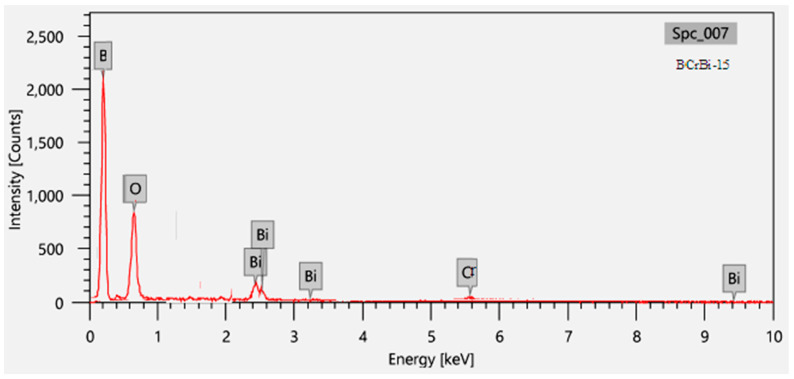
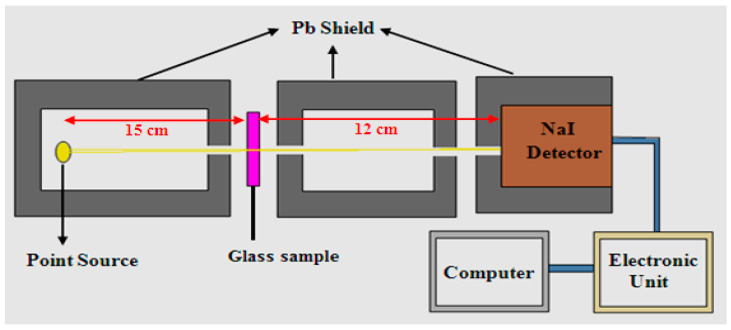
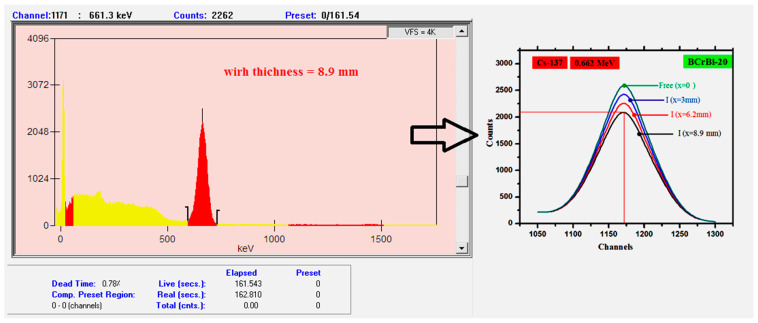
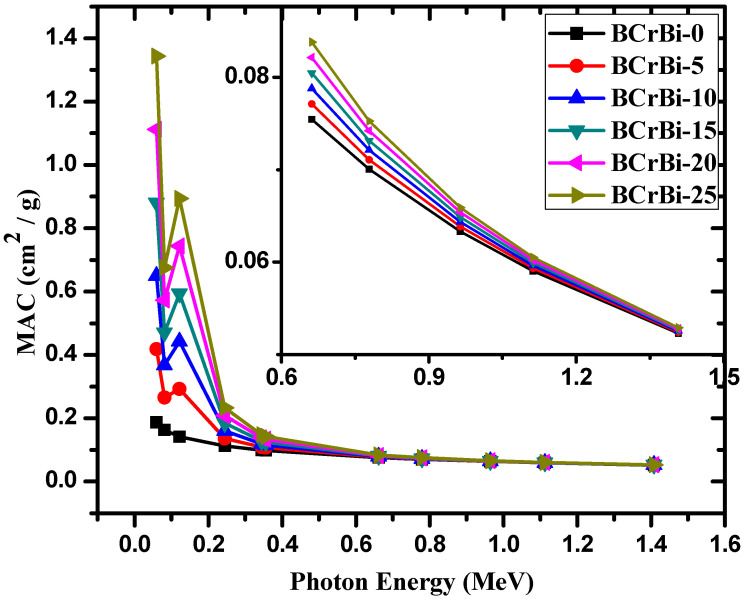
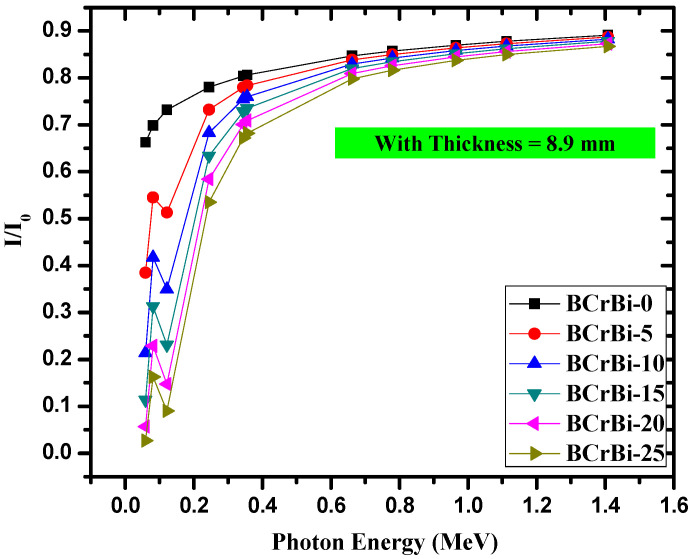
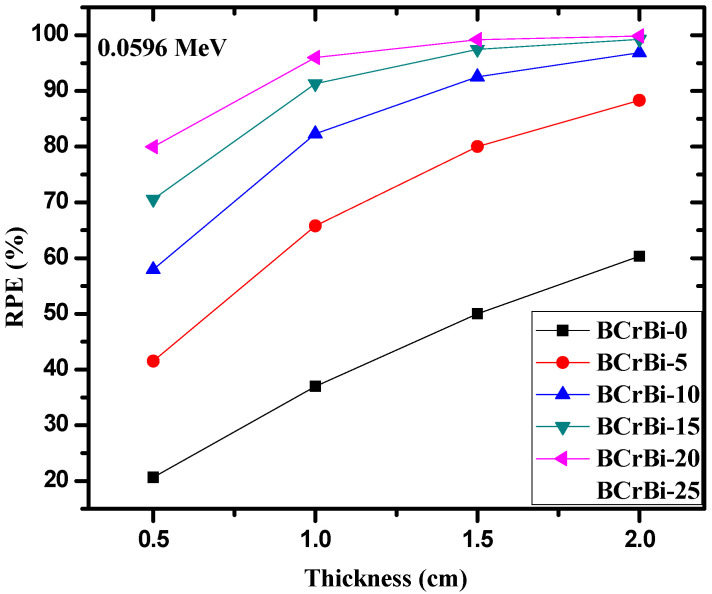
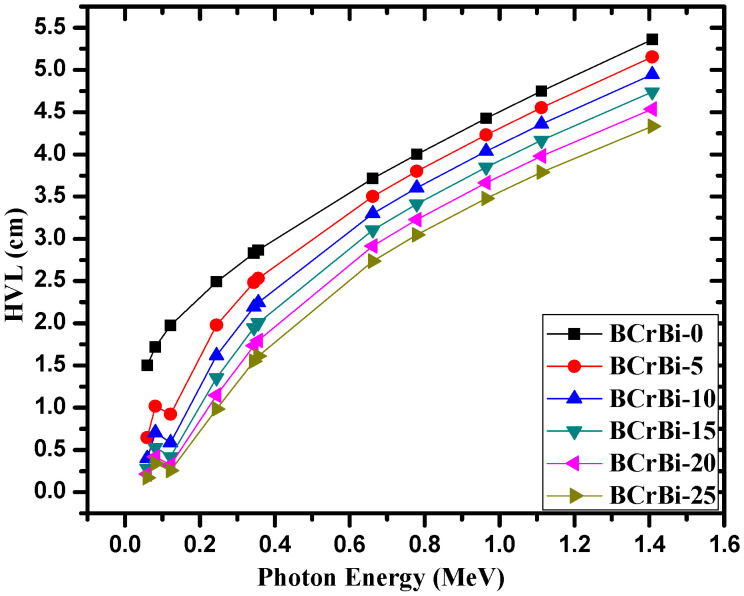
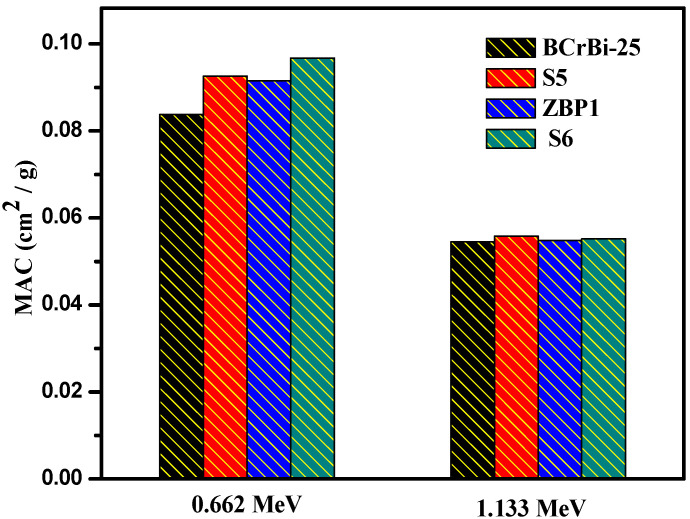
In the present work, bismuth borate glass samples with the composition of (99-) BO + 1CrO + () BiO ( = 0, 5, 10, 15, 20, and 25 wt %) were prepared using the melt quenching technique. The mass attenuation coefficient (MAC) of the prepared glass samples was measured through a narrow beam technique using a NaI(Tl) scintillation detector. Four point sources were used (Am, Ba, Eu, and Cs) to measure the MAC for the prepared glasses. The experimental data were compared with the theoretical results obtained from the XCOM, and it was shown that for all samples at all tested energies, the relative deviation between the samples is less than 3%. This finding signifies that the experimental data can adequately be used to evaluate the shielding ability of the glasses. The MAC of the sample with = 25 wt % was compared with different lead borate glasses and the results indicated that the present sample has high attenuation which is very close to commercial lead borate glasses. We determined the transmission factor (TF), and found that it is small at low energies and increases as the energy increases. The addition of BiO leads to reduction in the TF values, which improves the shielding performance of the glass system. The half value layer (HVL) of the BCrBi-10 sample was 0.400 cm at 0.595 MeV, 1.619 cm at 0.2447 MeV, and 4.946 cm at 1.4080 MeV. Meanwhile, the HVL of the BCrBi-20 sample is equal to 0.171 and 4.334 cm at 0.0595 and 1.4080 MeV, respectively. The HVL data emphasize that higher energy photons tend to penetrate through the glasses with greater ease than lower energy photons. Furthermore, the fast neutron removable cross section (FNRC) was determined for the present samples and compared with lead borate glass and concrete, and the results showed a remarkable superiority of the bismuth borate glass samples.
在本工作中,采用熔体淬火技术制备了组成为(99 - )BO + 1CrO + ()BiO( = 0、5、10、15、20和25 wt%)的硼酸铋玻璃样品。使用NaI(Tl)闪烁探测器通过窄束技术测量所制备玻璃样品的质量衰减系数(MAC)。使用四种点源(Am、Ba、Eu和Cs)来测量所制备玻璃的MAC。将实验数据与从XCOM获得的理论结果进行比较,结果表明,对于所有样品在所有测试能量下,样品之间的相对偏差小于3%。这一发现表明实验数据可充分用于评估玻璃的屏蔽能力。将 = 25 wt%的样品的MAC与不同的硼酸盐铅玻璃进行比较,结果表明本样品具有高衰减,非常接近商用硼酸盐铅玻璃。我们测定了传输因子(TF),发现其在低能量时较小,并且随着能量增加而增大。BiO的添加导致TF值降低,这提高了玻璃体系的屏蔽性能。BCrBi - 10样品在0.595 MeV时的半值层(HVL)为0.400 cm,在0.2447 MeV时为1.619 cm,在1.4080 MeV时为4.946 cm。同时,BCrBi - 20样品在0.0595和1.4080 MeV时的HVL分别等于0.171和4.334 cm。HVL数据强调,较高能量的光子比较低能量的光子更容易穿透玻璃。此外,测定了本样品的快中子去除截面(FNRC)并与硼酸盐铅玻璃和混凝土进行比较,结果显示硼酸铋玻璃样品具有显著优势。