Liu Fang, Fan Xiaoxue, Sun Xilei, Liu Bin, Li Junjie, Deng Yong, Jiang Huan, Jiang Tianze, Yan Peiguang
Beijing Key Laboratory of Passive Safety Technology for Nuclear Energy, School of Nuclear Science and Engineering, North China Electric Power University, Beijing 102206, China.
State Key Laboratory of Particle Detection and Electronics, Institute of High Energy Physics, Chinese Academy of Sciences, Beijing 100049, China.
Sensors (Basel). 2022 Jan 31;22(3):1099. doi: 10.3390/s22031099.
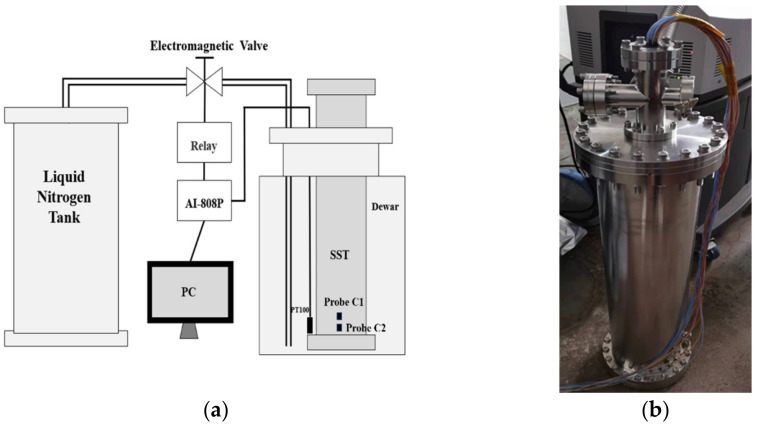
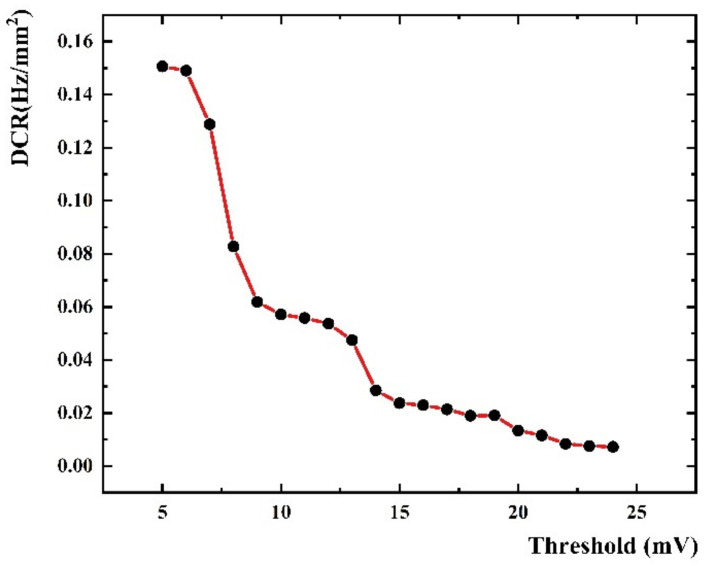
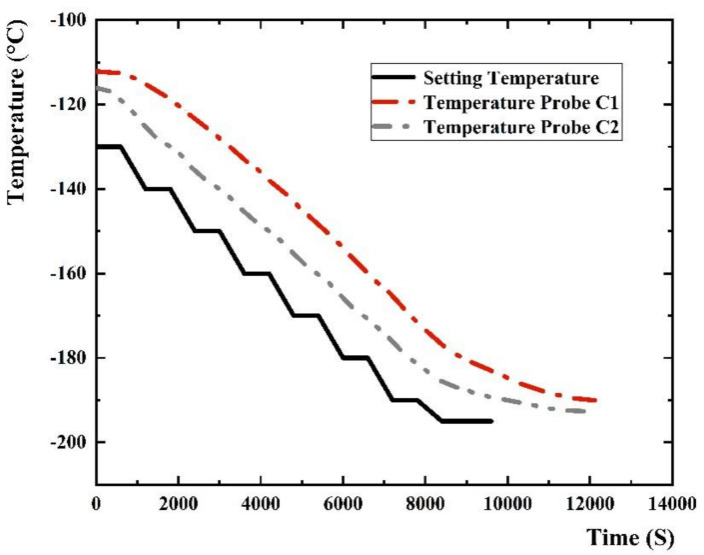
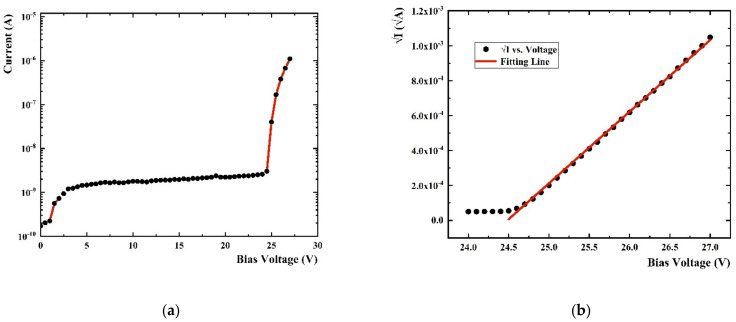
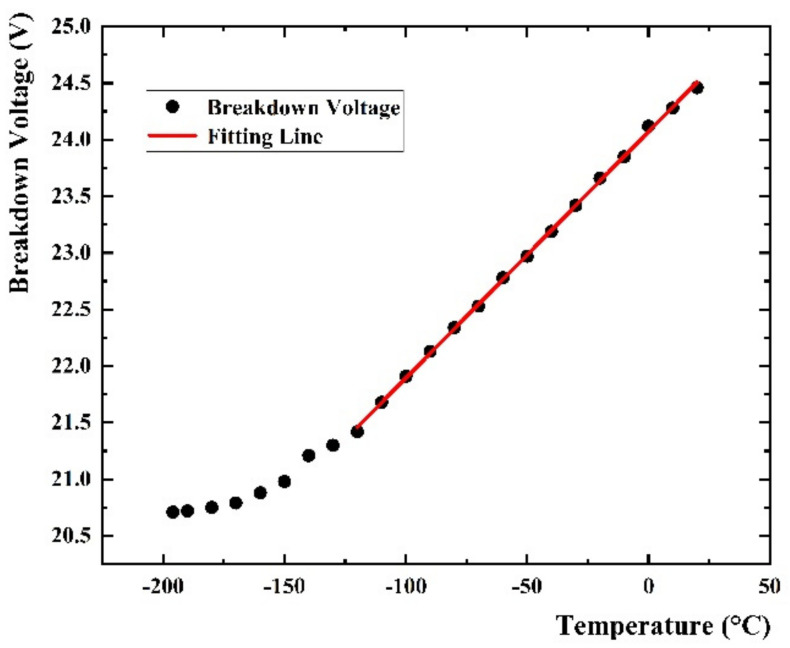
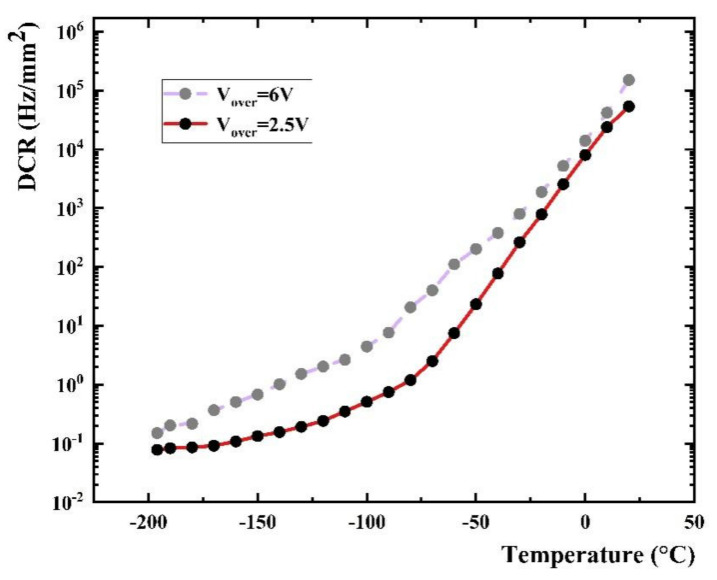
Silicon Photomultiplier (SiPM) is a sensor that can detect low-light signals lower than the single-photon level. In order to study the properties of neutrinos at a low detection threshold and low radioactivity experimental background, a low-temperature CsI neutrino coherent scattering detector is designed to be read by the SiPM sensor. Less thermal noise of SiPM and more light yield of CsI crystals can be obtained at the working temperature of liquid nitrogen. The breakdown voltage (V) and dark count rate (DCR) of SiPM at liquid nitrogen temperature are two key parameters for coherent scattering detection. In this paper, a low-temperature test is conducted on the mass-produced ON Semiconductor J-Series SiPM. We design a cryogenic system for cooling SiPM at liquid nitrogen temperature and the changes of operating voltage and dark noise from room to liquid nitrogen temperature are measured in detail. The results show that SiPM works at the liquid nitrogen temperature, and the dark count rate drops by six orders of magnitude from room temperature (120 kHz/mm) to liquid nitrogen temperature (0.1 Hz/mm).
硅光电倍增管(SiPM)是一种能够检测低于单光子水平的弱光信号的传感器。为了在低探测阈值和低放射性实验背景下研究中微子的特性,设计了一种低温碘化铯中微子相干散射探测器,由SiPM传感器进行读数。在液氮工作温度下,SiPM的热噪声更低,碘化铯晶体的光产额更高。SiPM在液氮温度下的击穿电压(V)和暗计数率(DCR)是相干散射探测的两个关键参数。本文对量产的安森美半导体J系列SiPM进行了低温测试。我们设计了一个用于在液氮温度下冷却SiPM的低温系统,并详细测量了从室温到液氮温度下工作电压和暗噪声的变化。结果表明,SiPM在液氮温度下工作,暗计数率从室温(120 kHz/mm)到液氮温度(0.1 Hz/mm)下降了六个数量级。