Robot Center, Samsung Research, Seoul 06765, Korea.
Robotics and Media Institute, Korea Institute of Science and Technology (KIST), 5 Hwarang-ro 14-gil, Seongbuk-gu, Seoul 02792, Korea.
Sensors (Basel). 2022 Feb 5;22(3):1222. doi: 10.3390/s22031222.
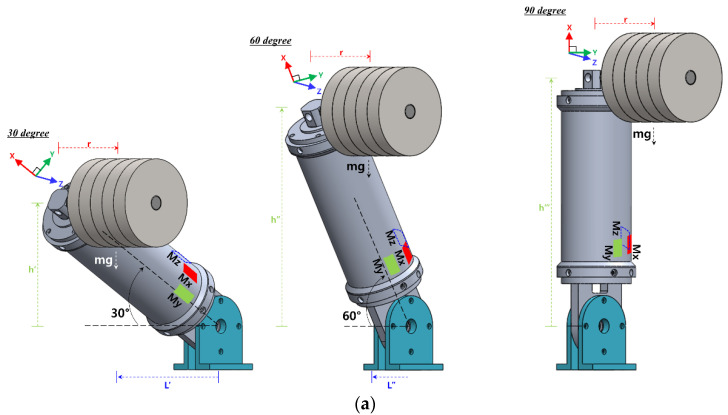
In order to effectively detect the contact state between the operator and the collaborative robot, a sensor with excellent external force detection performance is needed. The existing force/torque sensor and joint torque sensor, which are the two main external force sensors methods in cooperative robots, have limitations; only the force exerted at the end effector is detected, and it induces a low stiffness in the overall structure which affects the control performance. In the case of sensorless collision detection methods that utilize the current sensor that is used for motor control, the estimation of the performance of external force is sensitive to the sensor noise and dynamic model accuracy only to the extent that it can be used for collision detection. In this paper, we propose a strain gauge-based three-axis sensor of a cylindrical shape, which is often used as a link in a robot. By integrating sensors with robot links, the external force can be precisely measured without compromising the stiffness and is decoupled with joint disturbances, such as motor friction. Sensor calibration is conducted using static load evaluation equipment, and the reliability of collision detection is confirmed by comparing the theoretical/structural analysis results. Through the weight test and sensor characteristic evaluation, the performance and output stability are validated.
为了有效检测操作人员与协作机器人之间的接触状态,需要使用具有优异外力检测性能的传感器。协作机器人中现有的力/扭矩传感器和关节扭矩传感器这两种主要的外力传感器方法都存在局限性;它们只能检测末端执行器上施加的力,并且会导致整体结构的刚度降低,从而影响控制性能。在利用用于电机控制的电流传感器的无传感器碰撞检测方法的情况下,对外力性能的估计仅在可用于碰撞检测的程度上对传感器噪声和动态模型准确性敏感。在本文中,我们提出了一种基于应变计的圆柱形三轴传感器,它通常用作机器人的连杆。通过将传感器与机器人连杆集成,在不影响刚度的情况下可以精确测量外力,并与关节干扰(如电机摩擦)解耦。使用静态负载评估设备进行传感器校准,并通过比较理论/结构分析结果来确认碰撞检测的可靠性。通过重量测试和传感器特性评估,验证了性能和输出稳定性。