Vector Immunity and Transmission Biology Unit, Department of Environmental Health and Ecological Science, Ifakara Health Institute-Bagamoyo Office, P.O. Box 74, Bagamoyo, Coast Region, 61301, Tanzania.
Department of Infectious Diseases and Immunology, College of Veterinary Medicine, Emerging Pathogens Institute, University of Florida, Gainesville, FL, 32611, USA.
Parasit Vectors. 2022 Feb 14;15(1):56. doi: 10.1186/s13071-022-05181-2.
Plasmodium ovale is a neglected malarial parasite that can form latent hypnozoites in the human liver. Over the last decade, molecular surveillance studies of non-falciparum malaria in Africa have highlighted that P. ovale is circulating below the radar, including areas where Plasmodium falciparum is in decline. To eliminate malaria where P. ovale is endemic, a better understanding of its epidemiology, asymptomatic carriage, and transmission biology is needed.
We performed a pilot study on P. ovale transmission as part of an ongoing study of human-to-mosquito transmission of P. falciparum from asymptomatic carriers. To characterize the malaria asymptomatic reservoir, cross-sectional qPCR surveys were conducted in Bagamoyo, Tanzania, over three transmission seasons. Positive individuals were enrolled in transmission studies of P. falciparum using direct skin feeding assays (DFAs) with Anopheles gambiae s.s. (IFAKARA strain) mosquitoes. For a subset of participants who screened positive for P. ovale on the day of DFA, we incubated blood-fed mosquitoes for 14 days to assess sporozoite development.
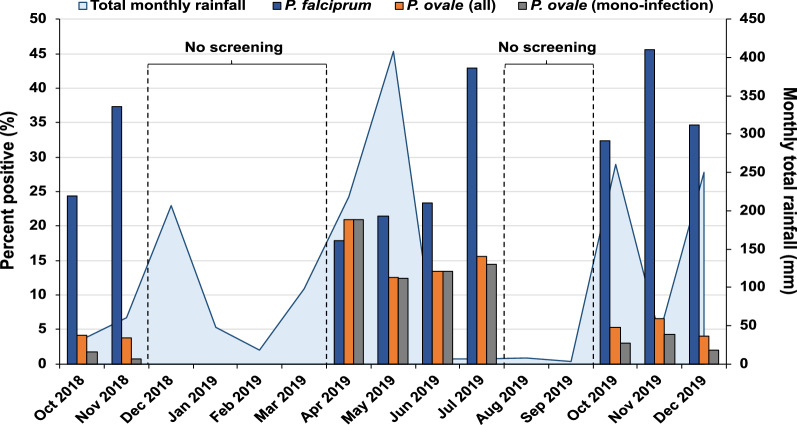
Molecular surveillance of asymptomatic individuals revealed a P. ovale prevalence of 11% (300/2718), compared to 29% (780/2718) for P. falciparum. Prevalence for P. ovale was highest at the beginning of the long rainy season (15.5%, 128/826) in contrast to P. falciparum, which peaked later in both the long and short rainy seasons. Considering that these early-season P. ovale infections were low-density mono-infections (127/128), we speculate many were due to hypnozoite-induced relapse. Six of eight P. ovale-infected asymptomatic individuals who underwent DFAs successfully transmitted P. ovale parasites to A. gambiae.
Plasmodium ovale is circulating at 4-15% prevalence among asymptomatic individuals in coastal Tanzania, largely invisible to field diagnostics. A different seasonal peak from co-endemic P. falciparum, the capacity to relapse, and efficient transmission to Anopheles vectors likely contribute to its persistence amid control efforts focused on P. falciparum.
卵形疟原虫是一种被忽视的疟原虫,可以在人类肝脏中形成潜伏的休眠子。在过去的十年中,对非洲非恶性疟原虫的分子监测研究表明,卵形疟原虫在悄悄传播,包括恶性疟原虫正在减少的地区。为了消除卵形疟原虫流行的地方的疟疾,需要更好地了解其流行病学、无症状携带和传播生物学。
我们进行了一项卵形疟原虫传播的试点研究,作为正在进行的从无症状带虫者向疟蚊传播恶性疟原虫的研究的一部分。为了描述疟疾无症状储存库,我们在坦桑尼亚巴加莫约进行了三次传播季节的横断面 qPCR 调查。对通过直接皮肤喂养试验(DFA)与冈比亚按蚊(IFAKARA 株)蚊子对恶性疟原虫进行传播研究的阳性个体进行了登记。对于在 DFA 当天筛查出卵形疟原虫阳性的一部分参与者,我们孵育了血餐蚊子 14 天,以评估子孢子发育情况。
对无症状个体的分子监测显示,卵形疟原虫的患病率为 11%(300/2718),而恶性疟原虫的患病率为 29%(780/2718)。在长雨季开始时,卵形疟原虫的患病率最高(15.5%,128/826),而恶性疟原虫在长雨季和短雨季的患病率都较高。考虑到这些早期季节性的卵形疟原虫感染是低密度的单一感染(127/128),我们推测许多是由休眠子诱导的复发引起的。在接受 DFA 的 8 名卵形疟原虫感染无症状个体中,有 6 名成功地将卵形疟原虫寄生虫传播给冈比亚按蚊。
在坦桑尼亚沿海的无症状个体中,卵形疟原虫的流行率为 4-15%,在现场诊断中大多难以发现。与共流行的恶性疟原虫相比,它具有不同的季节性高峰、复发能力和向疟蚊传播的高效能力,这可能是在以恶性疟原虫为重点的控制努力中它得以持续存在的原因。