Garnish Sarah E, Hildebrand Joanne M
The Walter and Eliza Hall Institute of Medical Research, Parkville, VIC 3052, Australia.
Department of Medical Biology, University of Melbourne, Parkville, VIC 3052, Australia.
Biochem Soc Trans. 2022 Feb 28;50(1):529-539. doi: 10.1042/BST20210517.
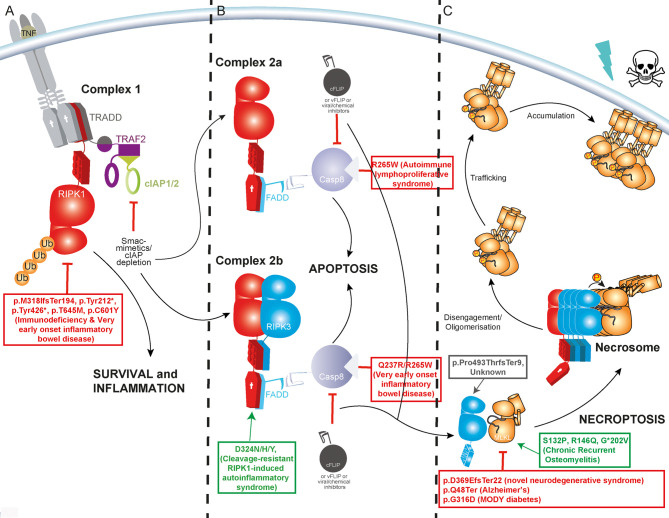
Programmed cell death has long been characterised as a key player in the development of human disease. Necroptosis is a lytic form of programmed cell death that is universally mediated by the effector protein mixed lineage kinase domain-like (MLKL), a pseudokinase. MLKL's activating kinase, receptor interacting protein kinase 3 (RIPK3), is itself activated within context specific scaffolds of receptor interacting protein kinase 1 (RIPK1), Z-DNA Binding Protein-1 (ZBP1) or TIR domain-containing adaptor inducing interferon-β (TRIF). These core necroptosis modulating proteins have been comprehensively revealed as potent drivers and suppressors of disease in inbred mouse strains. However, their roles in human disease within the 'real world' of diverse genetic backgrounds, natural infection and environmental challenges remains less well understood. Over 20 unique disease-associated human germline gene variants in this core necroptotic machinery have been reported in the literature and human clinico-genetics databases like ClinVar to date. In this review, we provide an overview of these human gene variants, with an emphasis on those encoding MLKL. These experiments of nature have the potential to not only enrich our understanding of the basic biology of necroptosis, but offer important population level insights into which clinical indications stand to benefit most from necroptosis-targeted drugs.
程序性细胞死亡长期以来一直被认为是人类疾病发展中的关键因素。坏死性凋亡是一种程序性细胞死亡的裂解形式,普遍由效应蛋白混合谱系激酶结构域样蛋白(MLKL,一种假激酶)介导。MLKL的激活激酶,即受体相互作用蛋白激酶3(RIPK3),自身在受体相互作用蛋白激酶1(RIPK1)、Z-DNA结合蛋白1(ZBP1)或含TIR结构域的衔接蛋白诱导干扰素-β(TRIF)的特定背景支架内被激活。这些核心坏死性凋亡调节蛋白已被全面揭示为近交系小鼠疾病的有力驱动因素和抑制因素。然而,在具有不同遗传背景、自然感染和环境挑战的“现实世界”中,它们在人类疾病中的作用仍不太清楚。迄今为止,在文献以及诸如ClinVar等人类临床遗传学数据库中,已报道了该核心坏死性凋亡机制中超过20种与疾病相关的独特人类种系基因变体。在本综述中,我们概述了这些人类基因变体,重点关注那些编码MLKL的变体。这些自然实验不仅有可能丰富我们对坏死性凋亡基本生物学的理解,还能为哪些临床适应症最有可能从靶向坏死性凋亡的药物中获益提供重要的群体层面见解。