Walter and Eliza Hall Institute of Medical Research, 1G Royal Parade, Parkville, Victoria 3052, Australia.
Department of Medical Biology, University of Melbourne, Parkville, Victoria 3052, Australia.
Biochem J. 2024 Sep 4;481(17):1125-1142. doi: 10.1042/BCJ20240255.
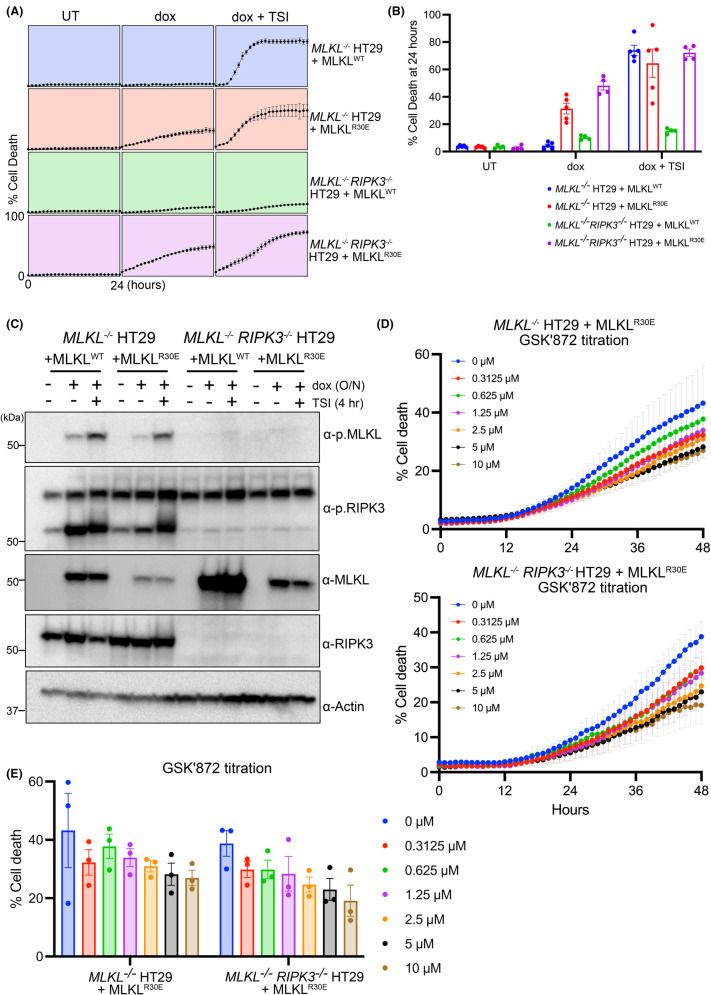
Necroptosis is a lytic and pro-inflammatory form of programmed cell death executed by the terminal effector, the MLKL (mixed lineage kinase domain-like) pseudokinase. Downstream of death and Toll-like receptor stimulation, MLKL is trafficked to the plasma membrane via the Golgi-, actin- and microtubule-machinery, where activated MLKL accumulates until a critical lytic threshold is exceeded and cell death ensues. Mechanistically, MLKL's lytic function relies on disengagement of the N-terminal membrane-permeabilising four-helix bundle domain from the central autoinhibitory brace helix: a process that can be experimentally mimicked by introducing the R30E MLKL mutation to induce stimulus-independent cell death. Here, we screened a library of 429 kinase inhibitors for their capacity to block R30E MLKL-mediated cell death, to identify co-effectors in the terminal steps of necroptotic signalling. We identified 13 compounds - ABT-578, AR-A014418, AZD1480, AZD5363, Idelalisib, Ipatasertib, LJI308, PHA-793887, Rapamycin, Ridaforolimus, SMI-4a, Temsirolimus and Tideglusib - each of which inhibits mammalian target of rapamycin (mTOR) signalling or regulators thereof, and blocked constitutive cell death executed by R30E MLKL. Our study implicates mTOR signalling as an auxiliary factor in promoting the transport of activated MLKL oligomers to the plasma membrane, where they accumulate into hotspots that permeabilise the lipid bilayer to cause cell death.
细胞程序性坏死是一种溶酶体依赖性的细胞死亡方式,其通过多种信号通路调控细胞的坏死过程,坏死细胞的内容物会被释放到组织中,进而引起炎症反应。