Chiari Catharina, Lutschounig Marie-Christine, Nöbauer-Huhmann Iris, Windhager Reinhard
Universitätsklinik für Orthopädie und Unfallchirurgie, Klinische Abteilung für Orthopädie, Medizinische Universität Wien, Währinger Gürtel 18-20, 1090, Wien, Österreich.
Universitätsklinik für Radiologie und Nuklearmedizin, Abteilung für Neuroradiologie/Muskuloskelettale Radiologie, Medizinische Universität Wien, Wien, Österreich.
Orthopade. 2022 Mar;51(3):211-218. doi: 10.1007/s00132-022-04214-z. Epub 2022 Feb 15.
Femoroacetabular impingement syndrome (FAIS) is a relevant cause of groin pain in adolescents. Athletes are particularly affected.
The article shall provide an evidence-based background for FAIS counseling and therapy in adolescents.
On the basis of the current literature, an overview of the prevalence and pathogenesis, evaluation and diagnostics, as well as the therapeutic recommendations for FAIS in adolescents was compiled.
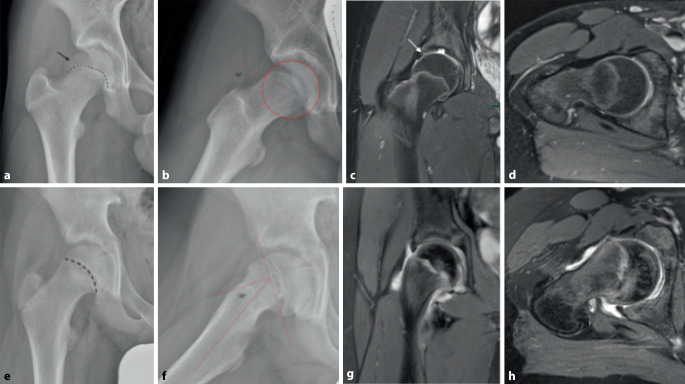
FAIS in adolescents primarily affects physically active patients. Certain sports favor the development of FAIS. Cam impingement, pincer impingement, and combined FAIS are the most common entities in this age group. Cam morphology occurs shortly before closure of the proximal femoral growth plate. In cam impingement, the slipped capital femoral epiphysis (SCFE) must be distinguished from the primary cam morphology. SCFE requires rapid surgical treatment with stabilization of the epiphysis, while primary cam impingement can be analyzed electively, and conservative treatment is first recommended. Damage to the labrum and cartilage is regularly observed. A systematic radiological evaluation using X‑rays and MRI is mandatory in order to develop an adequate treatment plan. In adolescent patients with FAIS, a conservative attempt at therapy should always be made; if this is unsuccessful, surgical repair with hip arthroscopy is indicated. The postoperative results are very good in adolescents, with a rapid improvement in symptoms, few complications, and a high return-to-sport rate.
股骨髋臼撞击综合征(FAIS)是青少年腹股沟疼痛的一个相关病因。运动员尤其易受影响。
本文旨在为青少年FAIS的咨询和治疗提供循证背景。
基于当前文献,汇编了青少年FAIS的患病率、发病机制、评估与诊断以及治疗建议的概述。
青少年FAIS主要影响身体活跃的患者。某些运动有利于FAIS的发展。凸轮撞击、钳夹撞击和复合型FAIS是该年龄组最常见的类型。凸轮形态在股骨近端生长板闭合前不久出现。在凸轮撞击中,必须将股骨头骨骺滑脱(SCFE)与原发性凸轮形态区分开来。SCFE需要通过骨骺稳定进行快速手术治疗,而原发性凸轮撞击可以选择性分析,首先推荐保守治疗。经常观察到盂唇和软骨损伤。为了制定适当的治疗方案,必须使用X线和MRI进行系统的影像学评估。对于患有FAIS的青少年患者,应始终尝试保守治疗;如果不成功,则需进行髋关节镜手术修复。青少年术后效果非常好,症状迅速改善,并发症少,恢复运动率高。