
一名人类免疫缺陷病毒患者的重症传染性软疣免疫重建炎症综合征病例
A Severe Case of Molluscum Contagiosum Immune Reconstitution Inflammatory Syndrome in a Patient with Human Immunodeficiency Virus.
作者信息
Siddiqui Nida, Mansfield Brett S, Olmesdahl Nine-Paula, Swart Peter, Nel Jeremy
机构信息
Dept. of Internal Medicine, School of Clinical Medicine, Faculty of Health Sciences, University of the Witwatersrand, Johannesburg, South Africa.
Division of Anatomical Pathology, Dept. of Pathology, National Health Laboratory Service and University of the Witwatersrand, Johannesburg, South Africa.
出版信息
Eur J Case Rep Intern Med. 2022 Jan 11;9(1):003115. doi: 10.12890/2022_003115. eCollection 2022.
UNLABELLED
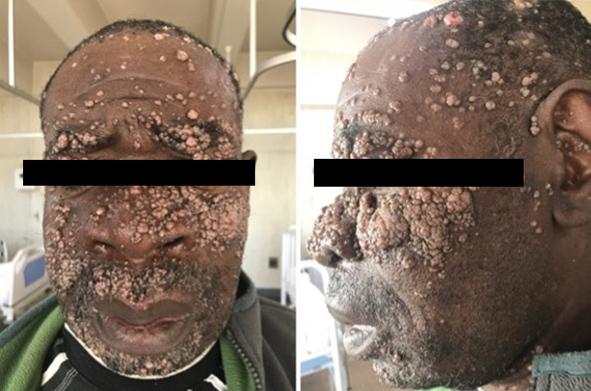
Paradoxical immune reconstitution inflammatory syndrome (IRIS) in human immunodeficiency virus (HIV)-positive patients initiating antiretroviral treatment (ART) is caused by restored immunity to specific antigens, resulting in worsening of a pre-existing infection. Molluscum contagiosum (MC) is commonly noted in HIV-positive individuals but ART alone is usually sufficient to bring about resolution. We present a rare case of severe MC-IRIS that worsened despite immune reconstitution.
LEARNING POINTS
Molluscum contagiosum is a common opportunistic infection which can have severe manifestations in immunocompromised individuals.Antiretroviral treatment alone is usually sufficient to clear the infection, however refractory cases can persist despite immune reconstitution.Failure to improve or worsening immune reconstitution inflammatory syndrome should raise suspicion for additional immunological dysfunction.Surgery, cytodestructive therapies and chemotherapeutic agents can be considered in extensive, persistent disease.
未标注
人类免疫缺陷病毒(HIV)阳性患者开始抗逆转录病毒治疗(ART)时出现的矛盾性免疫重建炎症综合征(IRIS)是由对特定抗原的免疫恢复引起的,导致先前存在的感染恶化。传染性软疣(MC)在HIV阳性个体中很常见,但仅ART通常足以使其消退。我们报告了一例罕见的严重MC-IRIS病例,尽管免疫重建,但病情仍恶化。
学习要点
传染性软疣是一种常见的机会性感染,在免疫功能低下的个体中可能有严重表现。仅抗逆转录病毒治疗通常足以清除感染,然而,尽管免疫重建,难治性病例仍可能持续存在。免疫重建炎症综合征未能改善或恶化应引起对其他免疫功能障碍的怀疑。对于广泛、持续的疾病,可考虑手术、细胞破坏疗法和化疗药物。


 Zotero 插件