Clinical Pharmacology and Safety Science, Oncology R&D, AstraZeneca, Cambridge, UK.
Oral Product Development, Pharmaceutical Technology & Development, Operations, AstraZeneca, Macclesfield, UK.
Clin Transl Sci. 2022 Apr;15(4):878-888. doi: 10.1111/cts.13209. Epub 2022 Feb 15.
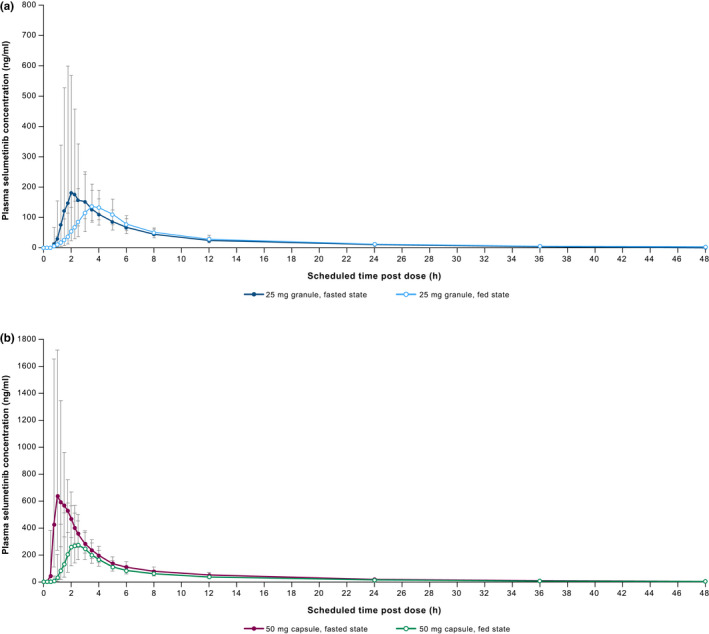
Selumetinib is an oral, potent, and highly selective allosteric MEK1/2 inhibitor approved for the treatment of pediatric patients (aged ≥2 years) with neurofibromatosis type 1 who have symptomatic, inoperable plexiform neurofibromas. A granule formulation of selumetinib is under development to improve dosing precision for younger pediatric patients who may be unable to swallow capsules. This phase I crossover study investigated the effect of food on the pharmacokinetic (PK) properties of selumetinib capsule and granule formulations. Healthy male volunteers were randomized to receive selumetinib granules (25 mg) or capsules (50 mg [2 × 25 mg]) under fasted or fed conditions (a low-fat meal). Plasma concentrations and PK parameters were determined less than or equal to 48 h postdose. Safety and tolerability were assessed. Across 24 volunteers, selumetinib was absorbed quickly, with a time to maximum concentration (T ) ranging from ~1-3 h. Geometric mean ratios (90% confidence interval [CI]) for maximum plasma concentration (C ) in the fed versus fasted state were 0.61 (90% CI 0.51-0.72) and 0.40 (90% CI 0.33-0.48) for the granule and capsule formulations, respectively, whereas geometric mean ratios (90% CI) for area under the plasma drug concentration-time curve in the fed versus fasted state were 0.97 (90% CI 0.91-1.02) and 0.62 (90% CI 0.55-0.70), respectively. Levels of less than 10% conversion to the N-desmethyl selumetinib metabolite were observed. Selumetinib was well-tolerated, with only a few adverse events of mild intensity reported. Selumetinib administration with a low-fat meal resulted in lower C and longer T for both formulations versus fasted conditions. However, area under the curve for selumetinib granules was similar under fasted and fed conditions. Overall, these findings support further development of this formulation for pediatric patients.
司美替尼是一种口服、强效、高度选择性的变构 MEK1/2 抑制剂,已获批准用于治疗患有 1 型神经纤维瘤病的儿科患者(年龄≥2 岁),这些患者患有症状性、不可切除的丛状神经纤维瘤。司美替尼颗粒制剂正在开发中,以提高可能无法吞服胶囊的年幼儿科患者的用药精度。这项 I 期交叉研究调查了食物对司美替尼胶囊和颗粒制剂的药代动力学(PK)特性的影响。健康男性志愿者随机接受空腹或进食条件下(低脂肪餐)司美替尼颗粒(25mg)或胶囊(50mg[2×25mg])。给药后≤48 小时内测定血浆浓度和 PK 参数。评估安全性和耐受性。在 24 名志愿者中,司美替尼吸收迅速,达峰时间(T )范围为 1-3 小时。与禁食状态相比,进食状态下的最大血浆浓度(C )的几何均数比值(90%置信区间[CI])分别为颗粒制剂和胶囊制剂的 0.61(90%CI 0.51-0.72)和 0.40(90%CI 0.33-0.48),而进食与禁食状态下的药时曲线下面积(AUC)的几何均数比值(90%CI)分别为 0.97(90%CI 0.91-1.02)和 0.62(90%CI 0.55-0.70)。观察到小于 10%转化为 N-去甲基司美替尼代谢物。司美替尼的耐受性良好,仅报告了少数轻度强度的不良事件。与禁食条件相比,低脂肪餐给药使两种制剂的 C 降低,T 延长。然而,空腹和进食条件下司美替尼颗粒的 AUC 相似。总体而言,这些发现支持进一步开发这种制剂用于儿科患者。