Hua Jing, Williams Gareth J, Jin Hua, Chen Juan, Xu Manyun, Zhou Yingchun, Gu Guixiong, Du Wenchong
Shanghai Key Laboratory of Maternal Fetal Medicine, Shanghai First Maternity and Infant Hospital, School of Medicine, Tongji University, Shanghai, China.
School of Social Sciences, Nottingham Trent University, Nottingham, United Kingdom.
Front Psychiatry. 2022 Jan 31;13:809181. doi: 10.3389/fpsyt.2022.809181. eCollection 2022.
Developmental Coordination Disorder (DCD) is a neurodevelopmental condition with high prevalence. Early motor milestones are important markers to identify DCD. The current study aims to evaluate the association between the onset of crawling and independent walking and their transition pattern during infancy and later motor impairments.
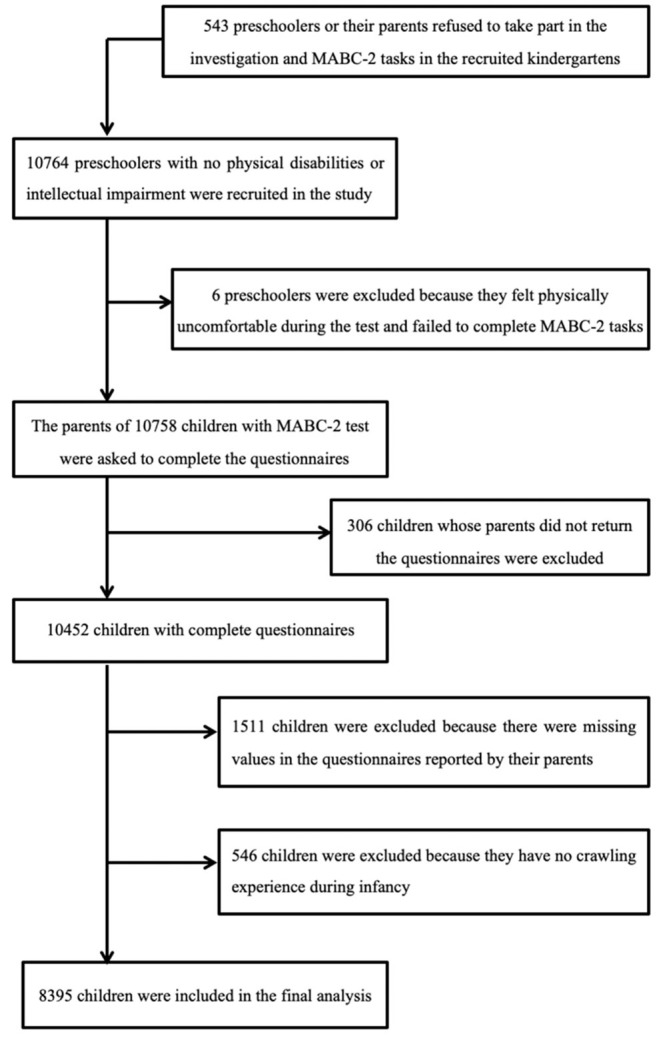
A total of 8,395 children aged 3-6 years old in China were included in the final analysis. A parent questionnaire was used to collect early milestone onset data. Children's motor performance was measured using the Movement Assessment Battery for Children-2nd edition (MABC-2). The association between motor milestones and motor impairment was analyzed using a multilevel regression model.
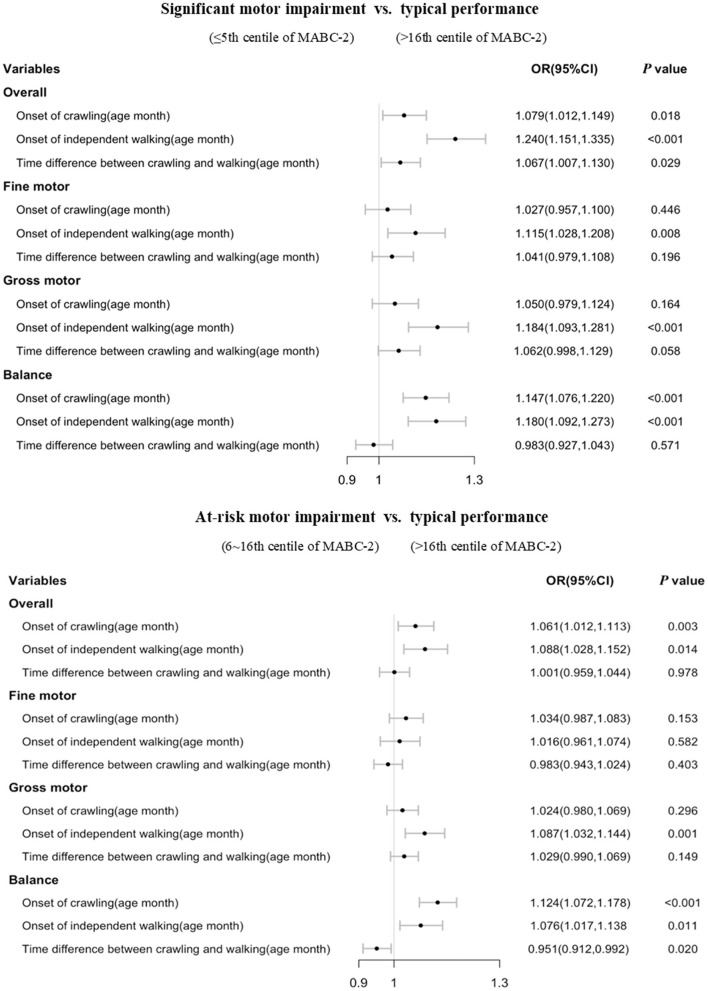
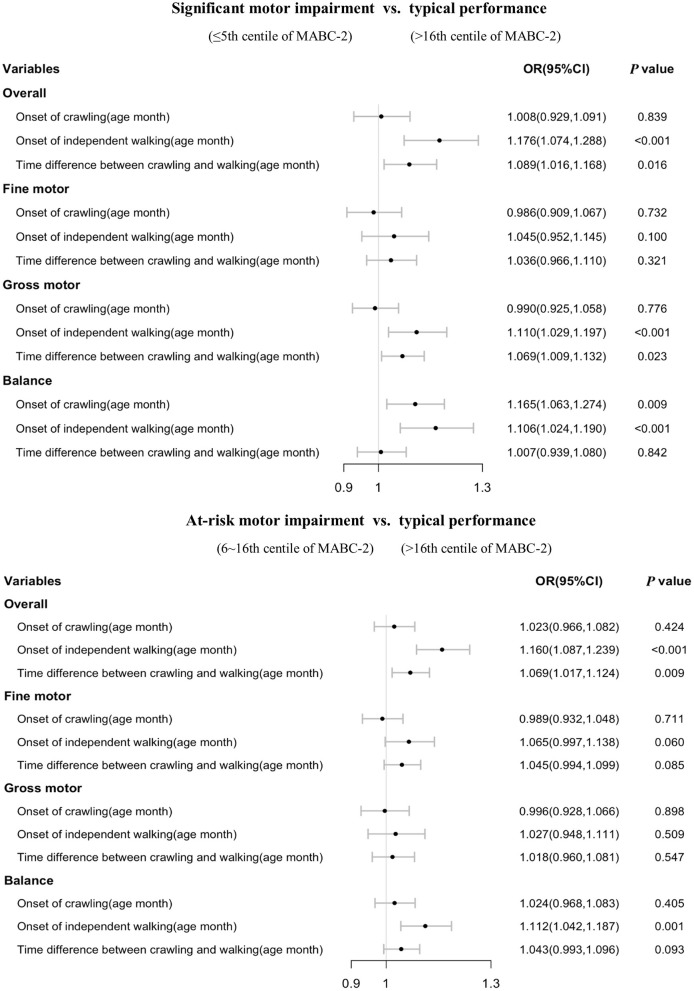
The result showed that a 1-month delay in crawling onset increased the risk of significant overall motor impairment by 5.3, and 14.0% when adjusting for child and family characteristics. A 1-month delay in walking onset increased the risk of significant overall motor, fine, gross, and balance impairment by 21.7, 8.3, 13.3, and 17.8%. A 1 month increase in the transition time from crawling to independent walking increased the risk of significant overall motor and gross motor impairment by 7.7 and 6.6%. These results were inconsistent across different age bands (each < 0.05).
Our study indicates that even a mild delay in crawling and walking onsets in infancy increase the risk for subsequent motor impairments in childhood, and children with motor impairments revealed a different transition pattern from crawling to walking. The motor abilities of children with motor impairments can be observed to diverge from typically developing children as early as 6-8 months old. The findings can facilitate the early identification of motor impairments in children, and provide early signs to initiate intervention.
发育性协调障碍(DCD)是一种高发性的神经发育疾病。早期运动里程碑是识别DCD的重要标志。本研究旨在评估婴儿期爬行和独立行走的开始时间及其转换模式与后期运动障碍之间的关联。
最终分析纳入了中国8395名3至6岁的儿童。通过家长问卷收集早期里程碑开始时间的数据。使用儿童运动评估量表第二版(MABC-2)测量儿童的运动表现。采用多水平回归模型分析运动里程碑与运动障碍之间的关联。
结果显示,爬行开始时间延迟1个月,在调整儿童和家庭特征后,显著总体运动障碍的风险增加5.3倍,即14.0%。行走开始时间延迟1个月,显著总体运动、精细、粗大运动和平衡障碍的风险分别增加21.7倍、8.3倍、13.3倍和17.8倍。从爬行到独立行走的转换时间每增加1个月,显著总体运动和粗大运动障碍的风险分别增加7.7倍和6.6倍。这些结果在不同年龄组中不一致(均P<0.05)。
我们的研究表明,婴儿期爬行和行走开始时间即使稍有延迟,也会增加儿童期后续运动障碍的风险,且有运动障碍的儿童从爬行到行走呈现出不同的转换模式。有运动障碍儿童的运动能力早在6至8个月大时就可观察到与正常发育儿童出现差异。这些发现有助于早期识别儿童的运动障碍,并为启动干预提供早期迹象。