Li Jiehan, Guo Shuning, Sun Zhenqiang, Fu Yang
Department of Gastroenterology, The First Affiliated Hospital of Zhengzhou University, Zhengzhou, China.
Department of Colorectal Surgery, The First Affiliated Hospital of Zhengzhou University, Zhengzhou, China.
Front Cell Dev Biol. 2022 Jan 31;10:808591. doi: 10.3389/fcell.2022.808591. eCollection 2022.
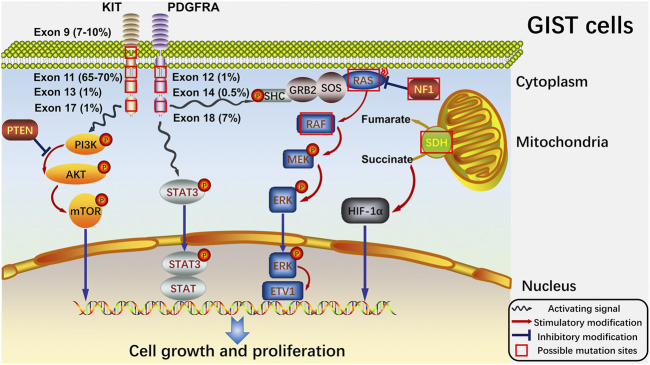
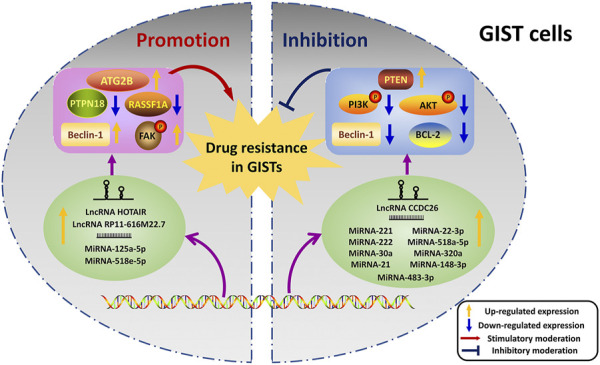
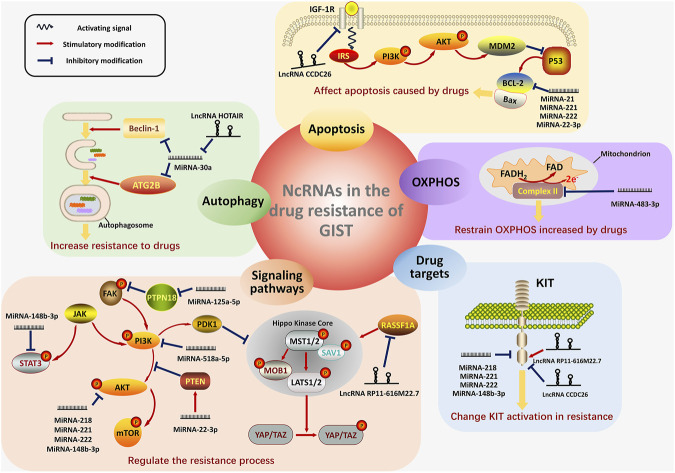
Gastrointestinal stromal tumor (GIST) is the most common mesenchymal tumor in the gastrointestinal tracts and a model for the targeted therapy of solid tumors because of the oncogenic driver mutations in KIT and PDGDRA genes, which could be effectively inhibited by the very first targeted agent, imatinib mesylate. Most of the GIST patients could benefit a lot from the targeted treatment of this receptor tyrosine kinase inhibitor. However, more than 50% of the patients developed resistance within 2 years after imatinib administration, limiting the long-term effect of imatinib. Noncoding RNAs (ncRNAs), the non-protein coding transcripts of human, were demonstrated to play pivotal roles in the resistance of various chemotherapy drugs. In this review, we summarized the mechanisms of how ncRNAs functioning on the drug resistance in GIST. During the drug resistance of GIST, there were five regulating mechanisms where the functions of ncRNAs concentrated: oxidative phosphorylation, autophagy, apoptosis, drug target changes, and some signaling pathways. Also, these effects of ncRNAs in drug resistance were divided into two aspects. How ncRNAs regulate drug resistance in GIST was further summarized according to ncRNA types, different drugs and categories of resistance. Moreover, clinical applications of these ncRNAs in GIST chemotherapies concentrated on the prognostic biomarkers and novel therapeutic targets.
胃肠道间质瘤(GIST)是胃肠道最常见的间充质肿瘤,由于KIT和PDGDRA基因存在致癌驱动突变,它也是实体瘤靶向治疗的一个范例,首个靶向药物甲磺酸伊马替尼可有效抑制这些突变。大多数GIST患者能从这种受体酪氨酸激酶抑制剂的靶向治疗中获益良多。然而,超过50%的患者在服用伊马替尼后2年内出现耐药,限制了伊马替尼的长期疗效。非编码RNA(ncRNAs)是人类的非蛋白质编码转录本,已被证明在多种化疗药物的耐药性中起关键作用。在本综述中,我们总结了ncRNAs在GIST耐药中发挥作用的机制。在GIST的耐药过程中,ncRNAs的功能集中在五个调节机制上:氧化磷酸化、自噬、凋亡、药物靶点变化和一些信号通路。此外,ncRNAs在耐药中的这些作用分为两个方面。根据ncRNA类型、不同药物和耐药类别,进一步总结了ncRNAs如何调节GIST的耐药性。此外,这些ncRNAs在GIST化疗中的临床应用集中在预后生物标志物和新的治疗靶点上。