Manchester Centre for Health Economics, Division of Population Health, School of Health Sciences, University of Manchester, Manchester, UK.
Institute of Education, University College London, London, UK.
BMC Psychiatry. 2022 Feb 17;22(1):126. doi: 10.1186/s12888-022-03769-7.
Preventing psychotic disorders and effective treatment in first-episode psychosis are key priorities for the National Institute for Health and Care Excellence. This review assessed the evidence base for the cost-effectiveness of health and social care interventions for people at risk of psychosis and for first-episode psychosis.
Electronic searches were conducted using the PsycINFO, MEDLINE and Embase databases to identify relevant published full economic evaluations published before August 2020. Full-text English-language studies reporting a full economic evaluation of a health or social care intervention aiming to reduce or prevent symptoms in people at risk of psychosis or experiencing first-episode psychosis were included. Screening, data extraction, and critical appraisal were performed using pre-specified criteria and forms based on the NHS Economic Evaluation Database (EED) handbook and Consolidated Health Economic Evaluation Reporting Standards (CHEERS) checklist for economic evaluations. The protocol was registered on the PROSPERO database (CRD42018108226). Results were summarised qualitatively.
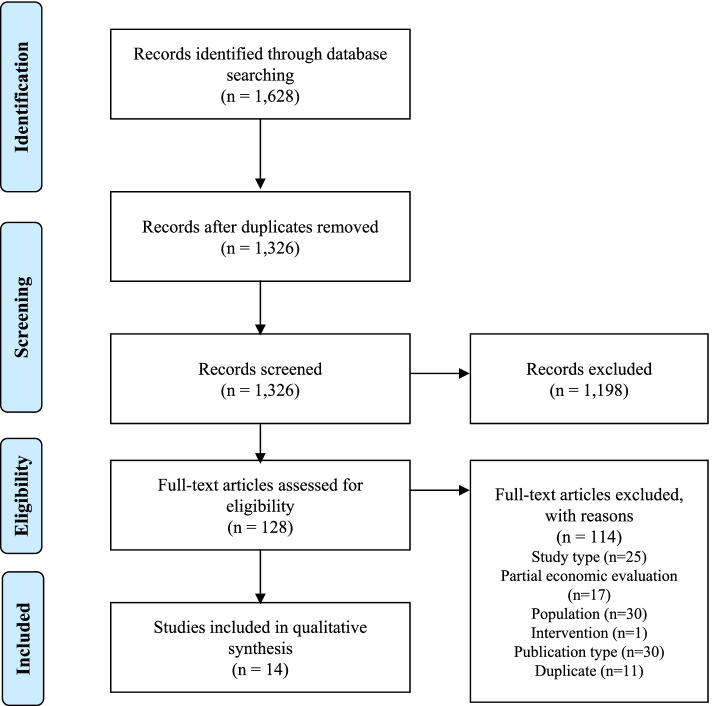
Searching identified 1,628 citations (1,326 following the removal of duplications). After two stages of screening 14 studies met the inclusion criteria and were included in the review. Interventions were varied and included multidisciplinary care, antipsychotic medication, psychological therapy, and assertive outreach. Evidence was limited in the at-risk group with only four identified studies, though all interventions were found to be cost-effective with a high probability (> 80%). A more substantial evidence base was identified for first-episode psychosis (11 studies), with a focus on early intervention (7/11 studies) which again had positive conclusions though with greater uncertainty.
Study findings generally concluded interventions were cost-effective. The evidence for the population who are at-risk of psychosis was limited, and though there were more studies for the population with first-episode psychosis, limitations of the evidence base (including generalisability and heterogeneity across the methods used) affect the certainty of conclusions.
预防精神病障碍和首发精神病的有效治疗是英国国家卫生与保健优化研究所的重点。本综述评估了针对有精神病风险人群和首发精神病人群的卫生和社会保健干预措施的成本效益的证据基础。
使用 PsycINFO、MEDLINE 和 Embase 数据库进行电子检索,以确定截至 2020 年 8 月之前发表的相关已发表的完整经济评估。纳入了旨在减少或预防有精神病风险人群或首发精神病人群症状的卫生或社会保健干预措施的全经济评估的全文英文研究。使用 NHS 经济评估数据库 (EED) 手册和经济评估的统一健康经济评估报告标准 (CHEERS) 清单中预先规定的标准和表格进行筛选、数据提取和关键评价。该方案在 PROSPERO 数据库 (CRD42018108226) 上进行了注册。结果以定性方式进行总结。
搜索共确定了 1628 条引文(去除重复项后为 1326 条)。经过两个阶段的筛选,有 14 项研究符合纳入标准并被纳入综述。干预措施多种多样,包括多学科护理、抗精神病药物、心理治疗和强化外展服务。在高危人群中,仅有四项研究符合纳入标准,证据有限,但所有干预措施均具有成本效益,概率较高(>80%)。在首发精神病人群中,证据基础更为广泛(11 项研究),重点是早期干预(11 项研究中的 7 项),这些研究也得出了积极的结论,但具有更大的不确定性。
研究结果普遍认为干预措施具有成本效益。有精神病风险人群的证据有限,虽然首发精神病人群的研究较多,但证据基础的局限性(包括方法使用的普遍性和异质性)影响了结论的确定性。