Whiston Aoife, Lennon Amy, Brown Catherine, Looney Chloe, Larkin Eve, O'Sullivan Laurie, Sik Nurcan, Semkovska Maria
Department of Psychology, University of Limerick, Limerick, Ireland.
Department of Psychology, University of Southern Denmark, Odense, Denmark.
Front Psychiatry. 2022 Feb 1;13:746678. doi: 10.3389/fpsyt.2022.746678. eCollection 2022.
Consistent evidence suggests residual depressive symptomology are the strongest predictors of depression relapse following cognitive-behavioral therapy (CBT) and antidepressant medications (ADM's). Psychometric network models help detecting and understanding central symptoms that remain post-treatment, along with their complex co-occurrences. However, individual psychometric network studies show inconsistent findings. This systematic review and IPD network analysis aimed to estimate and compare the symptom network structures of residual depressive symptoms following CBT, ADM's, and their combination.
PsycINFO, PsycArticles, and PubMed were systematically searched through October 2020 for studies that have assessed individuals with major depression at post-treatment receiving either CBT and/or ADM's (venlafaxine, escitalopram, mirtazapine). IPD was requested from eligible samples to estimate and compare residual symptom psychometric network models post-CBT and post-ADM's.
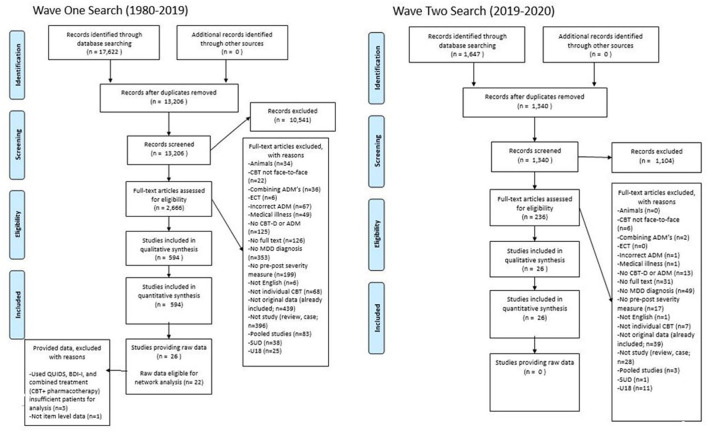
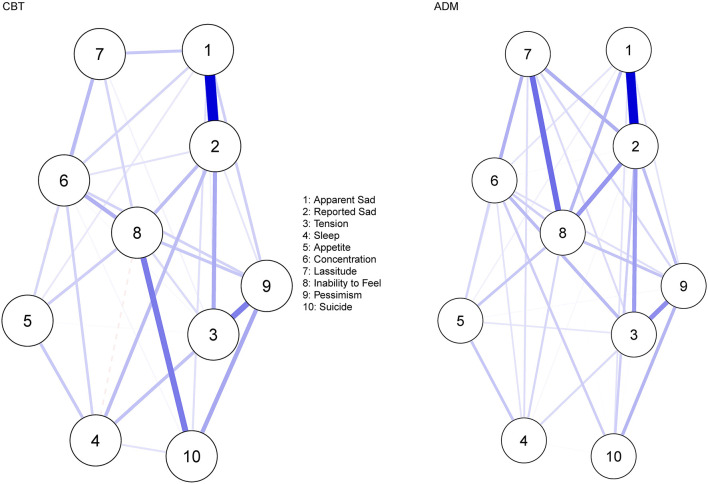
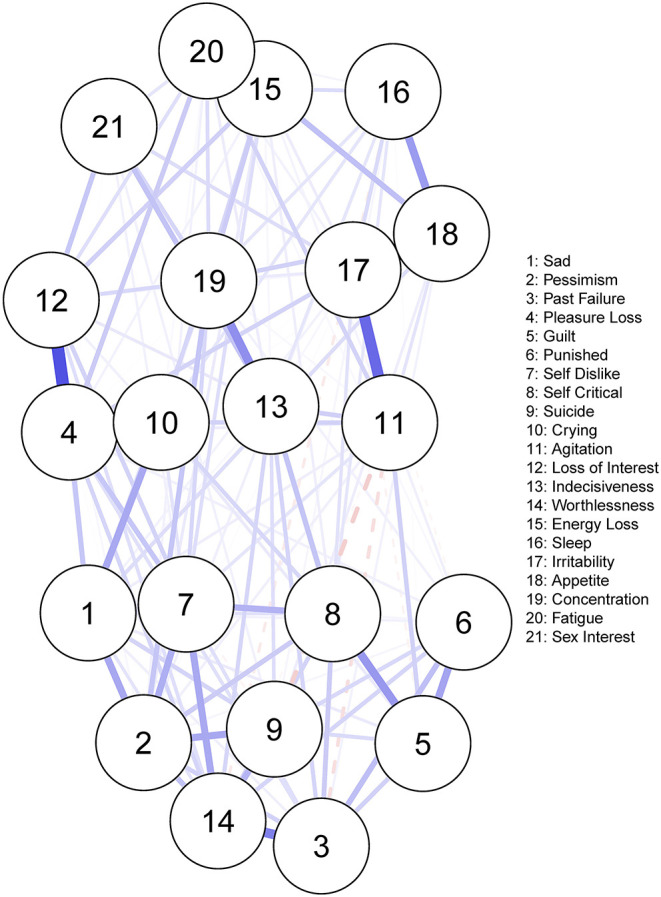
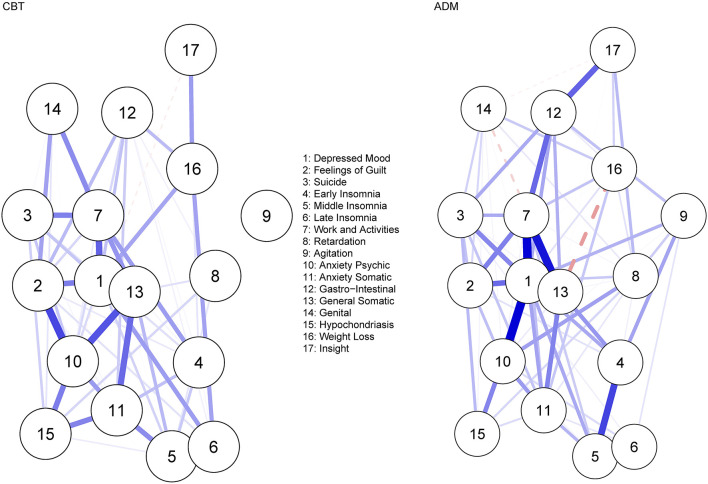
In total, 25 from 663 eligible samples, including 1,389 patients qualified for the IPD. Depressed mood and anhedonia were consistently central residual symptoms post-CBT and post-ADM's. For CBT, fatigue-related and anxiety symptoms were also central post-treatment. A significant difference in network structure across treatments (CBT vs. ADM) was observed for samples measuring depression severity using the MADRS. Specifically, stronger symptom occurrences were present amongst post-CBT (vs. ADM's) and amongst post-ADM's (vs. CBT). No significant difference in global strength was observed across treatments.
Core major depression symptoms remain central across treatments, strategies to target these symptoms should be considered. Anxiety and fatigue related complaints also remain central post-CBT. Efforts must be made amongst researchers, institutions, and journals to permit sharing of IPD. A protocol was prospectively registered on PROSPERO (CRD42020141663; https://www.crd.york.ac.uk/PROSPERO/display_record.php?RecordID=141663).
一致的证据表明,残留抑郁症状是认知行为疗法(CBT)和抗抑郁药物(ADM)治疗后抑郁症复发的最强预测因素。心理测量网络模型有助于检测和理解治疗后仍存在的核心症状及其复杂的共现情况。然而,个体心理测量网络研究结果并不一致。本系统评价和个体参与者数据(IPD)网络分析旨在估计和比较CBT、ADM及其联合治疗后残留抑郁症状的症状网络结构。
系统检索了截至2020年10月的PsycINFO、PsycArticles和PubMed数据库,以查找评估接受CBT和/或ADM(文拉法辛、艾司西酞普兰、米氮平)治疗后的重度抑郁症患者的研究。向符合条件的样本索取IPD,以估计和比较CBT和ADM治疗后残留症状的心理测量网络模型。
663个符合条件的样本中共有25个,包括1389名符合IPD条件患者。情绪低落和快感缺失在CBT和ADM治疗后始终是核心残留症状。对于CBT,与疲劳相关的症状和焦虑症状在治疗后也是核心症状。使用蒙哥马利-艾森伯格抑郁量表(MADRS)测量抑郁严重程度的样本,观察到不同治疗方法(CBT与ADM)的网络结构存在显著差异。具体而言,CBT治疗后(与ADM相比)以及ADM治疗后(与CBT相比)出现更强的症状共现情况。不同治疗方法之间未观察到全局强度的显著差异。
核心重度抑郁症状在各种治疗方法中仍然是核心症状,应考虑针对这些症状的策略。与焦虑和疲劳相关的主诉在CBT治疗后也仍然是核心症状。研究人员、机构和期刊必须努力允许共享IPD。一项方案已在国际前瞻性系统评价注册库(PROSPERO)上预先注册(CRD42020141663;https://www.crd.york.ac.uk/PROSPERO/display_record.php?RecordID=141663)。