Department of Neurosurgery, Xijing Hospital, Air Force Medical University, Xi'an 710032, China.
Department of Aerospace Medicine, Air Force Medical University, Xi'an 710032, China.
Oxid Med Cell Longev. 2022 Feb 7;2022:9030771. doi: 10.1155/2022/9030771. eCollection 2022.
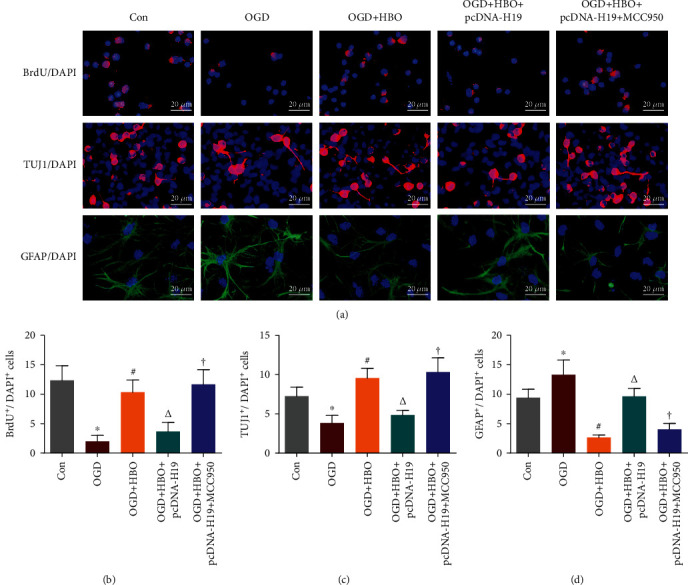
Due to the limited neurogenesis capacity, there has been a big challenge in better recovery from neurological dysfunction caused by stroke for a long time. Neural stem cell (NSC) programmed death is one of the unfavorable factors for neural regeneration after stroke. The types of death such as apoptosis and necroptosis have been deeply investigated while the pyroptosis of NSCs is not quite understood. Although it is well accepted that hyperbaric oxygen (HBO) alleviates the oxygen-glucose deprivation (OGD) injury after stroke and reduces programmed death of NSCs, whether NSC pyroptosis is involved in this process is still unknown. Therefore, this study is aimed at studying the potential effect of HBO treatment on NSC pyroptosis following OGD exposure, as well as its influence on NSC proliferation and differentiation . The results revealed that OGD increased NOD-like receptor protein 3 (NLRP3) expression to induce the pyroptotic death of NSCs, which was rescued by HBO treatment. And the upregulated lncRNA-H19 functioned as a molecular sponge of miR-423-5p to target NLRP3 for NSC pyroptosis following OGD. Most importantly, it was confirmed that HBO exerted protection of NSCs against pyroptosis by inhibiting lncRNA-H19/miR-423-5p/NLRP3 axis. Moreover, HBO restraint of lncRNA-H19-associated pyroptosis benefited the proliferation and neuronal differentiation of NSCs. It was concluded that HBO attenuated NSC pyroptosis via lncRNA-H19/miR-423-5p/NLRP3 axis and enhanced neurogenesis following OGD. The findings provide new insight into NSC programmed death and enlighten therapeutic strategy after stroke.
由于神经发生能力有限,长期以来,如何更好地从中风引起的神经功能障碍中恢复一直是一个巨大的挑战。神经干细胞(NSC)程序性死亡是中风后神经再生的不利因素之一。凋亡和坏死性细胞死亡等类型的死亡已经得到了深入研究,而 NSC 的细胞焦亡尚不完全清楚。虽然人们普遍认为高压氧(HBO)减轻中风后氧葡萄糖剥夺(OGD)损伤并减少 NSC 的程序性死亡,但 NSC 细胞焦亡是否参与这一过程尚不清楚。因此,本研究旨在研究 HBO 治疗对 OGD 暴露后 NSC 细胞焦亡的潜在影响,以及其对 NSC 增殖和分化的影响。结果表明,OGD 增加 NOD 样受体蛋白 3(NLRP3)的表达诱导 NSC 细胞焦亡,HBO 治疗可挽救这一过程。上调的长链非编码 RNA-H19 作为 miR-423-5p 的分子海绵,靶向 NLRP3 导致 OGD 后 NSC 细胞焦亡。最重要的是,证实 HBO 通过抑制 lncRNA-H19/miR-423-5p/NLRP3 轴发挥对 NSC 细胞焦亡的保护作用。此外,HBO 抑制 lncRNA-H19 相关的细胞焦亡有利于 NSC 的增殖和神经元分化。综上所述,HBO 通过 lncRNA-H19/miR-423-5p/NLRP3 轴减轻 NSC 细胞焦亡,并增强 OGD 后的神经发生。这些发现为 NSC 程序性死亡提供了新的见解,并为中风后的治疗策略提供了启示。