Interdisciplinary Metabolic Medicine Trials Unit, Division of Endocrinology and Diabetology, Medical University of Graz, Graz, Austria.
CBmed - Center for Biomarker Research in Medicine, Graz, Austria.
Diabet Med. 2022 Jun;39(6):e14813. doi: 10.1111/dme.14813. Epub 2022 Feb 28.
Intermittent fasting, a dietary intervention of alternate eating and fasting, has gained popularity in people trying to lose weight. Intermittent fasting could provide an alternative to classic caloric restriction in people with type 2 diabetes mellitus. The aim of the study is to determine the impact of a 12-week intermittent fasting regimen compared with usual care in people with type 2 diabetes mellitus receiving insulin therapy.
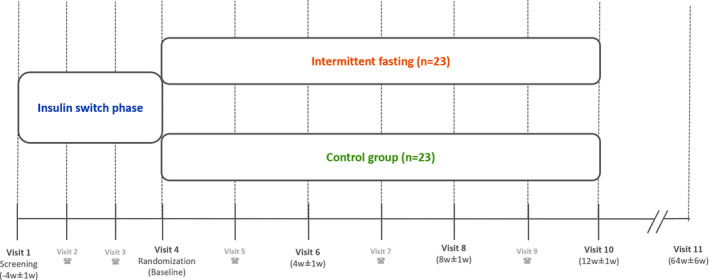
This open, single-centre, randomized controlled trial investigates participants with type 2 diabetes mellitus on insulin therapy and a glycated haemoglobin A1c (HbA1c) of ≥53 mmol/mol (≥7.0%) and a minimum insulin dose of 0.3 IU/kg body weight per day. Participants are randomized in a 1:1 ratio to either 12 weeks of intermittent fasting or the standard care group. All participants receive dietary counselling, continuous glucose monitoring, measurement of the resting metabolic rate, an oral glucose tolerance test, body composition measurement via dual-energy X-ray absorptiometry and stool samples for microbiome analyses at the beginning and at the end of the intervention. Two co-primary outcomes (analysed in hierarchical order) were chosen for the study: (i) the difference in the change of HbA1c from baseline to 12 weeks and (ii) the difference in the number of participants achieving a combined end point encompassing a body weight reduction of at least 2%, an insulin dose reduction of at least 10% and an absolute HbA1c reduction of at least 3 mmol/mol (0.3%) between the two groups.
间歇性禁食是一种交替进食和禁食的饮食干预方法,在试图减肥的人群中越来越受欢迎。间歇性禁食可能为 2 型糖尿病患者提供一种替代经典热量限制的方法。本研究的目的是确定与常规护理相比,12 周间歇性禁食方案对接受胰岛素治疗的 2 型糖尿病患者的影响。
这是一项开放、单中心、随机对照试验,纳入正在接受胰岛素治疗且糖化血红蛋白(HbA1c)≥53mmol/mol(≥7.0%)和胰岛素日剂量最低为 0.3IU/kg 体重的 2 型糖尿病患者。参与者以 1:1 的比例随机分为间歇性禁食组或标准护理组,共 12 周。所有参与者均接受饮食咨询、连续血糖监测、静息代谢率测量、口服葡萄糖耐量试验、双能 X 线吸收法测量身体成分和粪便样本用于微生物组分析,在干预开始和结束时进行。本研究选择了两个主要次要终点(按层次顺序分析):(i)从基线到 12 周时 HbA1c 变化的差异;(ii)两组之间达到体重至少减轻 2%、胰岛素剂量至少减少 10%和 HbA1c 绝对减少至少 3mmol/mol(0.3%)的综合终点的参与者人数差异。