Department of Global Health and Social Medicine, Harvard Medical School, Boston, Massachusetts, United States of America.
Division of Infectious Diseases, Boston Children's Hospital, Boston, Massachusetts, United States of America.
PLoS One. 2022 Feb 18;17(2):e0264216. doi: 10.1371/journal.pone.0264216. eCollection 2022.
To apply a cascade-of-care framework to evaluate the effectiveness-by age of the child-of an intensified tuberculosis patient-finding intervention.
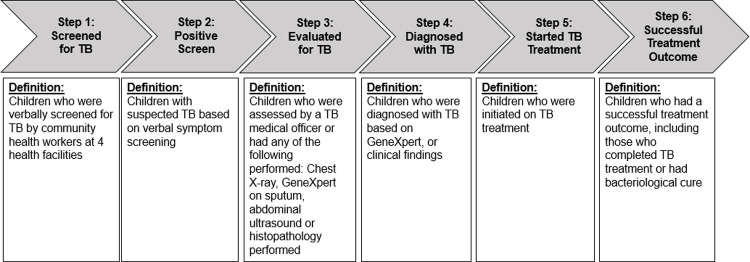
From a prospective screening program at four hospitals in Pakistan (2014-2016) we constructed a care cascade comprising six steps: screened, positive screen, evaluated, diagnosed, started treatment, and successful outcome. We evaluated the cascade by each year of age from 0 to 14 and report the age-specific mean proportion and standard deviation.
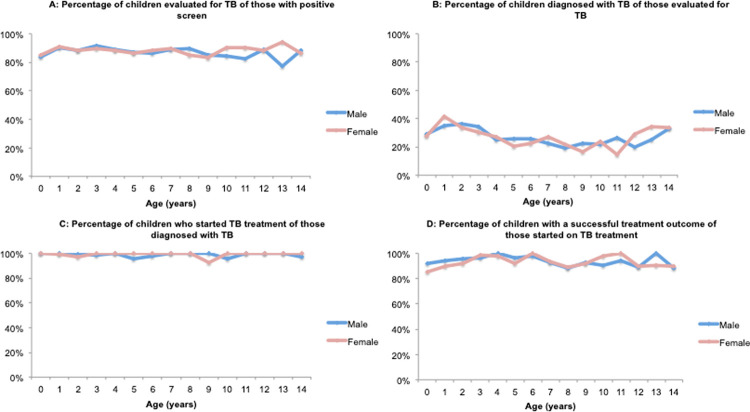
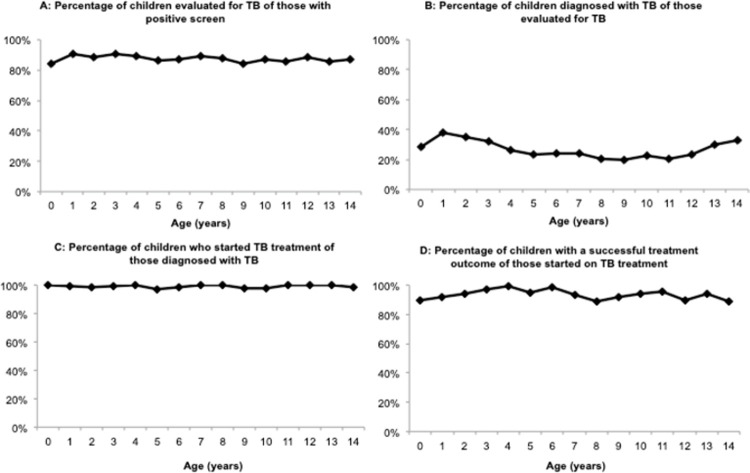
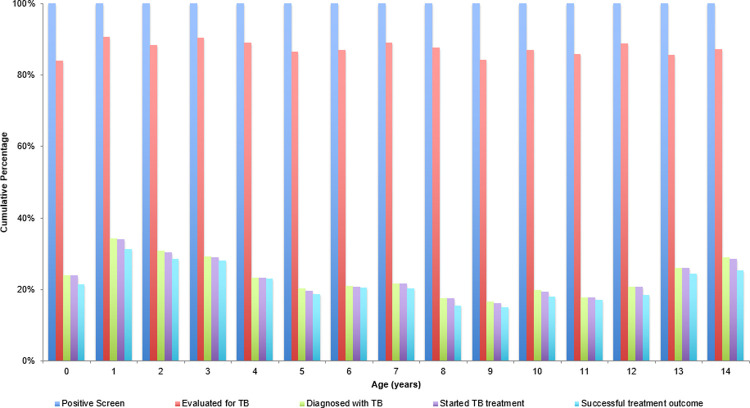
On average across all ages, only 12.5% (standard deviation: 2.0%) of children with a positive screen were not evaluated. Among children who had a complete evaluation, the highest percentages of children diagnosed with tuberculosis were observed in children 0-4 (mean: 31.9%; standard deviation: 4.8%), followed by lower percentages in children 5-9 (mean: 22.4%; standard deviation: 2.2%), and 10-14 (mean: 26.0%; standard deviation:5.4%). Nearly all children diagnosed with tuberculosis initiated treatment, and an average of 93.3% (standard deviation: 3.3%) across all ages had successful treatment outcomes.
This intervention was highly effective across ages 0-14 years. Our study illustrates the utility of applying operational analyses of age-stratified cascades to identify age-specific gaps in pediatric tuberculosis care that can guide future, novel interventions to close these gaps.
应用医疗保健级联框架评估强化结核病患者发现干预措施的效果(按儿童年龄分层)。
我们从巴基斯坦四家医院的前瞻性筛查项目(2014-2016 年)中构建了一个包含六个步骤的医疗保健级联:筛查、阳性筛查、评估、诊断、开始治疗和治疗成功。我们按照 0 至 14 岁的每个年龄评估级联,并报告每个年龄的平均比例和标准差。
在所有年龄段中,平均只有 12.5%(标准差:2.0%)的阳性筛查儿童未接受评估。在接受全面评估的儿童中,0-4 岁儿童中诊断为结核病的比例最高(平均值:31.9%;标准差:4.8%),其次是 5-9 岁(平均值:22.4%;标准差:2.2%)和 10-14 岁(平均值:26.0%;标准差:5.4%)。几乎所有诊断为结核病的儿童都开始接受治疗,所有年龄段的平均治疗成功率为 93.3%(标准差:3.3%)。
该干预措施在 0-14 岁儿童中效果显著。我们的研究说明了应用年龄分层级联的操作分析来识别儿科结核病护理中特定年龄的差距的有效性,这可以为未来的新型干预措施提供指导,以缩小这些差距。