Latour Katrien, Catry Boudewijn, Devleesschauwer Brecht, Buntinx Frank, De Lepeleire Jan, Jans Béatrice
Department of Epidemiology and Public Health, Sciensano, Brussels, Belgium.
Department of Public Health and Primary Care, KU Leuven, Leuven, Belgium.
Arch Public Health. 2022 Feb 18;80(1):58. doi: 10.1186/s13690-022-00818-1.
Belgium monitors the burden of healthcare-associated infections (HAIs) and antimicrobial use in nursing homes (NHs) by participating in the European point prevalence surveys (PPSs) organised in long-term care facilities (HALT surveys). We present the main findings of the three national PPSs conducted in NHs participating in at least one of these surveys, and in a cohort that participated in all three consecutive surveys.
All NHs were invited to voluntarily participate and conduct the survey on one single day in May-September 2010 (HALT-1), in April-May 2013 (HALT-2) or in September-November 2016 (HALT-3). Data were collected at institutional, ward and resident level. A detailed questionnaire had to be completed for all eligible (i.e. living full time in the facility since at least 24 h, present at 8:00 am and willing to participate) residents receiving at least one systemic antimicrobial agent and/or presenting at least one active HAI on the PPS day. The onset of signs/symptoms had to occur more than 48 h after the resident was (re-)admitted to the NH.
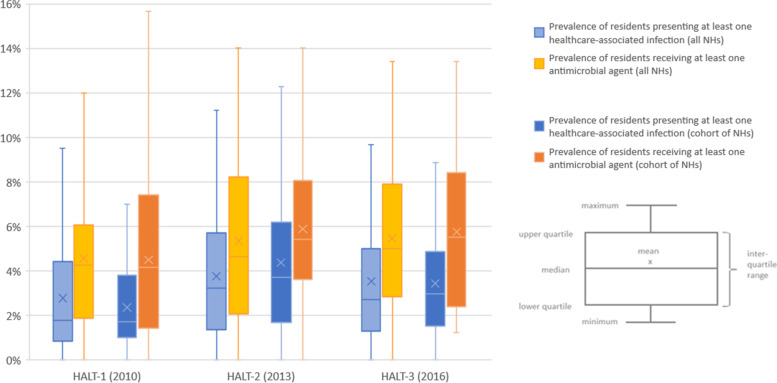
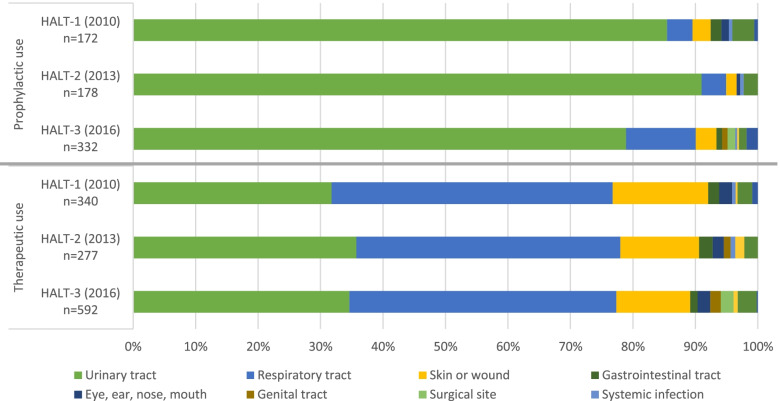
A total of 107, 87 and 158 NHs conducted the HALT-1, HALT-2 and HALT-3 survey, respectively. The median prevalence of residents with antimicrobial agent(s) increased from 4.3% (95% confidence interval (CI): 3.5-4.8%) in HALT-1 to 4.7% (95% CI: 3.5-6.5%) in HALT-2 and 5.0% (95% CI: 4.2-5.9%) in HALT-3. The median prevalence of residents with HAI(s) varied from 1.8% (95% CI: 1.4-2.7%) in HALT-1 to 3.2% (95% CI: 2.2-4.2%) in HALT-2 and 2.7% (95% CI: 2.1-3.4%) in HALT-3. Our post-hoc analysis on the cohort (n = 25 NHs) found similar trends. In all three surveys, respiratory tract infections were most frequently reported, followed by skin/wound infections in HALT-1 and urinary tract infections in HALT-2 and HALT-3. Antimicrobials were most commonly prescribed for the therapeutic treatment of an infection: 66.4% in HALT-1, 60.9% in HALT-2 and 64.1% in HALT-3. Uroprophylaxis accounted for 28.7%, 35.6% and 28.4% of all prescriptions, respectively.
None withstanding the limitations peculiar to the study design, the PPSs enabled us to assess the occurrence of and to increase awareness for HAIs and rational antimicrobial use in NHs at both local and national level.
比利时通过参与在长期护理机构开展的欧洲现患率调查(HALT调查),监测养老院中医疗保健相关感染(HAIs)的负担及抗菌药物使用情况。我们呈现了在至少参与其中一项调查的养老院中开展的三项全国性现患率调查的主要结果,以及在连续参与了全部三项调查的队列中的主要结果。
所有养老院均受邀自愿参与,并于2010年5月至9月的某一天(HALT - 1)、2013年4月至5月(HALT - 2)或2016年9月至11月(HALT - 3)进行调查。数据在机构、病房和居民层面收集。对于所有符合条件(即自至少24小时前开始全日制居住在该机构、上午8点在场且愿意参与)且在现患率调查日接受至少一种全身性抗菌药物治疗和/或患有至少一种活动性HAI的居民,需填写一份详细问卷。体征/症状的出现必须在居民入住养老院(重新入住)48小时之后。
分别有107家、87家和158家养老院进行了HALT - 1、HALT - 2和HALT - 3调查。使用抗菌药物的居民的中位现患率从HALT - 1中的4.3%(95%置信区间(CI):3.5 - 4.8%)增至HALT - 2中的4.7%(95% CI:3.5 - 6.5%)以及HALT - 3中的5.0%(95% CI:4.2 - 5.9%)。患有HAIs的居民的中位现患率在HALT - 1中为1.8%(95% CI:1.4 - 2.7%),在HALT - 2中为3.2%(95% CI:2.2 - 4.2%),在HALT - 3中为2.7%(95% CI:2.1 - 3.4%)。我们对该队列(n = 25家养老院)的事后分析发现了类似趋势。在所有三项调查中,呼吸道感染的报告最为频繁,其次是HALT - 1中的皮肤/伤口感染以及HALT - 2和HALT - 3中的尿路感染。抗菌药物最常用于感染的治疗:HALT - 1中为66.4%,HALT - 2中为60.9%,HALT - 3中为64.1%。预防性使用尿路抗菌药物分别占所有处方的28.7%、35.6%和28.4%。
尽管该研究设计存在特定局限性,但现患率调查使我们能够在地方和国家层面评估养老院中HAIs的发生情况,并提高对其的认识以及合理使用抗菌药物的意识。