Department of Infectious Diseases and Clinical Microbiology, Istanbul University-Cerrahpasa, Cerrahpasa School of Medicine, Istanbul, Turkey.
Department of Molecular Biology and Genetics, Bogazici University, Center for Life Sciences and Technologies, Istanbul, Turkey.
Life Sci Alliance. 2022 Feb 18;5(6). doi: 10.26508/lsa.202101103. Print 2022 Jun.
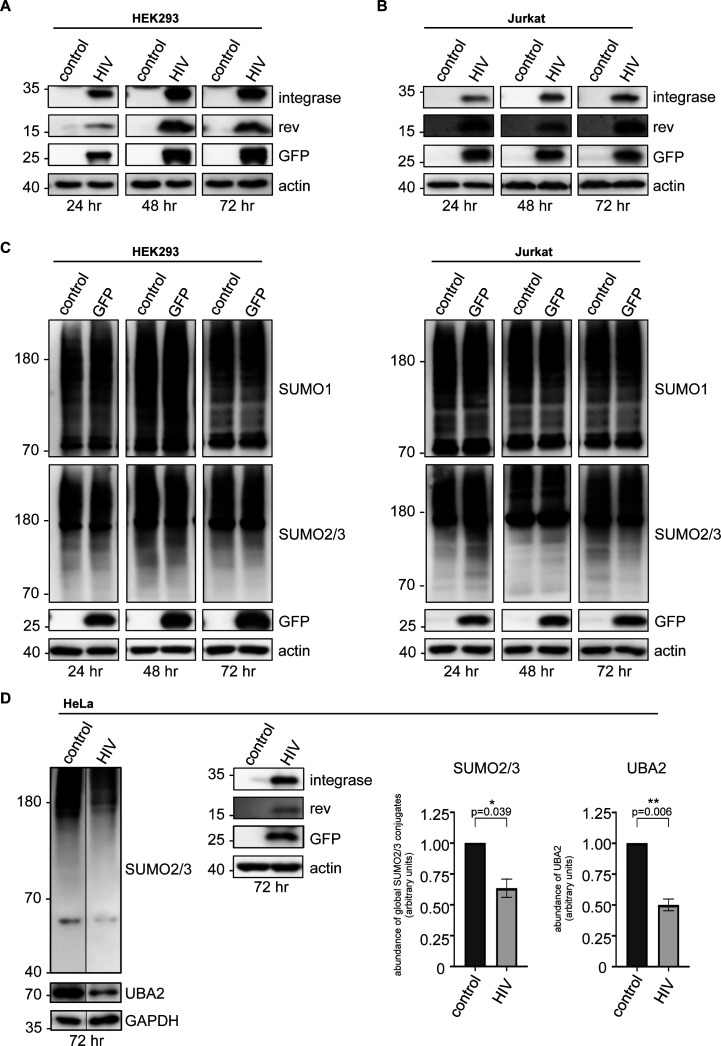
During infection, the human immunodeficiency virus type 1 (HIV-1) manipulates host cell mechanisms to its advantage, thereby controlling its replication or latency, and evading immune responses. Sumoylation is an essential post-translational modification that controls vital cellular activities including proliferation, stemness, or anti-viral immunity. SUMO peptides oppose pathogen replication and mediate interferon-dependent anti-viral activities. In turn, several viruses and bacteria attack sumoylation to disarm host immune responses. Here, we show that HIV-1 impairs cellular sumoylation and targets the host SUMO E1-activating enzyme. HIV-1 expression in cultured HEK293 cells or in CD4 Jurkat T lymphocytes diminishes sumoylation by both SUMO paralogs, SUMO1 and SUMO2/3. HIV-1 causes a sharp and specific decline in UBA2 protein levels, a subunit of the heterodimeric SUMO E1 enzyme, which likely serves to reduce the efficiency of global protein sumoylation. Furthermore, HIV-1-infected individuals display a significant reduction in total leukocyte sumoylation that is uncoupled from HIV-induced cytopenia. Because sumoylation is vital for immune function, T-cell expansion and activity, loss of sumoylation during HIV disease may contribute to immune system deterioration in patients.
在感染过程中,人类免疫缺陷病毒 1 型(HIV-1)操纵宿主细胞机制以获取优势,从而控制其复制或潜伏,并逃避免疫反应。SUMO 化是一种重要的翻译后修饰,控制着包括增殖、干性或抗病毒免疫在内的重要细胞活动。SUMO 肽可抵抗病原体复制并介导干扰素依赖性抗病毒活性。反过来,几种病毒和细菌攻击 SUMO 化以削弱宿主免疫反应。在这里,我们表明 HIV-1 会损害细胞 SUMO 化并靶向宿主 SUMO E1 激活酶。在培养的 HEK293 细胞或 CD4 Jurkat T 淋巴细胞中表达 HIV-1 会通过 SUMO 同源物 SUMO1 和 SUMO2/3 降低 SUMO 化水平。HIV-1 导致异二聚体 SUMO E1 酶的亚基 UBA2 蛋白水平急剧而特异性下降,这可能降低了全局蛋白 SUMO 化的效率。此外,HIV-1 感染者的总白细胞 SUMO 化显著降低,与 HIV 诱导的细胞减少无关。由于 SUMO 化对于免疫功能、T 细胞扩增和活性至关重要,因此在 HIV 疾病期间 SUMO 化的丧失可能导致患者免疫系统恶化。