Zou Jin, Peng Bo, Qu Jiuxin, Zheng Jun
Department of Clinical Laboratory, The Third People's Hospital of Shenzhen, Southern University of Science and Technology, National Clinical Research Center for Infectious Diseases, Shenzhen, China.
Faculty of Health Sciences, University of Macau, Zhuhai, Macau SAR, China.
Front Microbiol. 2022 Feb 2;12:708580. doi: 10.3389/fmicb.2021.708580. eCollection 2021.
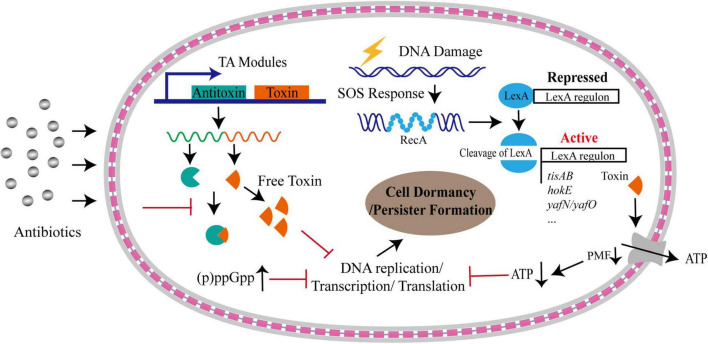
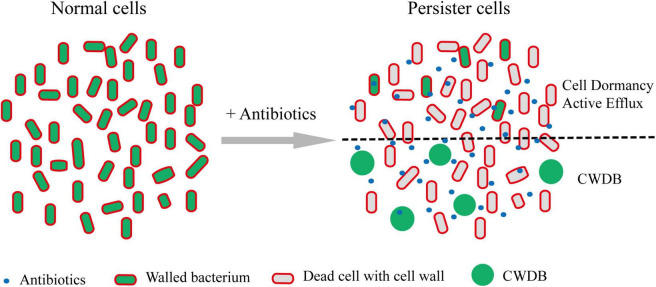
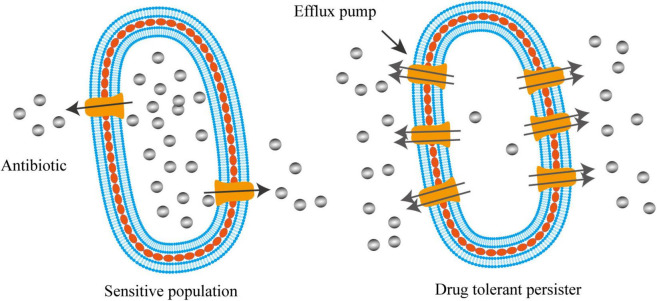
Bacterial persisters are a sub-population of phenotypic variants that tolerate high concentrations of antibiotics within the genetically homogeneous cells. They resume division upon the removal of drugs. Bacterial persistence is one of major causes of antibiotic treatment failure and recurrent infection. Cell dormancy, triggered by toxin/antitoxin pair, (p)ppGpp, SOS response and ATP levels, is known to be the mechanistic basis for persistence. However, recent studies have demonstrated that bacteria with active metabolism can maintain persistence by lowering intracellular antibiotic concentration via an efflux pump. Additionally, others and our work have showed that cell wall deficient bacteria (CWDB), including both L-form and spheroplasts that produced by β-lactam antibiotics, are associated with antibiotic persistence. They are not dormant cells as their cell walls have been completely damaged. In this review, we discuss the various types of persisters and highlight the contribution of non-walled bacteria on bacterial persistence.
细菌持留菌是表型变异体的一个亚群,在基因同质的细胞内耐受高浓度抗生素。去除药物后它们恢复分裂。细菌持留性是抗生素治疗失败和反复感染的主要原因之一。由毒素/抗毒素对、(p)ppGpp、SOS反应和ATP水平触发的细胞休眠是已知的持留性的机制基础。然而,最近的研究表明,具有活跃代谢的细菌可以通过外排泵降低细胞内抗生素浓度来维持持留性。此外,其他研究和我们的工作表明,细胞壁缺陷细菌(CWDB),包括由β-内酰胺抗生素产生的L型菌和原生质体,与抗生素持留性有关。它们不是休眠细胞,因为它们的细胞壁已被完全破坏。在这篇综述中,我们讨论了各种类型的持留菌,并强调了无壁细菌对细菌持留性的贡献。