Hu Yifan, Chen Youdong, Chen Zeyu, Zhang Xilin, Guo ChunYuan, Yu ZengYang, Xu Peng, Sun Lei, Zhou Xue, Gong Yu, Yu Qian, Shi Yuling
Department of Dermatology, Shanghai Skin Disease Hospital, Tongji University School of Medicine, Shanghai, China.
Department of Dermatology, Shanghai Tenth People's Hospital, Tongji University School of Medicine, Shanghai, China.
Front Cell Dev Biol. 2022 Feb 3;9:799560. doi: 10.3389/fcell.2021.799560. eCollection 2021.
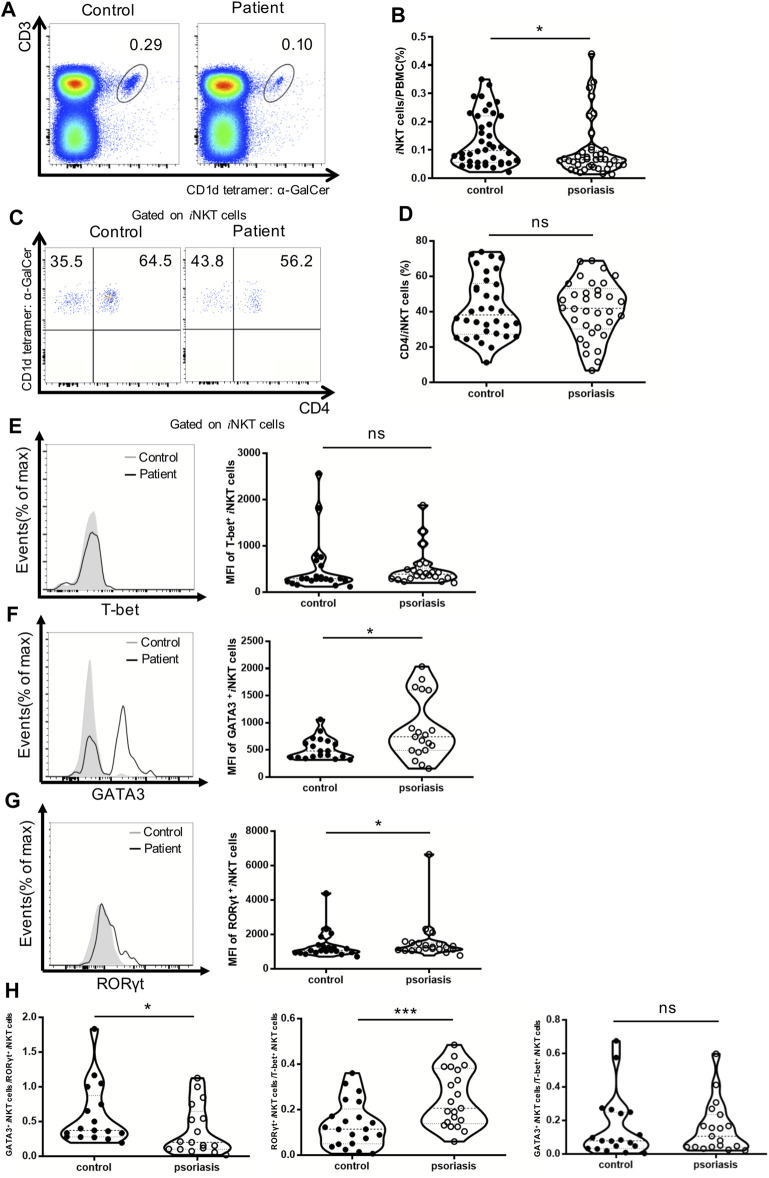
Psoriasis is a common immune-mediated skin disease that involves T-cell-mediated immunity. Invariant natural killer T (NKT) cells are a unique lymphocyte subpopulation that share properties and express surface markers of both NK cells and T cells. Previous reports indicate that NKT cells regulate the development of various inflammatory diseases. IL-17 is a key cytokine in the pathogenesis of psoriasis and a key therapeutic target. Secukinumab is a fully human IgG1κ antibody that targets IL-17A, thereby antagonizing the biological effects of IL-17. To explore the expression of NKT cells in psoriasis patients and the effect of secukinumab on them. We examined the frequencies of NKT cells, Tregs, naïve and memory CD4and CD8T cells in the PBMCs as well as their cytokine production in a cohort of 40 patients with moderate-to-severe plaque psoriasis and 40 gender- and age-matched healthy controls. We further collected peripheral blood of another 15 moderate-to-severe plaque psoriasis patients who were treated with secukinumab and evaluated the proportion of NKT cells in the PBMCs at baseline and week 12. The frequencies of conventional CD4 T cells, CD8 T cells, and Tregs in the PBMCs were comparable between psoriasis patients and healthy controls, but the frequencies of Th17 cells, Tc1 cells and Tc17 cells were increased in psoriasis patients. The frequency of peripheral NKT cells and CD69 NKT cells was significantly decreased in psoriasis patients. Both NKT2 cells and NKT17 cells were increased in psoriasis patients, but the ratio of NKT2 cells vs NKT17 cells was significantly reduced in psoriasis patients. After receiving secukinumab, the proportion of NKT cells in the PBMCs of patients was increased, while the proportion of NKT17 cells was decreased. Dysregulated NKT cells may be involved in the pathogenesis of psoriasis and secukinumab may play a regulatory role on NKT cells.
银屑病是一种常见的免疫介导性皮肤病,涉及T细胞介导的免疫。不变自然杀伤T(NKT)细胞是一种独特的淋巴细胞亚群,兼具自然杀伤细胞和T细胞的特性并表达其表面标志物。既往报道表明,NKT细胞可调节多种炎症性疾病的发展。白细胞介素-17(IL-17)是银屑病发病机制中的关键细胞因子及关键治疗靶点。司库奇尤单抗是一种全人源IgG1κ抗体,可靶向IL-17A,从而拮抗IL-17的生物学效应。为探究银屑病患者中NKT细胞的表达情况以及司库奇尤单抗对其的影响,我们检测了40例中度至重度斑块状银屑病患者及40例性别和年龄匹配的健康对照外周血单个核细胞(PBMC)中NKT细胞、调节性T细胞(Tregs)、初始及记忆性CD4和CD8 T细胞的频率,以及它们的细胞因子产生情况。我们还收集了另外15例接受司库奇尤单抗治疗的中度至重度斑块状银屑病患者的外周血,评估基线及第12周时PBMC中NKT细胞的比例。银屑病患者与健康对照PBMC中传统CD4 T细胞、CD8 T细胞和Tregs的频率相当,但银屑病患者中辅助性T细胞17(Th17)细胞、细胞毒性T细胞1(Tc1)细胞和Tc17细胞的频率增加。银屑病患者外周NKT细胞及CD69 NKT细胞的频率显著降低。银屑病患者中NKT2细胞和NKT17细胞均增加,但银屑病患者中NKT2细胞与NKT17细胞的比例显著降低。接受司库奇尤单抗治疗后,患者PBMC中NKT细胞的比例增加,而NKT17细胞的比例降低。失调的NKT细胞可能参与了银屑病的发病机制,司库奇尤单抗可能对NKT细胞发挥调节作用。