Yao Kai, Sun Jie, Huang Kaizhu, Jing Linzhi, Liu Hang, Huang Dejian, Jude Curran
School of Advanced Technology, Xi'an Jiaotong-Liverpool University, 111 Ren'ai Road, Suzhou, Jiangsu 215123, China.
School of Engineering, University of Liverpool, The Quadrangle, Brownlow Hill, L69 3GH, UK.
Int J Bioprint. 2021 Dec 30;8(1):495. doi: 10.18063/ijb.v8i1.495. eCollection 2022.
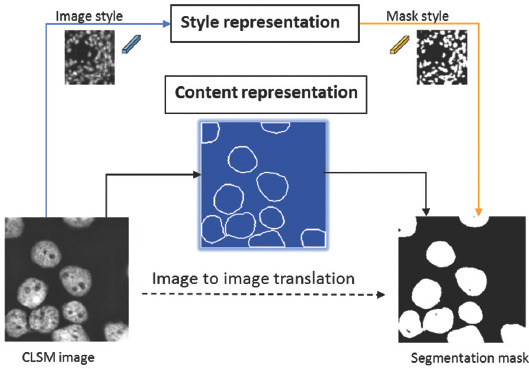
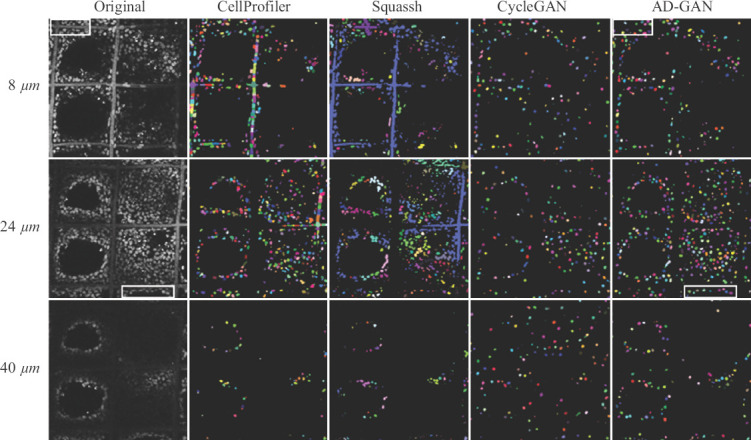
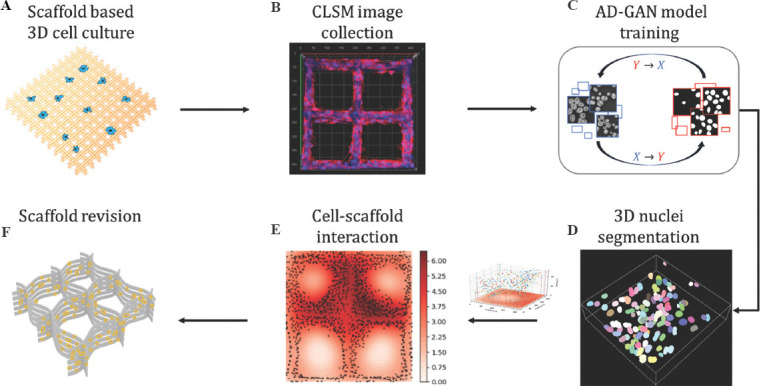
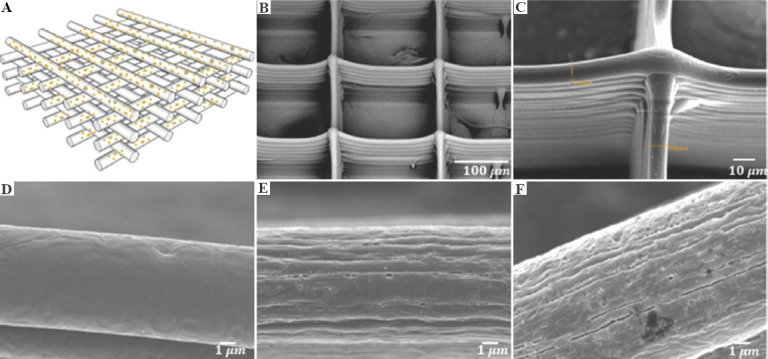
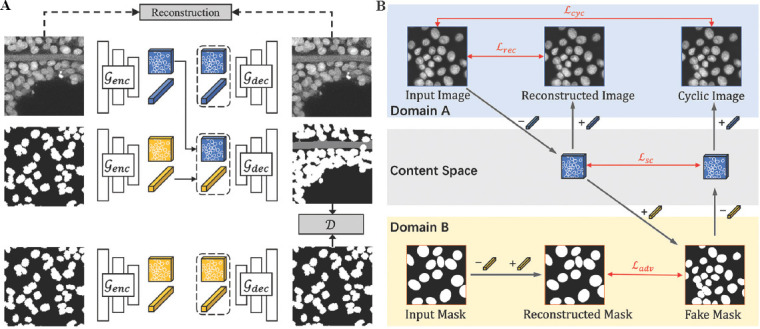
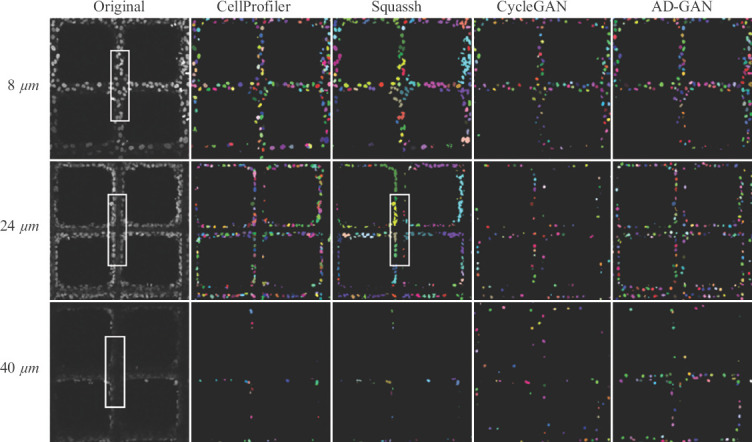
Fibrous scaffolds have been extensively used in three-dimensional (3D) cell culture systems to establish models in cell biology, tissue engineering, and drug screening. It is a common practice to characterize cell behaviors on such scaffolds using confocal laser scanning microscopy (CLSM). As a noninvasive technology, CLSM images can be utilized to describe cell-scaffold interaction under varied morphological features, biomaterial composition, and internal structure. Unfortunately, such information has not been fully translated and delivered to researchers due to the lack of effective cell segmentation methods. We developed herein an end-to-end model called Aligned Disentangled Generative Adversarial Network (AD-GAN) for 3D unsupervised nuclei segmentation of CLSM images. AD-GAN utilizes representation disentanglement to separate content representation (the underlying nuclei spatial structure) from style representation (the rendering of the structure) and align the disentangled content in the latent space. The CLSM images collected from fibrous scaffold-based culturing A549, 3T3, and HeLa cells were utilized for nuclei segmentation study. Compared with existing commercial methods such as Squassh and CellProfiler, our AD-GAN can effectively and efficiently distinguish nuclei with the preserved shape and location information. Building on such information, we can rapidly screen cell-scaffold interaction in terms of adhesion, migration and proliferation, so as to improve scaffold design.
纤维支架已广泛应用于三维(3D)细胞培养系统中,以建立细胞生物学、组织工程和药物筛选方面的模型。使用共聚焦激光扫描显微镜(CLSM)来表征此类支架上的细胞行为是一种常见的做法。作为一种非侵入性技术,CLSM图像可用于描述在各种形态特征、生物材料组成和内部结构下的细胞-支架相互作用。不幸的是,由于缺乏有效的细胞分割方法,此类信息尚未完全转化并传递给研究人员。我们在此开发了一种名为对齐解缠生成对抗网络(AD-GAN)的端到端模型,用于CLSM图像的3D无监督细胞核分割。AD-GAN利用表示解缠将内容表示(潜在的细胞核空间结构)与风格表示(结构的渲染)分离,并在潜在空间中对齐解缠后的内容。从基于纤维支架培养的A549、3T3和HeLa细胞收集的CLSM图像用于细胞核分割研究。与Squassh和CellProfiler等现有商业方法相比,我们的AD-GAN能够有效且高效地区分细胞核,并保留形状和位置信息。基于这些信息,我们可以快速筛选细胞-支架在黏附、迁移和增殖方面的相互作用,从而改进支架设计。