Clarke International University, P.O Box 7782, Kampala, Uganda.
Mbarara University of Science and Technology, P.O Box 1410, Mbarara, Uganda.
BMC Public Health. 2022 Feb 21;22(1):373. doi: 10.1186/s12889-022-12771-3.
Despite efforts to avert the negative effects of malaria, there remain barriers to the uptake of prevention measures, and these have hindered its eradication. This study explored the factors that influence uptake of malaria prevention strategies among pregnant women and children under-five years and the impact of COVID-19 in a malaria endemic rural district in Uganda.
This was a qualitative case study that used focus group discussions, in-depth interviews, and key informant interviews involving pregnant women, caregivers of children under-five years, traditional birth attendants, village health teams, local leaders, and healthcare providers to explore malaria prevention uptake among pregnant women and children under-five years. The interviews were audio-recorded, transcribed and data were analyzed using thematic content approach.
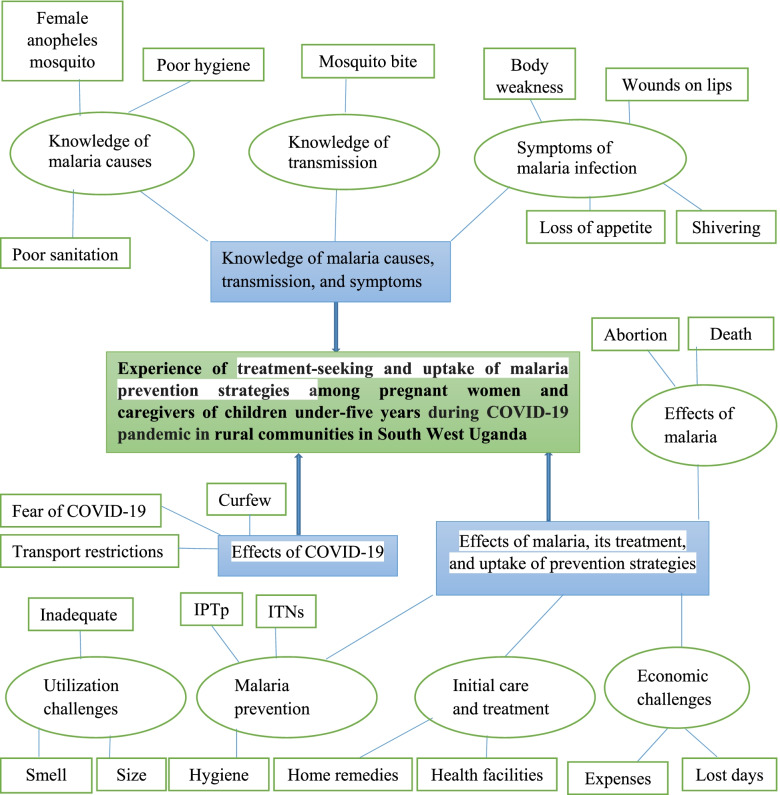
Seventy-two participants were enrolled in the Focus Group Discussions, 12 in the in-depth interviews, and 2 as key informants. Pregnant women and caregivers of children under-five years were able to recognize causes of malaria, transmission, and symptoms. All participants viewed malaria prevention as a high priority, and the use of insecticide-treated mosquito bed nets (ITNs) was upheld. Participants' own experiences indicated adverse effects of malaria to both pregnant women and children under-five. Home medication and the use of local herbs were a common practice. Some participants didn't use any of the malaria prevention methods due to deliberate refusal, perceived negative effects of the ITNs, and family disparity. The Corona Virus Disease-2019 (COVID-19) control measures did not abate the risk of malaria infection but these were deleterious to healthcare access and the focus of malaria prevention.
Although pregnant women and caregivers of children under-five years recognized symptoms of malaria infection, healthcare-seeking was not apt as some respondents used alternative approaches and delayed seeking formal healthcare. It is imperative to focus on the promotion of malaria prevention strategies and address drawbacks associated with misconceptions about these interventions, and promotion of health-seeking behaviors. As COVID-19 exacerbated the effect of malaria prevention uptake and healthcare seeking, it's critical to recommit and integrate COVID-19 prevention measures in normative living and restrict future barriers to healthcare access.
尽管人们努力避免疟疾的负面影响,但在接受预防措施方面仍存在障碍,这阻碍了疟疾的根除。本研究探讨了乌干达疟疾流行农村地区影响孕妇和 5 岁以下儿童采取疟疾预防策略的因素,以及 COVID-19 的影响。
这是一项定性案例研究,使用焦点小组讨论、深入访谈和关键知情人访谈,涉及孕妇、5 岁以下儿童的照顾者、传统助产士、村卫生团队、当地领导人和医疗保健提供者,以探讨孕妇和 5 岁以下儿童的疟疾预防措施的采用情况。访谈进行了录音,并进行了转录,数据采用主题内容分析方法进行分析。
共有 72 名参与者参加了焦点小组讨论,12 名参与者参加了深入访谈,2 名参与者作为关键知情人。孕妇和 5 岁以下儿童的照顾者能够认识到疟疾的病因、传播途径和症状。所有参与者都认为疟疾预防是重中之重,并且支持使用经杀虫剂处理的蚊帐(ITN)。参与者自己的经验表明,疟疾对孕妇和 5 岁以下儿童都有不良影响。家庭用药和使用当地草药是常见做法。一些参与者由于故意拒绝、认为 ITN 有负面影响以及家庭差异,而不使用任何疟疾预防方法。冠状病毒病-2019(COVID-19)控制措施并没有减轻疟疾感染的风险,但这些措施对获得医疗保健和疟疾预防工作的重点产生了不利影响。
尽管孕妇和 5 岁以下儿童的照顾者认识到疟疾感染的症状,但寻求医疗保健并不合适,因为一些受访者使用了替代方法,并延迟了寻求正规医疗保健的时间。当务之急是关注疟疾预防策略的推广,并解决与这些干预措施相关的误解所带来的问题,以及促进寻求医疗保健的行为。由于 COVID-19 加剧了疟疾预防措施的采用和寻求医疗保健的影响,因此必须重新承诺并将 COVID-19 预防措施纳入正常生活,并限制未来获得医疗保健的障碍。