• 文献检索
  • 文档翻译
  • 深度研究
  • 学术资讯
  • Suppr Zotero 插件Zotero 插件
  • 邀请有礼
  • 套餐&价格
  • 历史记录
应用&插件
Suppr Zotero 插件Zotero 插件浏览器插件Mac 客户端Windows 客户端微信小程序
定价
高级版会员购买积分包购买API积分包
服务
文献检索文档翻译深度研究API 文档MCP 服务
关于我们
关于 Suppr公司介绍联系我们用户协议隐私条款
关注我们

Suppr 超能文献

核心技术专利:CN118964589B侵权必究
粤ICP备2023148730 号-1Suppr @ 2026

文献检索

告别复杂PubMed语法,用中文像聊天一样搜索,搜遍4000万医学文献。AI智能推荐,让科研检索更轻松。

立即免费搜索

文件翻译

保留排版,准确专业,支持PDF/Word/PPT等文件格式,支持 12+语言互译。

免费翻译文档

深度研究

AI帮你快速写综述,25分钟生成高质量综述,智能提取关键信息,辅助科研写作。

立即免费体验

社交媒体使用与沙特阿拉伯普通人群中 COVID-19 疫苗接种接受度的关系 - 一项横断面研究。

Association between social media use and the acceptance of COVID-19 vaccination among the general population in Saudi Arabia - a cross-sectional study.

机构信息

Department of Family Medicine, Faculty of Medicine, King Abdulaziz University, Jeddah, Saudi Arabia.

Faculty of Medicine, King Abdulaziz University, Jeddah, Saudi Arabia.

出版信息

BMC Public Health. 2022 Feb 21;22(1):375. doi: 10.1186/s12889-022-12757-1.

DOI:10.1186/s12889-022-12757-1
PMID:35189874
原文链接:https://pmc.ncbi.nlm.nih.gov/articles/PMC8860460/
Abstract

BACKGROUND

The Coronavirus Disease of 2019 (COVID-19) pandemic is a worldwide global public health threat. Although acceptance of COVID-19 vaccination will be a critical step in combating the pandemic, achieving high uptake will be difficult, and potentially made more difficult by social media misinformation. This study aimed to examine the association between social media use and acceptance of receiving COVID-19 vaccine among the general population in Saudi Arabia.

METHODOLOGY

A cross-sectional study was conducted from June 17 to June 19, 2021 among 504 participants of the general population in Saudi Arabia. The data were collected using a three-part online questionnaire (sociodemographic characteristics, medical and vaccination history, pattern of social media use).

RESULTS

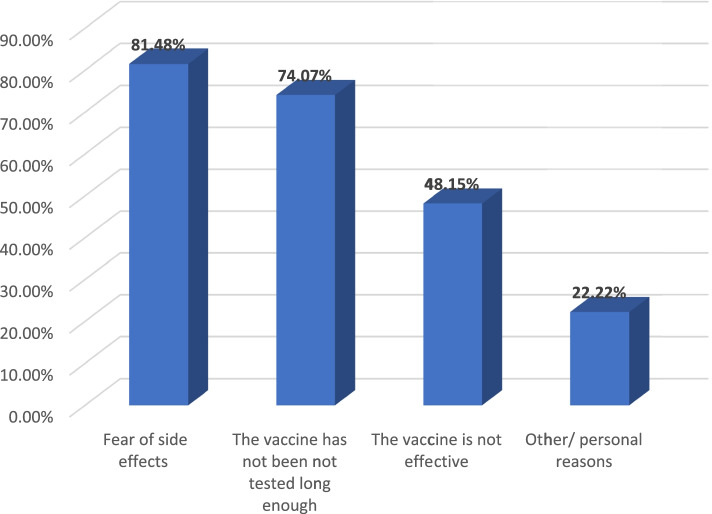
Among 504 participants who completed the survey, 477 participants were acceptant of the vaccine and 27 were non-accepting. A total of 335 individuals had already received the vaccine, 142 were willing to receive the vaccine and 27 were unwilling. One hundred and thirty participants denied using social media for COVID-19 news. Four factors were found to be significant in influencing vaccine acceptance in univariate analysis: having a chronic condition (odds ratio (OR) = 0.367, P = 0.019), believing that infertility is a side effect of the COVID-19 vaccine (OR = 0.298, P = 0.009), being concerned about a serious side effect from the vaccine (somewhat concerned: OR = 0.294, P = 0.022, very concerned: OR = 0.017, P < 0.0001), and basing the decision to be vaccinated on social media information (OR = 0.260, P = 0.006). Two of these factors fell away on multivariate analysis: basing the decision on social media information (OR = 0.356, P = 0.071), and a belief that vaccination causes infertility (OR = 0.0333, P = 0.054), suggesting that the associations are dependent on other factors.

CONCLUSION

‏In conclusion, there was no significant independent relationship between social media usage and people's willingness to receive a COVID-19 vaccination. Further studies to explore the association between social media use and vaccine decisions are required to generalize this observation to the Saudi population.

摘要

背景

2019 年冠状病毒病(COVID-19)大流行是全球公共卫生的全球性威胁。尽管接受 COVID-19 疫苗接种将是对抗大流行的关键步骤,但要实现高接种率将很困难,而社交媒体上的错误信息可能会使情况变得更加复杂。本研究旨在调查沙特阿拉伯普通人群中社交媒体使用与接受 COVID-19 疫苗之间的关联。

方法

2021 年 6 月 17 日至 6 月 19 日,对沙特阿拉伯的 504 名普通人群进行了横断面研究。使用三部分在线问卷(社会人口统计学特征,医疗和疫苗接种史,社交媒体使用模式)收集数据。

结果

在完成调查的 504 名参与者中,有 477 名参与者接受了疫苗,有 27 名不接受疫苗。共有 335 人已接种疫苗,142 人愿意接种疫苗,27 人不愿意接种疫苗。有 130 人否认使用社交媒体获取 COVID-19 消息。单因素分析发现 4 个因素对疫苗接种有显著影响:患有慢性病(优势比(OR)=0.367,P=0.019),认为不孕是 COVID-19 疫苗的副作用(OR=0.298,P=0.009),担心疫苗会产生严重副作用(有些担心:OR=0.294,P=0.022,非常担心:OR=0.017,P<0.0001),并根据社交媒体信息做出接种疫苗的决定(OR=0.260,P=0.006)。其中两个因素在多因素分析中消失:基于社交媒体信息做出决定(OR=0.356,P=0.071)和认为接种疫苗会导致不孕(OR=0.0333,P=0.054),这表明这些关联取决于其他因素。

结论

总之,社交媒体的使用与人们接受 COVID-19 疫苗之间没有显著的独立关系。需要进一步研究以探索社交媒体使用与疫苗接种决定之间的关系,以便将这一观察结果推广到沙特人口。

https://cdn.ncbi.nlm.nih.gov/pmc/blobs/1b51/8862549/e42ffbd14674/12889_2022_12757_Fig2_HTML.jpg
https://cdn.ncbi.nlm.nih.gov/pmc/blobs/1b51/8862549/f6e9318aafad/12889_2022_12757_Fig1_HTML.jpg
https://cdn.ncbi.nlm.nih.gov/pmc/blobs/1b51/8862549/e42ffbd14674/12889_2022_12757_Fig2_HTML.jpg
https://cdn.ncbi.nlm.nih.gov/pmc/blobs/1b51/8862549/f6e9318aafad/12889_2022_12757_Fig1_HTML.jpg
https://cdn.ncbi.nlm.nih.gov/pmc/blobs/1b51/8862549/e42ffbd14674/12889_2022_12757_Fig2_HTML.jpg

相似文献

1
Association between social media use and the acceptance of COVID-19 vaccination among the general population in Saudi Arabia - a cross-sectional study.社交媒体使用与沙特阿拉伯普通人群中 COVID-19 疫苗接种接受度的关系 - 一项横断面研究。
BMC Public Health. 2022 Feb 21;22(1):375. doi: 10.1186/s12889-022-12757-1.
2
SARS-CoV-2 variants and the global pandemic challenged by vaccine uptake during the emergence of the Delta variant: A national survey seeking vaccine hesitancy causes.SARS-CoV-2 变体和疫苗接种率在 Delta 变体出现期间面临的全球大流行:一项旨在寻找疫苗犹豫原因的全国性调查。
J Infect Public Health. 2022 Jul;15(7):773-780. doi: 10.1016/j.jiph.2022.06.007. Epub 2022 Jun 17.
3
Socio-Demographics Correlate of COVID-19 Vaccine Hesitancy During the Second Wave of COVID-19 Pandemic: A Cross-Sectional Web-Based Survey in Saudi Arabia.社会人口统计学与 COVID-19 疫苗犹豫在 COVID-19 大流行第二波期间的相关性:沙特阿拉伯的一项基于网络的横断面调查。
Front Public Health. 2021 Jun 24;9:698106. doi: 10.3389/fpubh.2021.698106. eCollection 2021.
4
Acceptance and Attitude toward COVID-19 Vaccination among the Public in Saudi Arabia: A Cross-sectional Study.沙特阿拉伯公众对 COVID-19 疫苗接种的接受度和态度:一项横断面研究。
J Contemp Dent Pract. 2021 Jul 1;22(7):730-734.
5
Willingness to receive COVID-19 vaccination among adults with chronic diseases in the Kingdom of Saudi Arabia.沙特阿拉伯王国慢性病成年人对 COVID-19 疫苗接种的意愿。
J Infect Public Health. 2021 Oct;14(10):1489-1496. doi: 10.1016/j.jiph.2021.08.002. Epub 2021 Aug 13.
6
Direct and Indirect Associations of Media Use With COVID-19 Vaccine Hesitancy in South Korea: Cross-sectional Web-Based Survey.直接和间接关联的媒体使用与 COVID-19 疫苗犹豫在韩国:横断面网络调查。
J Med Internet Res. 2022 Jan 6;24(1):e32329. doi: 10.2196/32329.
7
Acceptability of COVID-19 vaccination in Saudi Arabia: A cross-sectional study using a web-based survey.沙特阿拉伯民众对 COVID-19 疫苗接种的接受度:一项基于网络调查的横断面研究。
Hum Vaccin Immunother. 2021 Oct 3;17(10):3338-3347. doi: 10.1080/21645515.2021.1936869. Epub 2021 Jul 8.
8
Assessing the Knowledge and Attitude toward COVID-19 Vaccination in Saudi Arabia.评估沙特阿拉伯民众对 COVID-19 疫苗接种的认知和态度。
Int J Environ Res Public Health. 2021 Aug 2;18(15):8185. doi: 10.3390/ijerph18158185.
9
Willingness, beliefs, and barriers regarding the COVID-19 vaccine in Saudi Arabia: a multiregional cross-sectional study.沙特阿拉伯民众对 COVID-19 疫苗的意愿、信念和障碍:一项多区域横断面研究。
BMC Fam Pract. 2021 Dec 16;22(1):247. doi: 10.1186/s12875-021-01606-6.
10
Perception and Acceptance of Using Different Generic Types of COVID-19 Vaccine, the "Mix-and-Match" Strategy, in Saudi Arabia: Cross-Sectional Web-Based Survey.沙特阿拉伯民众对不同类型 COVID-19 疫苗、“混打”策略的认知和接受度:基于网络的横断面调查。
Int J Environ Res Public Health. 2022 Oct 26;19(21):13889. doi: 10.3390/ijerph192113889.

引用本文的文献

1
Social media crisis communication and public engagement during COVID-19 analyzing public health and news media organizations' tweeting strategies.新冠疫情期间的社交媒体危机沟通与公众参与:分析公共卫生和新闻媒体组织的推文策略
Sci Rep. 2025 May 24;15(1):18082. doi: 10.1038/s41598-025-90759-w.
2
Social media has become a mainstream source of medical information for patients with rheumatic diseases: a cross-sectional survey of patients.社交媒体已成为风湿性疾病患者获取医学信息的主流来源:一项对患者的横断面调查。
Rheumatol Int. 2024 Oct;44(10):2159-2166. doi: 10.1007/s00296-024-05634-0. Epub 2024 Jun 8.
3
COVID-19 Vaccine Hesitancy among Population in Jazan Region of Saudi Arabia.

本文引用的文献

1
Fake news and COVID-19: modelling the predictors of fake news sharing among social media users.假新闻与新冠疫情:社交媒体用户间假新闻分享预测因素的建模分析
Telemat Inform. 2021 Jan;56:101475. doi: 10.1016/j.tele.2020.101475. Epub 2020 Jul 30.
2
Attitudes toward the SARS-CoV-2 Vaccine: Results from the Saudi Residents' Intention to Get Vaccinated against COVID-19 (SRIGVAC) Study.对严重急性呼吸综合征冠状病毒2疫苗的态度:沙特居民接种2019冠状病毒病疫苗意向(SRIGVAC)研究结果
Vaccines (Basel). 2021 Jul 18;9(7):798. doi: 10.3390/vaccines9070798.
3
Beliefs and barriers associated with COVID-19 vaccination among the general population in Saudi Arabia.
沙特阿拉伯吉赞地区人群对新冠疫苗的犹豫态度
Healthcare (Basel). 2023 Nov 27;11(23):3051. doi: 10.3390/healthcare11233051.
4
Hesitancy toward vaccination against COVID-19: A scoping review of prevalence and associated factors in the Arab world.对 COVID-19 疫苗接种犹豫不决:阿拉伯世界的流行率及相关因素的范围综述。
Hum Vaccin Immunother. 2023 Aug 1;19(2):2245720. doi: 10.1080/21645515.2023.2245720.
5
Death Anxiety Among Pakistani HCWs: The Role of COVID-19 Vaccine Acceptance and Positive Religious Coping Strategy.巴基斯坦医护人员的死亡焦虑:新冠疫苗接种意愿及积极宗教应对策略的作用
Omega (Westport). 2023 Jun 28:302228231186360. doi: 10.1177/00302228231186360.
6
Effect of a mobile app chatbot and an interactive small-group webinar on COVID-19 vaccine intention and confidence in Japan: a randomised controlled trial.移动应用程序聊天机器人和互动式小组网络研讨会对日本 COVID-19 疫苗接种意愿和信心的影响:一项随机对照试验。
BMJ Glob Health. 2023 May;8(5). doi: 10.1136/bmjgh-2022-010370.
7
The association of care burden with motivation of vaccine acceptance among caregivers of stroke patients during the COVID-19 pandemic: mediating roles of problematic social media use, worry, and fear.在 COVID-19 大流行期间,卒中患者照顾者的护理负担与疫苗接受意愿的相关性:问题性社交媒体使用、担忧和恐惧的中介作用。
BMC Psychol. 2023 May 15;11(1):157. doi: 10.1186/s40359-023-01186-3.
8
Knowledge, attitude, and practices of front line health workers after receiving a COVID-19 vaccine: a cross-sectional study in Pakistan.一线卫生工作者接种 COVID-19 疫苗后的知识、态度和实践:巴基斯坦的一项横断面研究。
PeerJ. 2023 Mar 14;11:e14727. doi: 10.7717/peerj.14727. eCollection 2023.
9
Assessing the adverse effects of COVID-19 vaccine in different scenarios in Saudi Arabia: A cross-sectional study.评估 COVID-19 疫苗在沙特阿拉伯不同场景下的不良影响:一项横断面研究。
Saudi Med J. 2023 Feb;44(2):194-201. doi: 10.15537/smj.2023.44.2.20220680.
10
The impact of information sources on COVID-19 vaccine hesitancy and resistance in sub-Saharan Africa.信息来源对撒哈拉以南非洲 COVID-19 疫苗犹豫和抵制的影响。
BMC Public Health. 2023 Jan 6;23(1):38. doi: 10.1186/s12889-022-14972-2.
沙特阿拉伯普通民众对 COVID-19 疫苗接种的信念和障碍。
BMC Public Health. 2021 Jul 21;21(1):1438. doi: 10.1186/s12889-021-11501-5.
4
Hesitancy Toward a COVID-19 Vaccine.对 COVID-19 疫苗的犹豫。
Ecohealth. 2021 Mar;18(1):44-60. doi: 10.1007/s10393-021-01524-0. Epub 2021 Jun 4.
5
When it is available, will we take it? Social media users' perception of hypothetical COVID-19 vaccine in Nigeria.当疫苗上市时,我们会接种吗?尼日利亚社交媒体用户对假设的 COVID-19 疫苗的看法。
Pan Afr Med J. 2021 Mar 2;38:230. doi: 10.11604/pamj.2021.38.230.27325. eCollection 2021.
6
Public Trust and Willingness to Vaccinate Against COVID-19 in the US From October 14, 2020, to March 29, 2021.2020 年 10 月 14 日至 2021 年 3 月 29 日美国民众对 COVID-19 疫苗的信任度和接种意愿
JAMA. 2021 Jun 15;325(23):2397-2399. doi: 10.1001/jama.2021.8246.
7
COVID-19 Vaccine Hesitancy among Young Adults in Saudi Arabia: A Cross-Sectional Web-Based Study.沙特阿拉伯青年成年人对新冠疫苗的犹豫态度:一项基于网络的横断面研究
Vaccines (Basel). 2021 Apr 1;9(4):330. doi: 10.3390/vaccines9040330.
8
Acceptability of a COVID-19 Vaccine among the Saudi Population.沙特人群对新冠疫苗的可接受性
Vaccines (Basel). 2021 Mar 5;9(3):226. doi: 10.3390/vaccines9030226.
9
Acceptability of a COVID-19 Vaccine Among Healthcare Workers in the Kingdom of Saudi Arabia.沙特阿拉伯王国医护人员对新冠疫苗的接受度
Front Med (Lausanne). 2021 Mar 1;8:644300. doi: 10.3389/fmed.2021.644300. eCollection 2021.
10
Influence of social media on parents' attitudes towards vaccine administration.社交媒体对家长接种疫苗态度的影响。
Hum Vaccin Immunother. 2022 Dec 31;18(1):1872340. doi: 10.1080/21645515.2021.1872340. Epub 2021 Feb 17.