The Department of Infectious Diseases, Israel Institute for Biological Research, Ness-Ziona, Israel.
The Department of Biotechnology, Israel Institute for Biological Research, Ness-Ziona, Israel.
Arch Virol. 2022 Apr;167(4):1041-1049. doi: 10.1007/s00705-022-05392-z. Epub 2022 Feb 22.
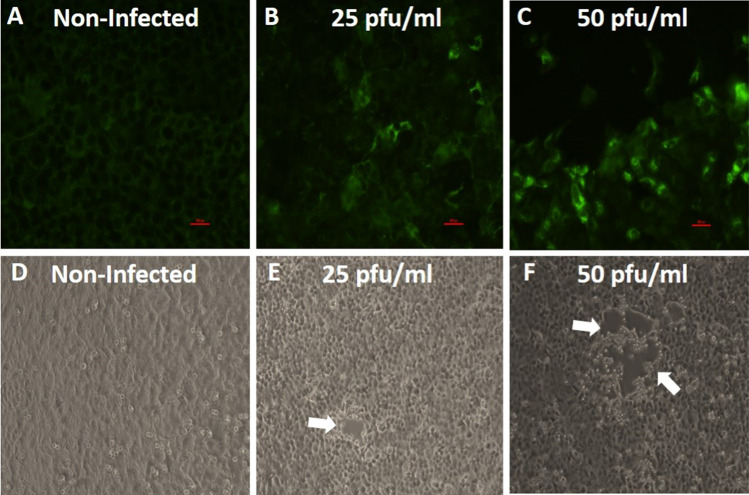
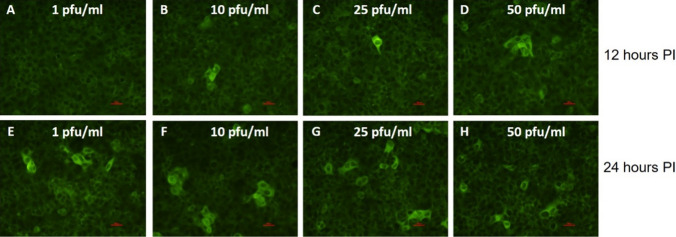
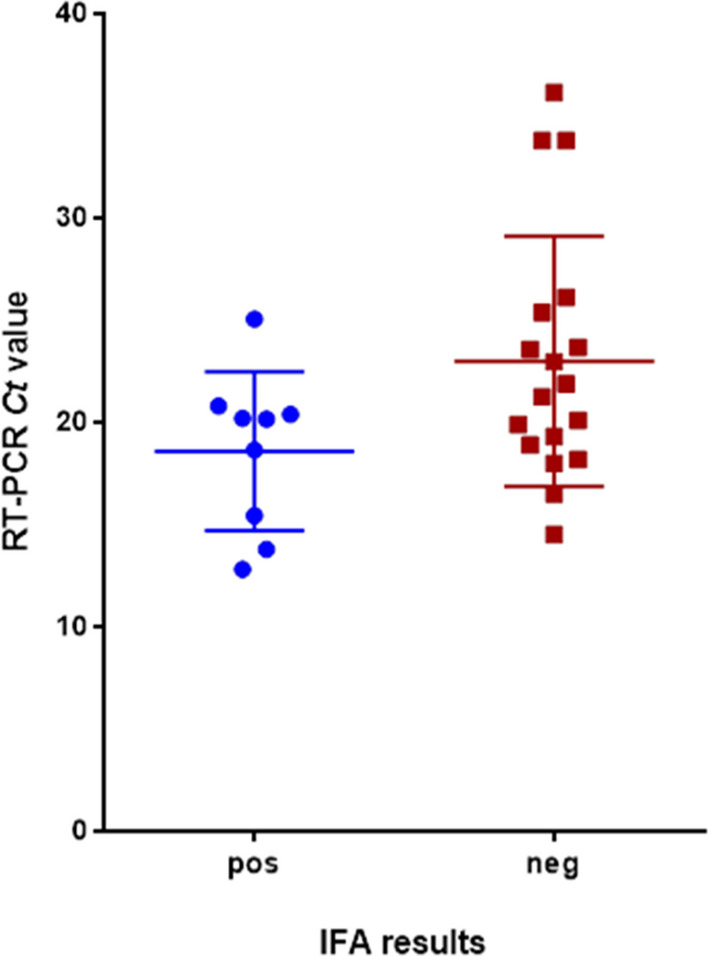
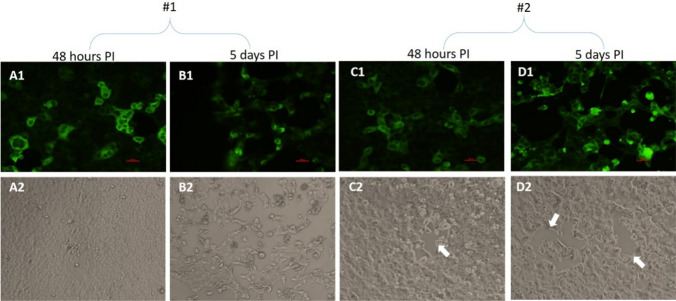
SARS-CoV-2, the etiologic agent of the COVID-19 pandemic, emerged as the cause of a global crisis in 2019. Currently, the main method for identification of SARS-CoV-2 is a reverse transcription (RT)-PCR assay designed to detect viral RNA in oropharyngeal (OP) or nasopharyngeal (NP) samples. While the PCR assay is considered highly specific and sensitive, this method cannot determine the infectivity of the sample, which may assist in evaluation of virus transmissibility from patients and breaking transmission chains. Thus, cell-culture-based approaches such as cytopathic effect (CPE) assays are routinely employed for the identification of infectious viruses in NP/OP samples. Despite their high sensitivity, CPE assays take several days and require additional diagnostic tests in order to verify the identity of the pathogen. We have therefore developed a rapid immunofluorescence assay (IFA) for the specific detection of SARS-CoV-2 in NP/OP samples following cell culture infection. Initially, IFA was carried out on Vero E6 cultures infected with SARS-CoV-2 at defined concentrations, and infection was monitored at different time points. This test was able to yield positive signals in cultures infected with 10 pfu/ml at 12 hours postinfection (PI). Increasing the incubation time to 24 hours reduced the detectable infective dose to 1 pfu/ml. These IFA signals occur before the development of CPE. When compared to the CPE test, IFA has the advantages of specificity, rapid detection, and sensitivity, as demonstrated in this work.
SARS-CoV-2,COVID-19 大流行的病原体,于 2019 年成为全球危机的原因。目前,鉴定 SARS-CoV-2 的主要方法是逆转录(RT)-PCR 检测,用于检测口咽(OP)或鼻咽(NP)样本中的病毒 RNA。虽然 PCR 检测被认为具有高度特异性和敏感性,但该方法不能确定样本的传染性,这可能有助于评估患者病毒的传播能力并阻断传播链。因此,细胞培养为基础的方法,如细胞病变效应(CPE)检测,通常用于鉴定 NP/OP 样本中的传染性病毒。尽管 CPE 检测具有很高的灵敏度,但需要数天的时间,并且需要进行额外的诊断测试才能验证病原体的身份。因此,我们开发了一种快速免疫荧光检测(IFA),用于鉴定 NP/OP 样本中的 SARS-CoV-2,在细胞培养感染后进行。最初,IFA 是在感染 SARS-CoV-2 的 Vero E6 培养物上进行的,在不同时间点监测感染情况。该检测方法能够在感染 10 pfu/ml 后 12 小时(PI)的培养物中产生阳性信号。将孵育时间延长至 24 小时,可将可检测的感染剂量降低至 1 pfu/ml。这些 IFA 信号出现在 CPE 发展之前。与 CPE 检测相比,IFA 具有特异性、快速检测和灵敏度的优势,如本工作所示。