Department of Community Health Sciences, Aga Khan University, Stadium Road, PO Box 3500, Karachi, 74800, Pakistan.
BMC Womens Health. 2022 Feb 22;22(1):45. doi: 10.1186/s12905-022-01622-3.
Pakistan has the highest rate of stillbirth (30.6 stillbirths per 1000 total births) as compared to other South Asian countries. The psychological impact of stillbirths on bereaved women is well documented; however, there is a dearth of literature on lived experiences of women with multiple stillbirths in Pakistan.
The purpose of this research is to understand the lived experiences of women who had multiple stillbirths in Thatta, Pakistan.
An interpretative phenomenological study was conducted in district Thatta with eight women who experienced more than one stillbirth. A semi-structured in-depth interview guide was used for data collection. The data were analyzed by using thematic analysis approach.
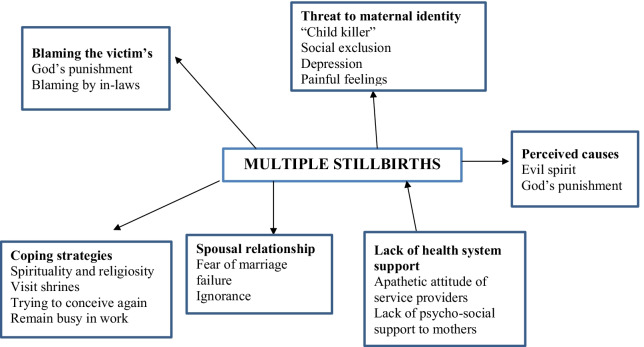
The results of this study show that experiencing multiple stillbirths has a devastating impact on women's mental and social wellbeing. The women who experienced multiple stillbirths are stigmatized as "child-killer" or cursed or being punished by God. They are avoided in social gatherings within the families and community, because of these social pressures these women seek spiritual and religious treatment, and struggle to conceive again to deliver a live baby. It was observed that the psycho-social and medical needs of these bereaved women remain unaddressed not only by the healthcare system but also by the society at large.
The physical, social and mental well-being of women who experience multiple stillbirth are at stake. These women are being considered social outcast. Health care providers including physicians, lady health workers, and traditional birth attendants should be trained on provision of psychosocial support along with the routine care that they provide in communities and health facilities. The health care providers should also inform the bereaved women about the biomedical causes of stillbirths that would be helpful to mitigate the stigma associated with stillbirths. Moreover, the health care providers should also counsel family members especially in-laws of these sorrowful women about the biomedical causes of stillbirths that would also be helpful to mitigate the stigma associated with stillbirths.
与其他南亚国家相比,巴基斯坦的死产率(每 1000 例总分娩中有 30.6 例死产)最高。死产对失去孩子的妇女的心理影响已有大量记录;然而,在巴基斯坦,关于经历多次死产的妇女的生活经历的文献却很少。
本研究旨在了解在巴基斯坦萨塔地区经历多次死产的妇女的生活经历。
在萨塔地区进行了解释性现象学研究,研究对象为 8 名经历过一次以上死产的妇女。使用半结构化深入访谈指南收集数据。使用主题分析方法对数据进行分析。
这项研究的结果表明,经历多次死产对妇女的身心健康产生了毁灭性的影响。经历多次死产的妇女被污名化为“杀婴者”或被诅咒或受到上帝的惩罚。由于这些社会压力,她们在家庭和社区的社交聚会上被回避,这些妇女寻求精神和宗教治疗,并努力再次怀孕以生下一个活婴。研究还观察到,不仅医疗保健系统,而且整个社会都没有满足这些失去孩子的妇女的心理社会和医疗需求。
经历多次死产的妇女的身心健康受到威胁。这些妇女被视为社会弃儿。医疗保健提供者,包括医生、妇女健康工作者和传统助产士,应接受提供心理社会支持以及他们在社区和卫生设施中提供的常规护理方面的培训。医疗保健提供者还应向失去孩子的妇女通报死产的生物医学原因,这将有助于减轻与死产相关的耻辱感。此外,医疗保健提供者还应向这些悲伤妇女的家属,特别是姻亲,提供有关死产的生物医学原因的咨询,这也有助于减轻与死产相关的耻辱感。