Department of Community Health Sciences, Aga Khan University, Karachi, Pakistan.
RTI International, Durham, NC, USA.
Reprod Health. 2018 Jun 22;15(Suppl 1):100. doi: 10.1186/s12978-018-0526-3.
Stillbirth rates remain high, especially in low and middle-income countries, where rates are 25 per 1000, ten-fold higher than in high-income countries. The United Nations' Every Newborn Action Plan has set a goal of 12 stillbirths per 1000 births by 2030 for all countries.
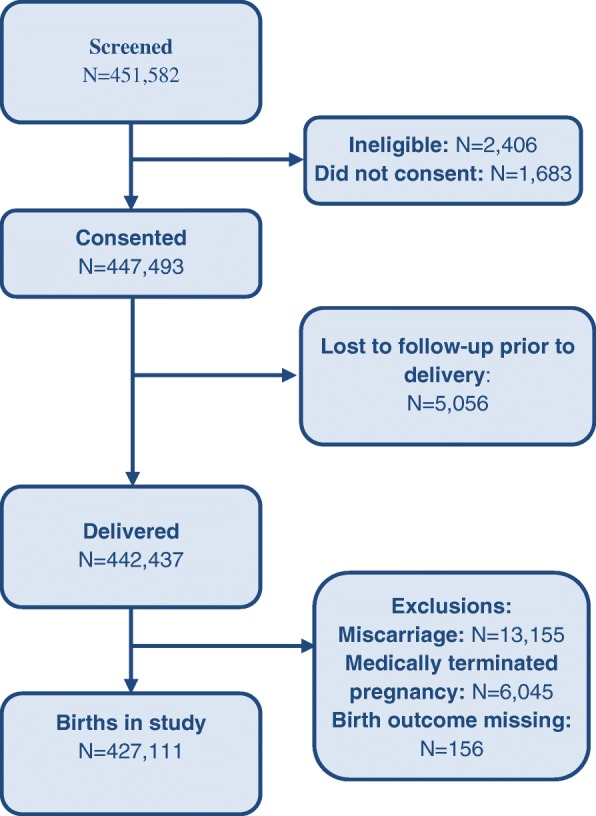
From a population-based pregnancy outcome registry, including data from 2010 to 2016 from two sites each in Africa (Zambia and Kenya) and India (Nagpur and Belagavi), as well as sites in Pakistan and Guatemala, we evaluated the stillbirth rates and rates of annual decline as well as risk factors for 427,111 births of which 12,181 were stillbirths.
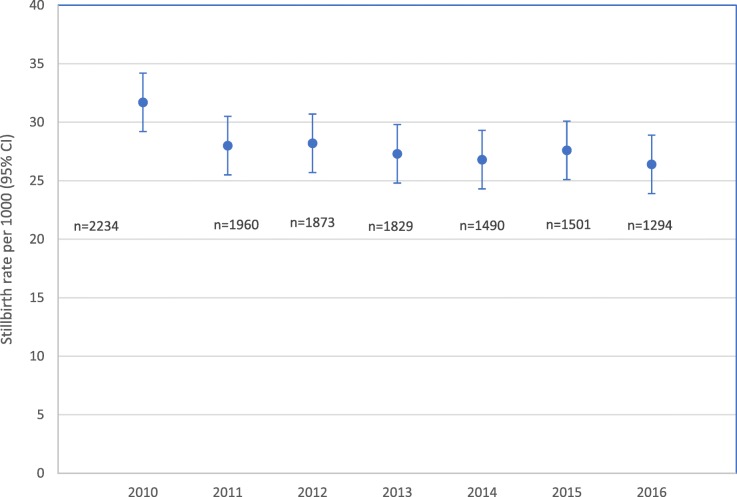
The mean stillbirth rates for the sites were 21.3 per 1000 births for Africa, 25.3 per 1000 births for India, 56.9 per 1000 births for Pakistan and 19.9 per 1000 births for Guatemala. From 2010 to 2016, across all sites, the mean stillbirth rate declined from 31.7 per 1000 births to 26.4 per 1000 births for an average annual decline of 3.0%. Risk factors for stillbirth were similar across the sites and included maternal age < 20 years and age > 35 years. Compared to parity 1-2, zero parity and parity > 3 were both associated with increased stillbirth risk and compared to women with any prenatal care, women with no prenatal care had significantly increased risk of stillbirth in all sites.
At the current rates of decline, stillbirth rates in these sites will not reach the Every Newborn Action Plan goal of 12 per 1000 births by 2030. More attention to the risk factors and treating the causes of stillbirths will be required to reach the Every Newborn Action Plan goal of stillbirth reduction.
NCT01073475 .
死胎率仍然很高,尤其是在中低收入国家,其比率为每 1000 例 25 例,是高收入国家的 10 倍。联合国“每个新生儿行动计划”设定了到 2030 年所有国家每 1000 例活产中死胎数为 12 例的目标。
从一个基于人群的妊娠结局登记处,包括来自非洲(赞比亚和肯尼亚)和印度(那格浦尔和贝尔高姆)的每个地点 2010 年至 2016 年的数据,以及来自巴基斯坦和危地马拉的地点,我们评估了 427111 例活产中的死胎率和年下降率以及危险因素,其中 12181 例为死胎。
非洲各地点的平均死胎率为每 1000 例 21.3 例,印度为每 1000 例 25.3 例,巴基斯坦为每 1000 例 56.9 例,危地马拉为每 1000 例 19.9 例。2010 年至 2016 年,所有地点的平均死胎率从每 1000 例 31.7 例下降到每 1000 例 26.4 例,平均年下降 3.0%。死胎的危险因素在各地点相似,包括母亲年龄<20 岁和年龄>35 岁。与产次 1-2 相比,零产次和产次>3 与死胎风险增加相关,与任何产前护理的妇女相比,没有产前护理的妇女在所有地点的死胎风险均显著增加。
按照目前的下降速度,这些地点的死胎率到 2030 年不会达到“每个新生儿行动计划”每 1000 例 12 例的目标。要实现“每个新生儿行动计划”减少死胎的目标,需要更加关注危险因素并治疗死胎的原因。
NCT01073475 。