Chadha-Day Francesca, Ellis John, Marsh David J E
Institute for Particle Physics Phenomenology, Department of Physics, Durham University, Durham DH1 3LE, UK.
Theoretical Physics and Cosmology Group, Department of Physics, Kings College London, Strand, London WC2R 2LS, UK.
Sci Adv. 2022 Feb 25;8(8):eabj3618. doi: 10.1126/sciadv.abj3618. Epub 2022 Feb 23.
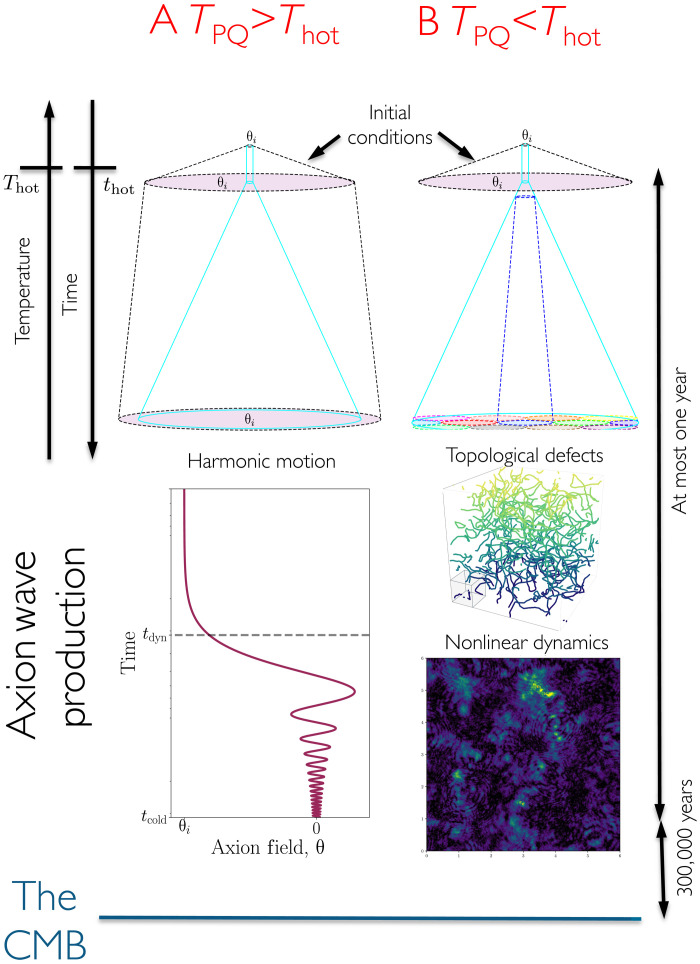
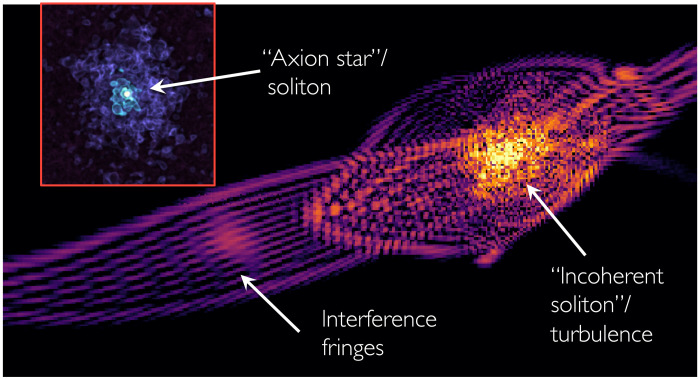
The axion has emerged in recent years as a leading particle candidate to provide the mysterious dark matter in the cosmos, as we review here for a general scientific audience. We describe first the historical roots of the axion in the Standard Model of particle physics and the problem of charge-parity invariance of the strong nuclear force. We then discuss how the axion emerges as a dark matter candidate and how it is produced in the early universe. The symmetry properties of the axion dictate the form of its interactions with ordinary matter. Astrophysical considerations restrict the particle mass and interaction strengths to a limited range, which facilitates the planning of experiments to detect the axion. A companion review discusses the exciting prospect that the axion could be detected in the near term in the laboratory.
近年来,轴子已成为一种主要的粒子候选者,用以提供宇宙中神秘的暗物质,我们在此为广大普通科学受众进行综述。我们首先描述轴子在粒子物理学标准模型中的历史根源以及强核力的电荷宇称不变性问题。然后我们讨论轴子如何作为暗物质候选者出现以及它在早期宇宙中是如何产生的。轴子的对称性质决定了它与普通物质相互作用的形式。天体物理学方面的考虑将粒子质量和相互作用强度限制在一个有限的范围内,这有助于规划探测轴子的实验。另一篇相关综述讨论了轴子近期有望在实验室中被探测到这一令人兴奋的前景。