Department of Nephrology, Sun Yat-sen Memorial Hospital, Sun Yat-sen University, No.107 Yanjiang West Road, Yuexiu District, Guangzhou, Guangdong, People's Republic of China.
Clinical Trials Unit, The First Affiliated Hospital, Sun Yat-sen University, No.58 Zhongshan 2nd Road, Yuexiu District, Guangzhou, Guangdong, People's Republic of China.
BMC Nephrol. 2022 Feb 23;23(1):78. doi: 10.1186/s12882-021-02632-3.
The association between homocysteine (Hcy) and IgA nephropathy (IgAN) is not well understood. We aimed to investigate the relationship between Hcy and clinicopathologic features in IgAN patients.
A total of 337 IgAN patients and 150 sex- and age- matched healthy controls were enrolled in this single-center retrospective study. According to Hcy ≤ 10 μmol/L or > 10 μmol/L, patients were divided into low and high Hcy groups. Multivariate logistic regression was performed to explore the risk factors for elevated Hcy.
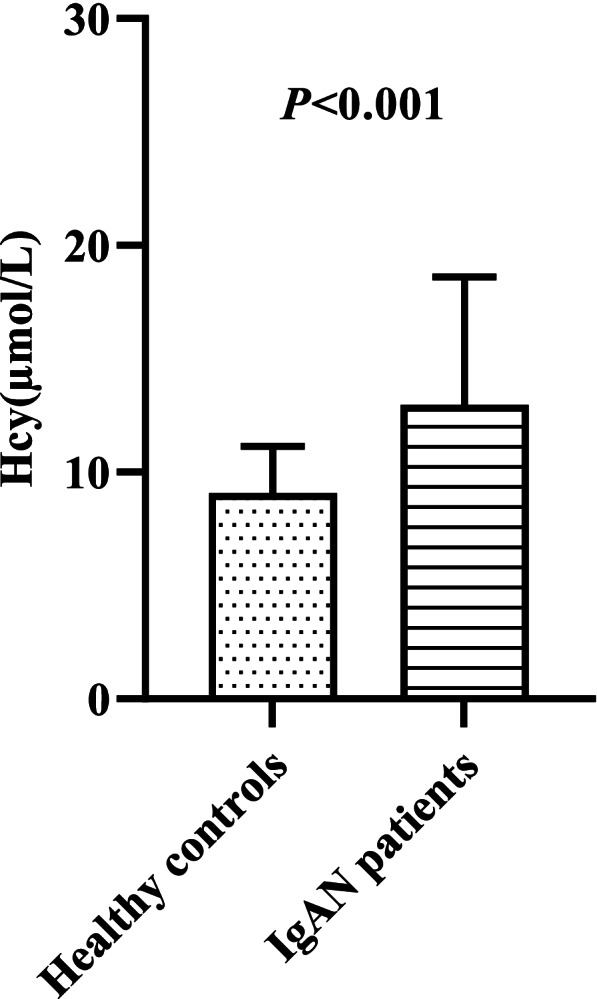
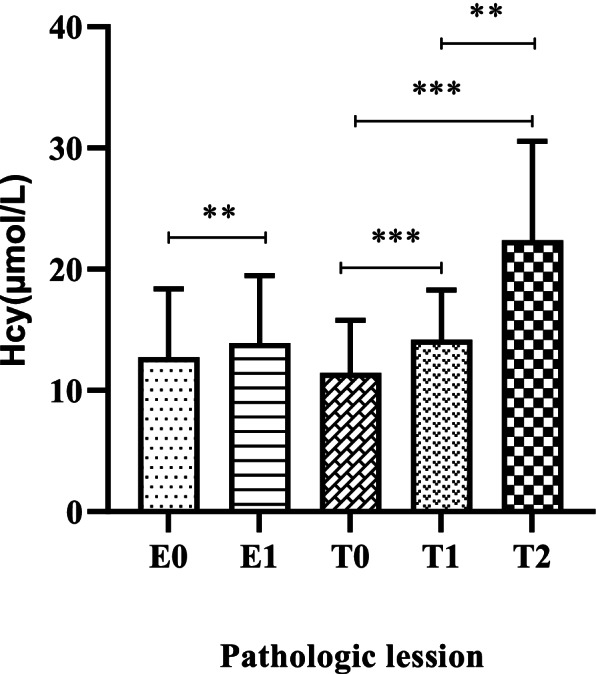
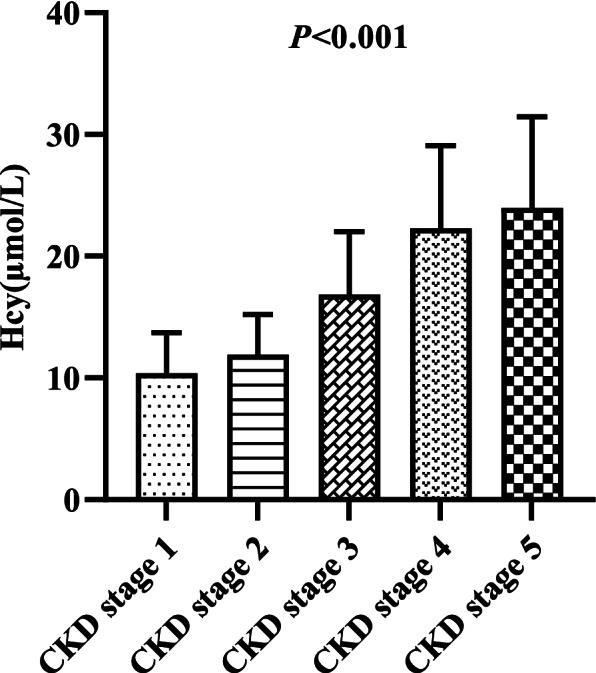
Serum Hcy was higher in IgAN patients than in healthy controls [11.6 (9.1,15.3) vs. 8.8 (7.5,10.6) μmol/L, P < 0.001], unanimously in the subgroup of 156 patients with a normal estimated glomerular filtration rate (eGFR) (≥ 90 ml/min/1.73 m) [9.9 (7.6,12.4) vs. 8.8 (7.5,10.6) μmol/L, P < 0.001]. Compared to the low Hcy group, serum creatinine (Scr), blood urine nitrogen (BUN), uric acid (UA), endocapillary hypercellularity (E) and tubular atrophy/interstitial fibrosis lesion (T) were higher in the high Hcy group. Hcy levels were positively correlated with Scr, BUN, UA, 24-h urine protein, and E and T lesions, but negatively correlated with eGFR and superoxide dismutase (SOD). In the subgroup with normal eGFR, patients with higher Hcy were persistent with higher Scr, BUN and T lesions. A multivariate logistic regression model showed that the risk of elevated Hcy in patients with pathological T increased by 2.87-fold. T lesions could better predict high Hcy, with an odds ratio (OR) of 14.20 in the subgroup with normal eGFR.
Pathologic T was an independent risk factor associated with elevated Hcy, especially at the early stage of IgAN.
同型半胱氨酸(Hcy)与 IgA 肾病(IgAN)之间的关系尚不清楚。本研究旨在探讨 IgAN 患者中 Hcy 与临床病理特征之间的关系。
本研究为单中心回顾性研究,共纳入 337 例 IgAN 患者和 150 名性别和年龄匹配的健康对照者。根据 Hcy≤10μmol/L 或>10μmol/L,将患者分为低 Hcy 组和高 Hcy 组。采用多变量 logistic 回归分析探讨 Hcy 升高的危险因素。
与健康对照组相比,IgAN 患者血清 Hcy 水平升高[11.6(9.1,15.3)比 8.8(7.5,10.6)μmol/L,P<0.001],在 156 例估计肾小球滤过率(eGFR)正常(≥90ml/min/1.73m)的患者亚组中亦如此[9.9(7.6,12.4)比 8.8(7.5,10.6)μmol/L,P<0.001]。与低 Hcy 组相比,高 Hcy 组血清肌酐(Scr)、血尿素氮(BUN)、尿酸(UA)、内皮下细胞增生(E)和肾小管萎缩/间质纤维化病变(T)更高。Hcy 水平与 Scr、BUN、UA、24 小时尿蛋白和 E、T 病变呈正相关,与 eGFR 和超氧化物歧化酶(SOD)呈负相关。在 eGFR 正常的亚组中,Hcy 较高的患者持续存在 Scr 升高、BUN 和 T 病变。多变量 logistic 回归模型显示,病理 T 患者 Hcy 升高的风险增加 2.87 倍。在 eGFR 正常的亚组中,T 病变预测 Hcy 升高的优势比(OR)为 14.20。
病理 T 是与 Hcy 升高相关的独立危险因素,尤其是在 IgAN 的早期阶段。