Palgamkar Jyotshna B, Jindal Deepika K, Sawkar Sujatha V, Deshmukh Sangeeta D, Katakdhond Mamta S, Ishwar Chitrarekha P, Athalye Arundhati S, Shah Nilesh J, Parikh Firuza R
Department of Assisted Reproduction and Genetics, Jaslok - FertilTree International Centre, Jaslok Hospital and Research Center, Mumbai, Maharashtra, India.
Department of Medical and Scientific affairs, Roche Diagnostics India Pvt. Ltd., Mumbai, Maharashtra, India.
J Hum Reprod Sci. 2021 Oct-Dec;14(4):380-385. doi: 10.4103/jhrs.jhrs_71_21. Epub 2021 Dec 31.
Antimullerian hormone (AMH) is a key marker of ovarian reserve and predictor of response to fertility treatment.
To understand the prevalence of low ovarian reserve in Indian women seeking infertility treatment, compare their AMH with age-matched fertile Indian controls and understand ethnic differences with Caucasian women.
Retrospective observational study done as collaboration between our fertilization centre and a laboratory with Pan-India presence.
Women aged 20-44 years were selected as Group A (seeking infertility treatment = 54,473), Group B (conceived naturally in the past; = 283) and Group C (data of Caucasian women; = 718). Serum AMH levels were measured and descriptive analysis done.
Descriptive statistics and Chi-square test.
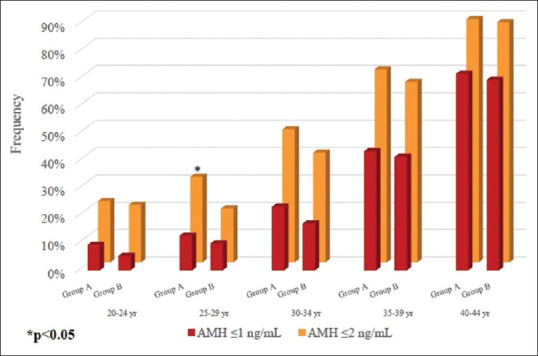
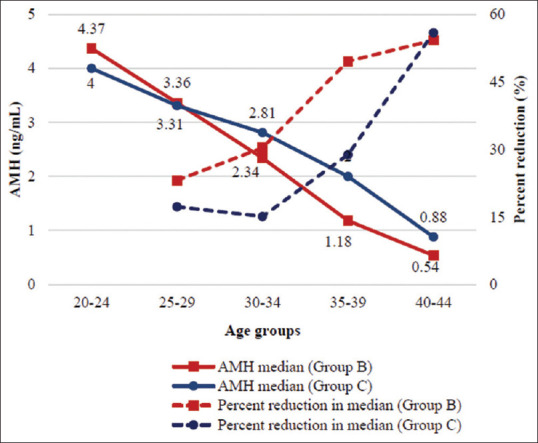
In Group A, 28.7%, 48.7% and 70.6% of women aged <30 years, 30-34 years and 35-39 years had serum AMH levels ≤2 ng/mL and the proportions were higher than Group B. The rate at which median AMH decreased was 1.1-2 times faster in Group B as compared to Group C. The decrease in median AMH across age groups in Group A was similar to Group B.
Indian women in their late twenties and early thirties visiting fertility centers showed a worrisome trend of low AMH. Our study can be used as a reference for those women considering postponing pregnancy. It may be time to look at intangible cultural factors linked to social habits, ethnicity, diet, genetic predispositions, and environmental factors like endocrine disrupting chemicals contributing to premature ovarian senescence.
抗苗勒管激素(AMH)是卵巢储备的关键标志物以及生育治疗反应的预测指标。
了解寻求不孕治疗的印度女性中卵巢储备低下的患病率,将她们的AMH与年龄匹配的有生育能力的印度对照者进行比较,并了解与白种女性的种族差异。
这是一项回顾性观察研究,由我们的受精中心与一家在全印度设有机构的实验室合作开展。
选取年龄在20 - 44岁的女性作为A组(寻求不孕治疗者 = 54473例)、B组(过去自然受孕者 = 283例)和C组(白种女性数据 = 718例)。检测血清AMH水平并进行描述性分析。
描述性统计和卡方检验。
在A组中,年龄<30岁、30 - 34岁和35 - 39岁的女性中,分别有28.7%、48.7%和70.6%的血清AMH水平≤2 ng/mL,这些比例高于B组。与C组相比,B组中AMH中位数下降的速度快1.1 - 2倍。A组各年龄组AMH中位数的下降情况与B组相似。
前往生育中心就诊的二十多岁末和三十出头的印度女性显示出AMH水平低这一令人担忧的趋势。我们的研究可为那些考虑推迟怀孕的女性提供参考。或许是时候审视与社会习惯、种族、饮食、遗传易感性以及环境因素(如导致卵巢早衰的内分泌干扰化学物质)相关的无形文化因素了。