Lu Yi-Fan, Li Ding-Xiang, Zhang Ran, Zhao Lin-Lin, Qiu Zhen, Du Yan, Ji Shuai, Tang Dao-Quan
The Second Clinical College, Xuzhou Medical University, Xuzhou, China.
Jiangsu Key Laboratory of New Drug Research and Clinical Pharmacy, Xuzhou Medical University, Xuzhou, China.
Front Pharmacol. 2022 Feb 7;13:809482. doi: 10.3389/fphar.2022.809482. eCollection 2022.
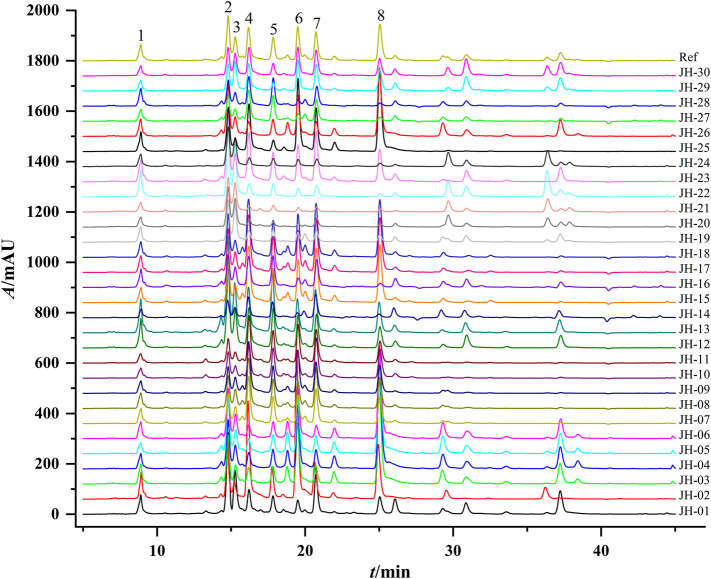
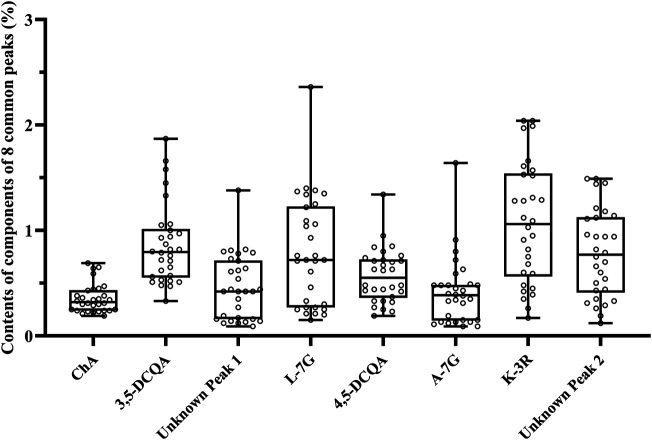
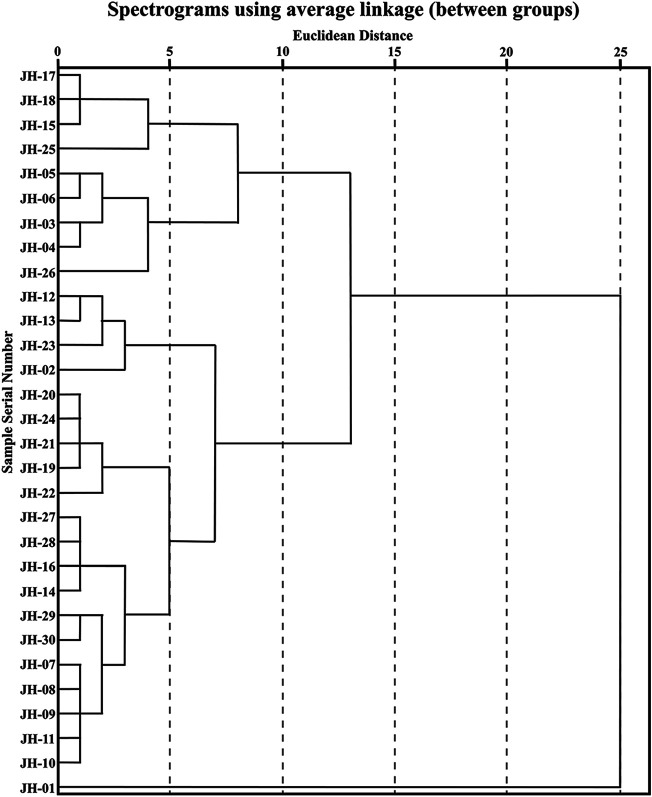
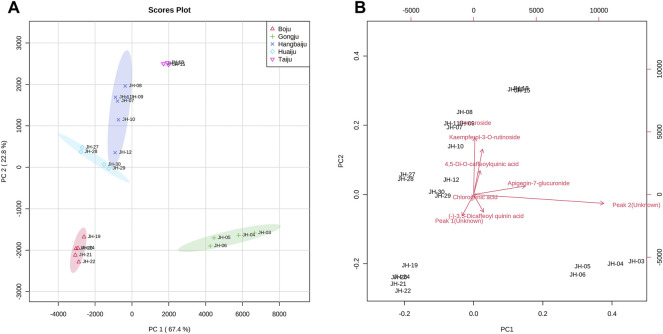
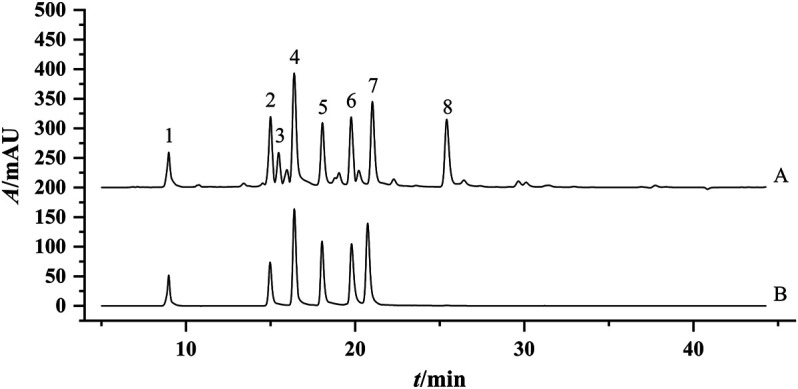
Traditionally, the quality evaluation of (CM) cv. (Juhua) attributes its habitats and processing methods, however, this strategy of neglecting bioactive ingredients usually results in deviation of quality evaluation. This study aims to explore the quality marker (Q-marker) based on spectrum-effect relationship and quality control strategy of CMs. The chromatographic fingerprint of 30 flower head samples of CMs from five different habitats including Hang-baiju, Gongju, Huaiju, Taiju and Boju were constructed by high performance liquid chromatography and analyzed through chemometrics methods such as similarity analysis (SA), cluster analysis (CA) and principal component analysis (PCA). The common peaks were quantified by external standard method and relative correction factor method. The radical scavenging capacity assays of DPPH·, ·OH and ABTS were carried out. The Q-marker was explored by the correlation analysis between the contents of common peaks and radical scavenging capacity, and then used to evaluate the quality of 30 flower head samples of CMs. A total of eight common peaks were appointed in 30 flower head samples of CMs, and their similarities ranged from 0.640 to 0.956. CA results showed that 30 flower head samples of CMs could be divided into five categories with reference to the Euclidean distance of 5. PCA results showed that common peaks played a major role in differential contribution of CMs. The quantification of common peaks hinted that their contents possessed significant variation whether for different accessions or the same accessions of CMs. The correlation analysis showed that chlorogenic acid, 3,5--dicaffeoylquinic acid, unknown peak 1, 4,5--dicaffeoylquinic acid and kaempferol-3--rutinoside could be used as the Q-markers for the quality evaluation of 30 flower head samples of commercially available CMs. The analysis strategy that combines chromatographic fingerprint analysis, multiple ingredients quantification, chemical anti-oxidant activity evaluation and spectrum-effect relationship analysis clarified the therapeutic material basis and discovered the Q-markers, which possibly offers a more comprehensive quality assessment of CMs.
传统上,(杭白菊)品种的(菊花)质量评价归因于其产地和加工方法,然而,这种忽视生物活性成分的策略通常会导致质量评价出现偏差。本研究旨在基于光谱效应关系探索(菊花)的质量标志物(Q-标志物)及其质量控制策略。采用高效液相色谱法构建了包括杭白菊、贡菊、怀菊、滁菊和亳菊在内的五个不同产地的30份(菊花)头状花序样品的色谱指纹图谱,并通过相似度分析(SA)、聚类分析(CA)和主成分分析(PCA)等化学计量学方法进行分析。采用外标法和相对校正因子法对共有峰进行定量。进行了DPPH·、·OH和ABTS的自由基清除能力测定。通过共有峰含量与自由基清除能力的相关性分析探索Q-标志物,进而用于评价30份(菊花)头状花序样品的质量。在30份(菊花)头状花序样品中共指定了8个共有峰,其相似度范围为0.640至0.956。聚类分析结果表明,以5的欧氏距离为参考,30份(菊花)头状花序样品可分为五类。主成分分析结果表明,共有峰在(菊花)的差异贡献中起主要作用。共有峰的定量分析表明,无论对于不同种质还是相同种质的(菊花),其含量均存在显著差异。相关性分析表明,绿原酸、3,5-二咖啡酰奎宁酸、未知峰1、4,5-二咖啡酰奎宁酸和山柰酚-3-芸香糖苷可作为市售(菊花)30份头状花序样品质量评价的Q-标志物。结合色谱指纹图谱分析、多成分定量、化学抗氧化活性评价和光谱效应关系分析的分析策略阐明了治疗物质基础并发现了Q-标志物,这可能为(菊花)提供更全面的质量评估。