Hossain Mohammad Anwar, Hossain K M Amran, Sakel Mohamed, Kabir Md Feroz, Saunders Karen, Faruqui Rafey, Hossain Mohammad Sohrab, Uddin Zakir, Kader Manzur, Walton Lori Maria, Haque Md Obaidul, Shafin Rubayet, Chakrovorty Sonjit Kumar, Jahid Iqbal Kabir
Department of Physiotherapy, Centre for the Rehabilitation of the Paralysed (CRP), Dhaka, Bangladesh.
Department of Microbiology, Jashore University of Science and Technology (JUST), Jashore, Bangladesh.
Front Neurol. 2022 Feb 7;12:739354. doi: 10.3389/fneur.2021.739354. eCollection 2021.
The aim of this research is to focus on gaining an insight into the knowledge, attitudes, behavioural practises (KAP), and psychological impact relating to COVID-19 among the people living with spinal cord injury receiving in-patient rehabilitation.
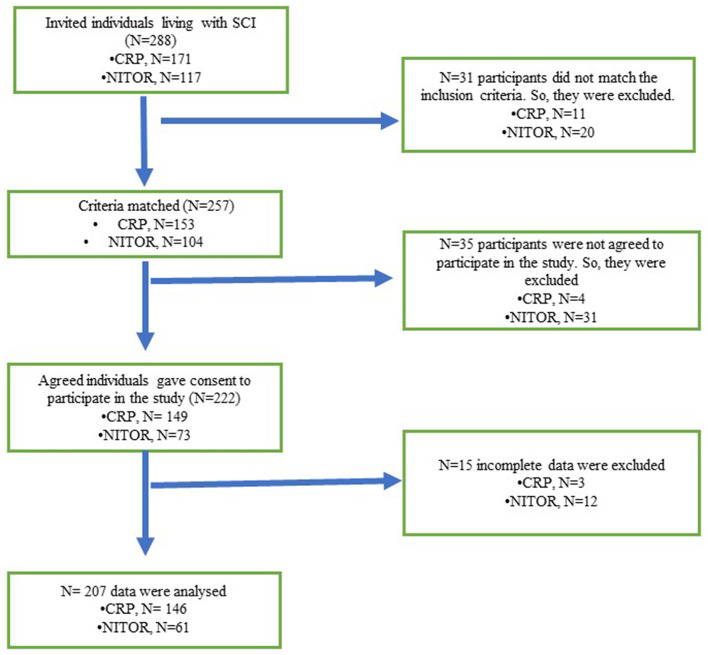
A prospective, cross-sectional survey of people with SCI ( = 207), who were in active in-patient rehabilitation from two tertiary SCI Rehabilitation Centres in Bangladesh. Data were collected via face-to-face interviews, after voluntary consent, using a pretested, language validated questionnaire on Knowledge, Attitude and Behavioural practises (KAP) and the Depression, Anxiety, Stress Scale (DASS-21). Ethical approval and trial registration were obtained prospectively.
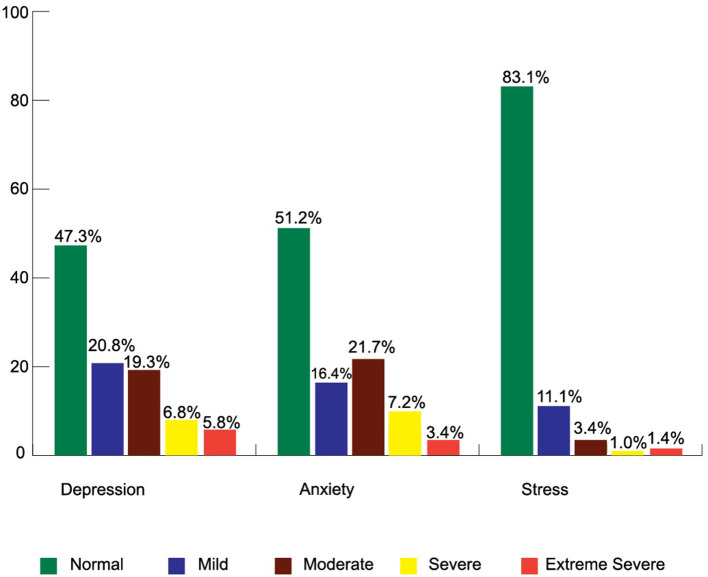
A total of 207 people with SCI responded, among which 87% were men and 13% were women, with a mean age of 34.18 ± 12.9 years. Within the sample group, people living with tetraplegia comprised 33.8%, and people living with paraplegia comprised 66.2%. Overall, 63.8% of the participants were diagnosed with an SCI categorised as ASIA-A. Overall, the "knowledge score" was 8.59 ± 2.3 out of 12, "depression" was 11.18 ± 8, "anxiety" was 7.72 ± 5.1, and "stress" was 9.32 ± 6.7 from a total of 21 scores each category. The strong correlation was between knowledge, DASS scores, and age ( < 0.05). In addition, there was a strong correlation between knowledge, gender ( < 0.05) and education ( < 0.01). Binary logistic regression found a stronger association of knowledge and DASS scores with gender, young age, illiteracy ( < 0.01), and rural residence ( < 0.05). A positive relationship was found between depression and anxiety scores ( < 0.01) and a moderate positive relationship was found between depression and stress scores ( < 0.01). A positive attitude was reported by the majority of participants ( < 0.05). In terms of behavioural practises, participants reported both self and caregiver had followed health advice with regard to consulting health professionals (65.7%), implementing isolation (63.8%), taking droplet precaution care (87.4%), and hygiene care (90.3%).
Participants in this study reported high levels of knowledge, adoption of positive attitudes, and the practise of positive health advisory behaviours related to COVID-19 prevention procedures. However, high levels of depression, anxiety, and stress were also reported. Overall, women and younger participants were more likely to have high KAP, whereas those living in rural areas and with literacy challenges were less likely to report high knowledge scores.
本研究旨在深入了解脊髓损伤患者在住院康复期间对新冠病毒病(COVID-19)的知识、态度、行为习惯(KAP)以及心理影响。
对来自孟加拉国两个三级脊髓损伤康复中心正在接受积极住院康复治疗的207名脊髓损伤患者进行前瞻性横断面调查。在获得自愿同意后,通过面对面访谈,使用经过预测试、语言验证的关于知识、态度和行为习惯(KAP)的问卷以及抑郁、焦虑、压力量表(DASS-21)收集数据。前瞻性地获得了伦理批准和试验注册。
共有207名脊髓损伤患者做出回应,其中87%为男性,13%为女性,平均年龄为34.18±12.9岁。在样本组中,四肢瘫痪患者占33.8%,截瘫患者占66.2%。总体而言,63.8%的参与者被诊断为亚洲脊髓损伤协会(ASIA)分级为A的脊髓损伤。总体而言,在满分12分的情况下,“知识得分”为8.59±2.3,“抑郁”得分为11.18±8,“焦虑”得分为7.72±5.1,“压力”得分为9.32±6.7,每个类别总分均为21分。知识、DASS得分与年龄之间存在强相关性(P<0.05)。此外,知识与性别(P<0.05)和教育程度(P<0.01)之间也存在强相关性。二元逻辑回归发现,知识和DASS得分与性别、年轻、文盲(P<0.01)以及农村居住情况(P<0.05)之间存在更强的关联。抑郁和焦虑得分之间存在正相关关系(P<0.01),抑郁和压力得分之间存在中度正相关关系(P<0.01)。大多数参与者报告了积极的态度(P<0.05)。在行为习惯方面,参与者报告自己和照顾者在咨询健康专业人员(65.7%)、实施隔离(63.8%)、采取飞沫预防措施(87.4%)和卫生护理(90.3%)方面都遵循了健康建议。
本研究中的参与者报告了与COVID-19预防程序相关的高水平知识、积极态度的采纳以及积极健康咨询行为的实践。然而,也报告了高水平的抑郁、焦虑和压力。总体而言,女性和年轻参与者更有可能具有较高的KAP,而农村地区的人和有识字困难的人报告高知识得分的可能性较小。