Meno Kgothatso, Yah Clarence, Mendes Adriano, Venter Marietjie
Zoonotic Arbo and Respiratory Virus Program, Department of Medical Virology, Centre for Viral Zoonoses, University of Pretoria, Pretoria, South Africa.
Front Microbiol. 2022 Feb 7;12:798810. doi: 10.3389/fmicb.2021.798810. eCollection 2021.
Sindbis virus (SINV) is a mosquito-borne alphavirus that is widely distributed worldwide. Little is known about the febrile and neurological disease burden due to SINV in South Africa.
Clinical samples of patients with acute febrile disease of unknown cause (AFDUC) were collected through the African Network for Improved Diagnostics, Epidemiology and Management of Common Infectious Agents at three sentinel hospital surveillance sites in South Africa. In total, 639 patients were screened using a PCR-based macroarray that can simultaneously detect nucleic acids of 30 pathogens, including SINV, from January 2019 to December 2020. Serum samples were randomly selected from the arbovirus season (January-June) and also screened with a commercial indirect immunofluorescence assay for anti-SINV IgM. In addition, 31 paired cerebrospinal fluid (CSF) specimens from the same patients were screened for IgM. Micro-neutralization assays were performed on all IgM-positive samples.
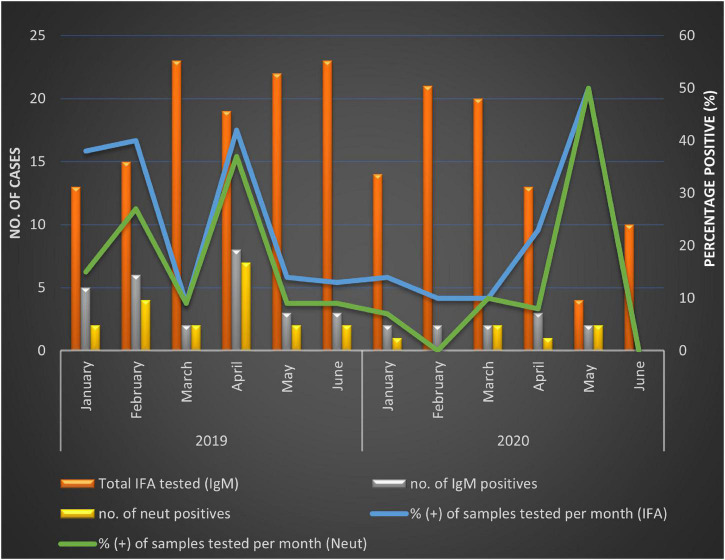
None of the specimens tested positive for SINV by molecular screening; however, 38/197 (19.0%) samples were positive for SINV-specific IgM. A total of 25/38 (65.8%) IgM-positive samples tested positive for SINV-neutralizing antibodies, giving an overall incidence of 12.7%. Furthermore, 2/31 (6.5%) CSF specimens tested positive for IgM but were negative for neutralizing antibodies. There was a higher incidence of SINV-positive cases in Mpumalanga (26.0%) than Gauteng province (15.0%). The most significant months for IgM-positive cases were April 2019 (OR = 2.9, < 0.05), and May 2020 (OR = 7.7, < 0.05).
SINV or a closely related virus contributed to 12.7% of AFDUC cases in hospitalized patients during the late summer and autumn months in South Africa and was significantly associated with arthralgia, meningitis, and headaches.
辛德毕斯病毒(SINV)是一种由蚊子传播的甲病毒,在全球广泛分布。关于南非因辛德毕斯病毒导致的发热和神经疾病负担,人们了解甚少。
通过非洲改善常见传染病诊断、流行病学及管理网络,在南非三个定点医院监测点收集病因不明的急性发热疾病(AFDUC)患者的临床样本。2019年1月至2020年12月期间,共对639名患者使用基于PCR的宏阵列进行筛查,该宏阵列可同时检测包括辛德毕斯病毒在内的30种病原体的核酸。血清样本从虫媒病毒流行季节(1月至6月)随机选取,并使用商业间接免疫荧光法检测抗辛德毕斯病毒IgM。此外,对同一患者的31对脑脊液(CSF)标本进行IgM筛查。对所有IgM阳性样本进行微量中和试验。
通过分子筛查,所有标本均未检测出辛德毕斯病毒呈阳性;然而,197份样本中有38份(19.0%)辛德毕斯病毒特异性IgM呈阳性。38份IgM阳性样本中共有25份(65.8%)辛德毕斯病毒中和抗体检测呈阳性,总体发病率为12.7%。此外,31份脑脊液标本中有2份(6.5%)IgM检测呈阳性,但中和抗体检测呈阴性。姆普马兰加省(26.0%)辛德毕斯病毒阳性病例的发病率高于豪登省(15.0%)。IgM阳性病例最显著的月份是2019年4月(OR = 2.9,P < 0.05)和2020年5月(OR = 7.7,P < 0.05)。
在南非夏末和秋季,辛德毕斯病毒或一种密切相关的病毒导致住院患者中12.7%的病因不明急性发热疾病病例,且与关节痛、脑膜炎和头痛显著相关。