Division of Molecular Internal Medicine, Department of Internal Medicine II, University Hospital Würzburg, Würzburg, Germany.
Department of Hematology, University of Groningen, University Medical Center Groningen, Groningen, The Netherlands.
Theranostics. 2022 Jan 1;12(4):1486-1499. doi: 10.7150/thno.66119. eCollection 2022.
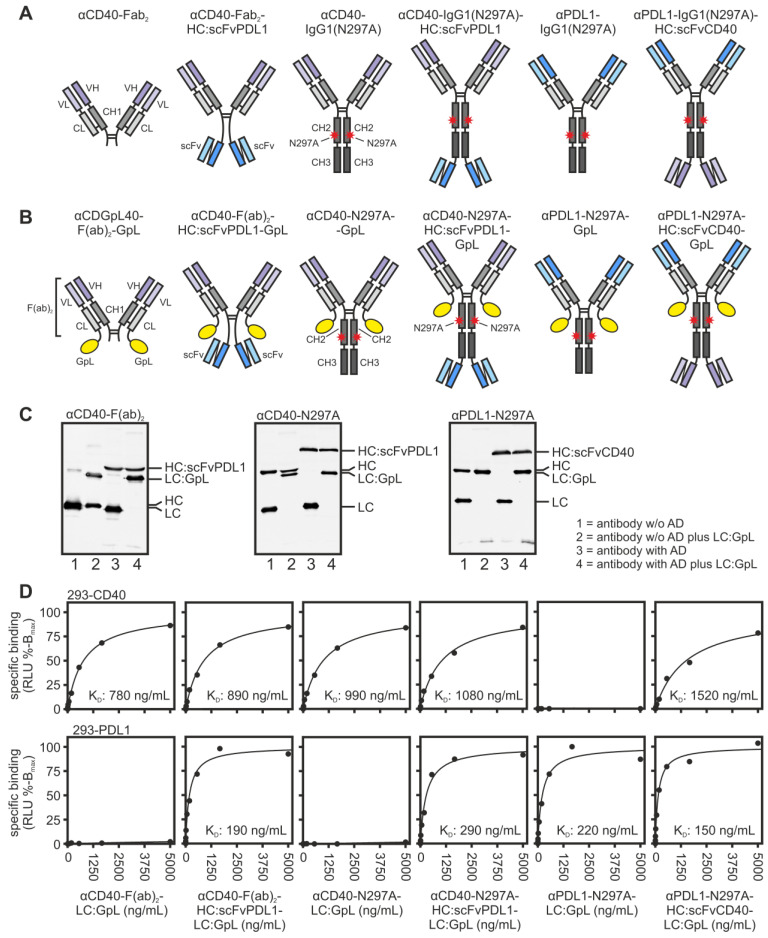
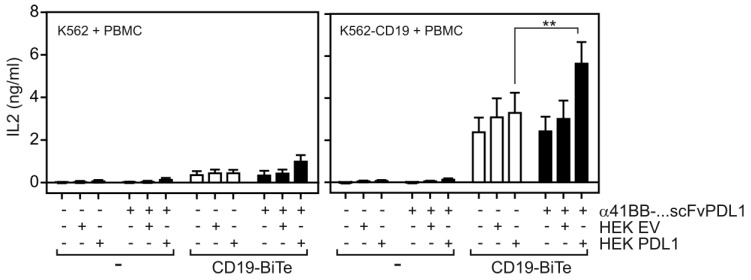
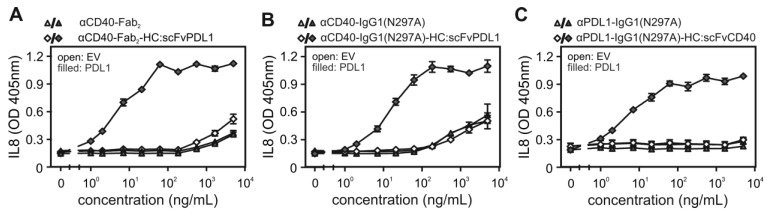
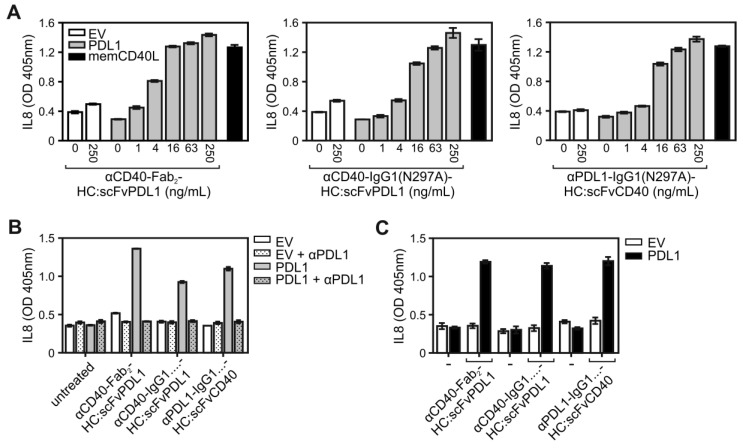
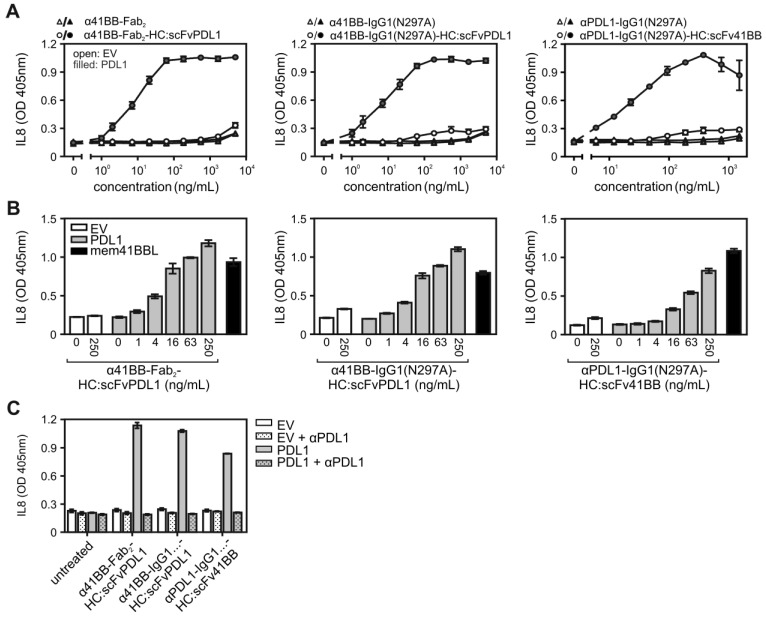
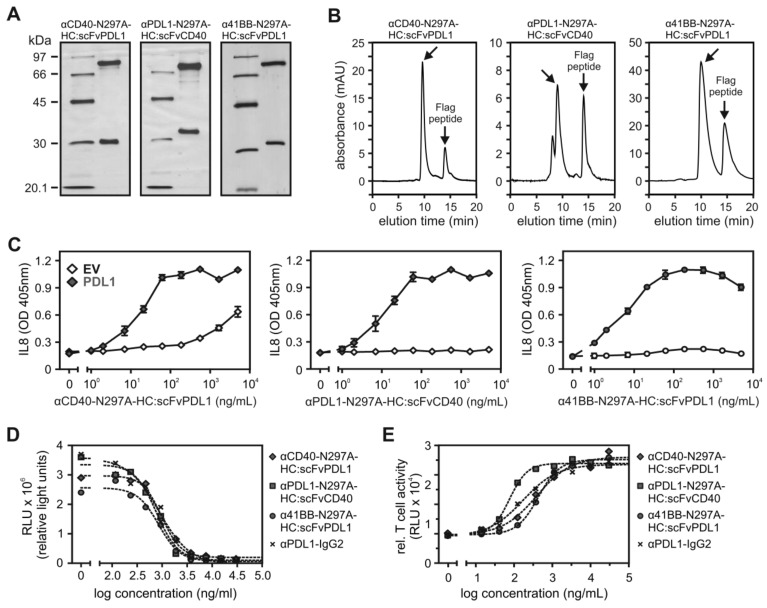
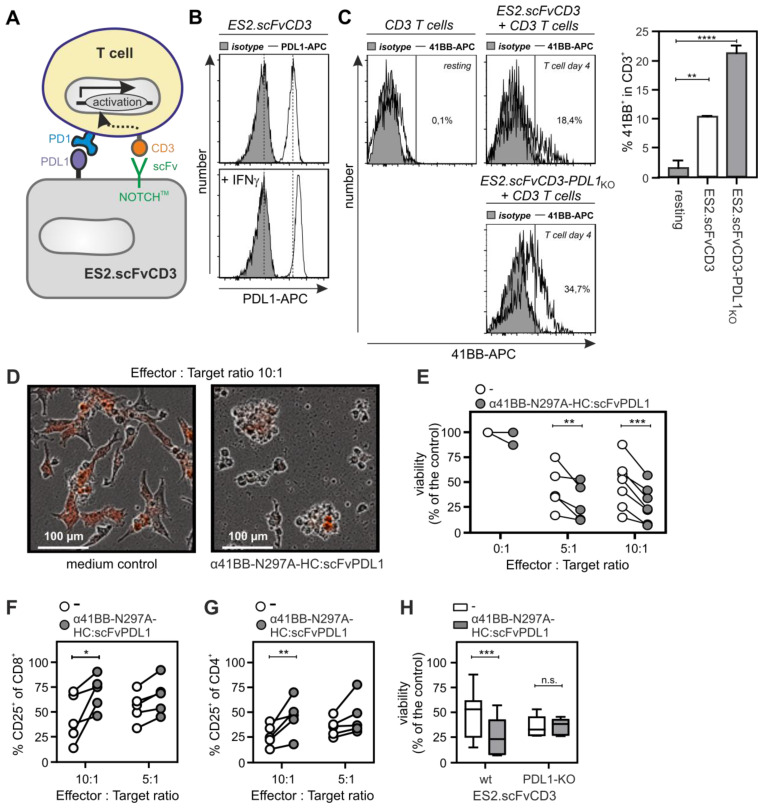
A strategy to broaden the applicability of checkpoint inhibitors is the combined use with antibodies targeting the immune stimulatory receptors CD40 and 41BB. However, the use of anti-CD40 and anti-41BB antibodies as agonists is problematic in two ways. First, anti-CD40 and anti-41BB antibodies need plasma membrane-associated presentation by FcγR binding to exert robust agonism but this obviously limits their immune stimulatory efficacy by triggering ADCC, CDC or anti-inflammatory FcγRIIb activities. Second, off tumor activation of CD40 and 41BB may cause dose limiting systemic inflammation. To overcome the FcγR-dependency of anti-41BB and anti-CD40 antibodies, we genetically fused such antibodies with a PDL1-specific blocking scFv as anchoring domain to enable FcγR-independent plasma membrane-associated presentation of anti-CD40- and anti-41BB antibodies. By help of GpL-tagged variants of the resulting bispecific antibodies, binding to their molecular targets was evaluated by help of cellular binding studies. Membrane PDL1-restricted engagement of CD40 and 41BB but also inhibition of PDL1-induced PD1 activation were evaluated in coculture assays with PDL1-expressing tumor cell lines and 41BB, CD40 and PD1 responsible cell lines or T-cells. The binding properties of the bispecific antibody fusion proteins remained largely unchanged compared to their parental molecules. Upon anchoring to membrane PDL1, the bispecific antibody fusion proteins activated CD40/41BB signaling as efficient as the parental anti-CD40/anti-41BB antibodies when bound to FcγRs or cells expressing membrane-bound CD40L/41BBL. PD1 inhibition remained intact and the anti-41BB fusion protein thus showed PDL1-restricted costimulation of T-cells activated in vitro with anti-CD3 or a BiTe. Targeting of anti-CD40 and anti-41BB fusion proteins to membrane PDL1 with a blocking PDL1 scFv links PD1-PDL1 checkpoint blockade intrinsically with engagement of CD40 or 41BB.
拓宽检查点抑制剂适用性的一种策略是与靶向免疫刺激受体 CD40 和 41BB 的抗体联合使用。然而,以激动剂的形式使用抗 CD40 和抗 41BB 抗体存在两个问题。首先,抗 CD40 和抗 41BB 抗体需要通过 FcγR 结合来实现细胞膜相关表达,以发挥强大的激动作用,但这显然会通过触发 ADCC、CDC 或抗炎性 FcγRIIb 活性来限制其免疫刺激功效。其次,肿瘤外激活 CD40 和 41BB 可能会导致剂量限制的全身炎症。为了克服抗 41BB 和抗 CD40 抗体对 FcγR 的依赖性,我们将这些抗体与 PD-L1 特异性阻断 scFv 基因融合,作为锚定结构域,以实现抗 CD40 和抗 41BB 抗体的 FcγR 非依赖性细胞膜相关表达。借助 GpL 标记的双特异性抗体变体,通过细胞结合研究评估其对分子靶标的结合。通过与表达 PD-L1 的肿瘤细胞系以及负责表达 41BB、CD40 和 PD1 的细胞系或 T 细胞进行共培养实验,评估了 CD40 和 41BB 的膜 PD-L1 限制性结合以及对 PD-L1 诱导的 PD1 激活的抑制作用。与亲本分子相比,双特异性抗体融合蛋白的结合特性基本保持不变。当锚定到膜 PD-L1 上时,双特异性抗体融合蛋白在与 FcγR 结合或与表达膜结合型 CD40L/41BBL 的细胞结合时,激活 CD40/41BB 信号的效率与亲本抗 CD40/抗 41BB 抗体相当。PD1 抑制作用保持完整,因此,抗 41BB 融合蛋白在体外使用抗 CD3 或 BiTe 激活的 T 细胞中表现出膜 PD-L1 限制的共刺激作用。使用阻断 PD-L1 scFv 将抗 CD40 和抗 41BB 融合蛋白靶向到膜 PD-L1 上,将 PD1-PD-L1 检查点阻断与 CD40 或 41BB 的结合内在联系起来。