Losco Luigi, Sereni Simone, Aksoyler Dicle, Spadoni Davide, Bolletta Alberto, Cigna Emanuele
Plastic Surgery and Microsurgery Unit, Department of Translational Research and New Technologies in Medicine and Surgery, University of Pisa, Pisa, Italy.
Plastic Surgery Unit, Department of Medicine, Surgery and Dentistry, University of Salerno, Baronissi, Salerno, Italy.
Plast Reconstr Surg Glob Open. 2022 Feb 17;10(2):e4131. doi: 10.1097/GOX.0000000000004131. eCollection 2022 Feb.
Due to the wide spectrum of lower extremity defect presentation, various reconstructive techniques are available. Classic adipofascial flaps are still a second choice. The authors described a new multistage reconstructive approach with perforator-based pedicled adipofascial flap.
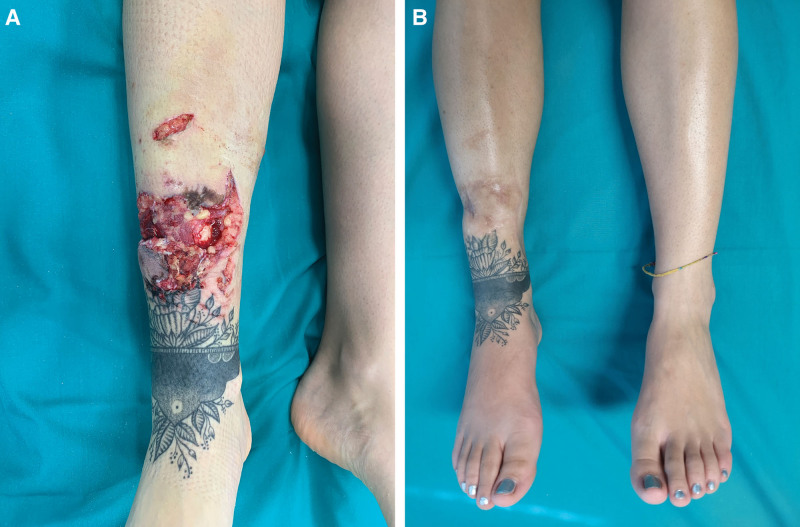
This retrospective study analyzed data of 23 patients undergoing adipofascial flap reconstruction after distal leg trauma between June 2017 and January 2020. A reconstructive approach with an adipofascial flap followed by a skin graft was used in all patients. Patients were divided into two treatment groups, and in only one treatment group, an acellular dermal matrix was placed above the adipofascial flap during the first stage of the reconstruction. Negative pressure wound therapy was applied to both groups. Surgical technique, outcomes, and complications were discussed.
All patients achieved complete healing, and no flap loss was reported. Minor complications occurred in four patients; all were treated conservatively on outpatient basis. The surgical and aesthetic results were evaluated as satisfactory from both patients and professionals. However, the group treated with acellular dermal matrix showed a lower complication rate, and resulted significantly more satisfied with the overall results and in several domains of the questionnaire administered postoperatively ( < 0.05).
The adipofascial flap is a safe and effective approach for the reconstruction of small-to-medium-sized defects of the distal lower extremity. Our two-stage reconstructive approach maximizes the pearls offered by the established technique; the dermal matrix guarantees a layered reconstruction optimizing the surgical and aesthetic outcomes of the skin graft with minimal donor site morbidity.
由于下肢缺损表现形式多样,有多种重建技术可供选择。经典的脂肪筋膜瓣仍是第二选择。作者描述了一种基于穿支蒂脂肪筋膜瓣的新型多阶段重建方法。
这项回顾性研究分析了2017年6月至2020年1月期间23例小腿远端创伤后接受脂肪筋膜瓣重建患者的数据。所有患者均采用脂肪筋膜瓣重建后植皮的方法。患者分为两个治疗组,仅在一个治疗组中,在重建的第一阶段将脱细胞真皮基质置于脂肪筋膜瓣上方。两组均应用负压伤口治疗。讨论了手术技术、结果和并发症。
所有患者均实现完全愈合,未报告皮瓣丢失。4例患者出现轻微并发症;均在门诊进行保守治疗。患者和专业人员对手术和美学效果的评价均为满意。然而,接受脱细胞真皮基质治疗的组并发症发生率较低,并且在术后问卷调查的总体结果和几个领域中满意度明显更高(<0.05)。
脂肪筋膜瓣是重建下肢远端中小面积缺损的一种安全有效的方法。我们的两阶段重建方法最大限度地发挥了现有技术的优势;真皮基质保证了分层重建,以最小的供区并发症优化了植皮的手术和美学效果。