Anderson Richard A, Cameron David, Clatot Florian, Demeestere Isabelle, Lambertini Matteo, Nelson Scott M, Peccatori Fedro
MRC Centre for Reproductive Health, University of Edinburgh, Edinburgh, UK.
Edinburgh University Cancer Centre, IGMM, Edinburgh, UK.
Hum Reprod Update. 2022 May 2;28(3):417-434. doi: 10.1093/humupd/dmac004.
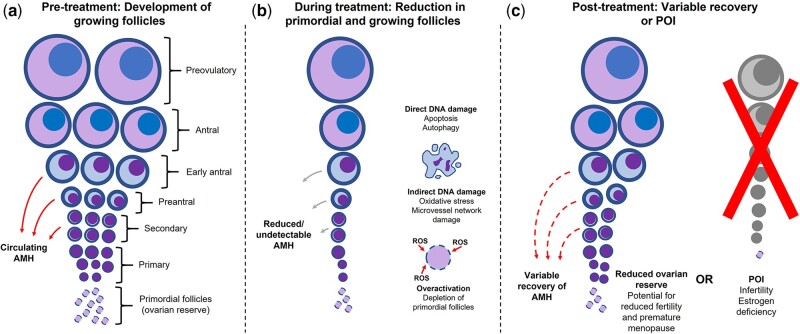
Female patients undergoing anticancer treatment are at elevated risk of adverse ovarian outcomes including infertility and premature ovarian insufficiency (POI), which is associated with short- and long-term health risks. Anti-Müllerian hormone (AMH) is a key biomarker of ovarian reserve, but its role prior to and after cancer treatment is less well understood.
To conduct a systematic review evaluating AMH as a biomarker of ovarian reserve and POI before and after anticancer treatment, which has become a pressing clinical issue in reproductive medicine. There are a large number of observational studies, but differences in patient groups, cancer diagnoses and study design make this a confusing field that will benefit from a thorough and robust review.
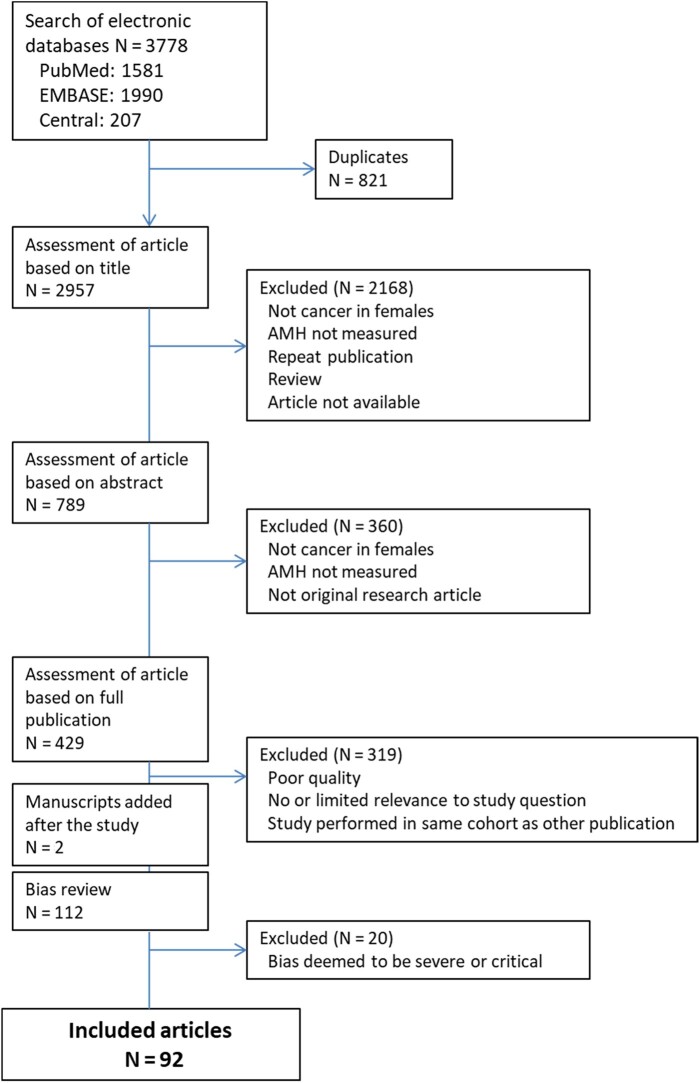
A systematic literature search for AMH in women with cancer was conducted in PubMed, Embase and Cochrane Central Register of Controlled Trials up to 1 April 2021. Bias review was conducted using the Risk of Bias In Non-randomized Studies of Interventions (ROBINS-I) protocol along with qualitative assessment of quality. Exploratory subgroups were established based on age, cancer type and length of follow-up.
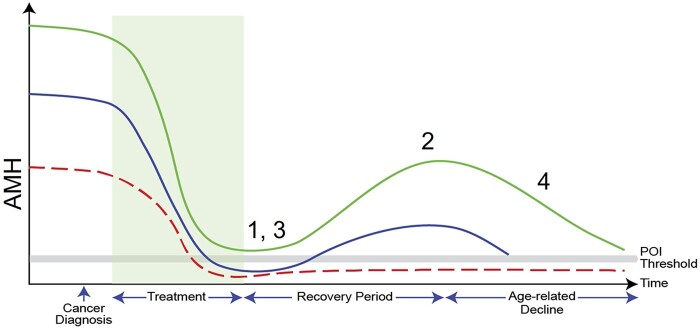
Ninety-two publications (N = 9183 patients) were included in this analysis after quality and bias review. Reduced/undetectable AMH was consistently identified in 69/75 studies (92%) following chemotherapy or radiotherapy, with reductions ranging from 42% to concentrations below the limit of detection, and many reporting mean or median declines of ≥90%. Where longitudinal data were analysed (42 studies), a majority (33/42 (79%)) of studies reported at least partial recovery of AMH at follow-up, however, effect estimates were highly variable, reflecting that AMH levels were strongly impacted by anticancer treatment (i.e. the chemotherapy regimen used and the number of treatment cycles need), with recovery and its degree determined by treatment regimen, age and pre-treatment AMH level. In 16/31 (52%) publications, oligo/amenorrhoea was associated with lower post-treatment AMH consistent with impending POI, although menstruation and/or pregnancy were reported in patients with low or undetectable AMH. Long-term (>5 years) follow-up of paediatric patients following cancer treatment also found significantly lower AMH compared with control groups in 14/20 (70%) of studies, with very variable effect sizes from complete loss of AMH to full recovery depending on treatment exposure, as in adult patients.
AMH can be used to identify the damaging effect of cancer treatments on ovarian function. This can be applied to individual women, including pre-pubertal and adolescent girls, as well as comparing different treatment regimens, ages and pre-treatment AMH levels in populations of women. While there was evidence for its value in the diagnosis of POI after cancer treatment, further studies across a range of diagnoses/treatment regimens and patient ages are required to clarify this, and to quantify its predictive value. A major limitation for the use of AMH clinically is the very limited data relating post-treatment AMH levels to fertility, duration of reproductive lifespan or time to POI; analysis of these clinically relevant outcomes will be important in further research.
接受抗癌治疗的女性患者出现不良卵巢结局的风险升高,包括不孕和卵巢早衰(POI),这与短期和长期健康风险相关。抗苗勒管激素(AMH)是卵巢储备的关键生物标志物,但其在癌症治疗前后的作用尚不太清楚。
进行一项系统评价,评估AMH作为抗癌治疗前后卵巢储备和POI的生物标志物,这已成为生殖医学中一个紧迫的临床问题。有大量的观察性研究,但患者群体、癌症诊断和研究设计的差异使得这一领域令人困惑,需要进行全面而有力的综述。
截至2021年4月1日,在PubMed、Embase和Cochrane对照试验中央注册库中对癌症女性患者的AMH进行了系统文献检索。使用干预性非随机研究的偏倚风险(ROBINS-I)方案进行偏倚审查,并对质量进行定性评估。根据年龄、癌症类型和随访时间建立探索性子组。
经过质量和偏倚审查后,本分析纳入了92篇出版物(N = 9183例患者)。在69/75项研究(92%)中,化疗或放疗后一致发现AMH降低/检测不到,降低幅度从42%到低于检测限,许多研究报告平均或中位数下降≥90%。在分析纵向数据的研究(42项研究)中,大多数研究(33/42(79%))报告随访时AMH至少部分恢复,然而,效应估计值差异很大,这反映出AMH水平受到抗癌治疗的强烈影响(即所用的化疗方案和所需的治疗周期数),恢复情况及其程度由治疗方案、年龄和治疗前AMH水平决定。在16/31(52%)的出版物中,少经/闭经与治疗后较低的AMH相关,与即将发生的POI一致,尽管AMH低或检测不到的患者有月经和/或妊娠的报告。癌症治疗后儿科患者的长期(>5年)随访也发现,在14/20(70%)的研究中,与对照组相比,AMH显著降低,效应大小差异很大,从AMH完全丧失到完全恢复,这与成年患者情况相同。
AMH可用于识别癌症治疗对卵巢功能的损害作用。这可应用于个体女性,包括青春期前和青春期女孩,也可用于比较不同治疗方案、年龄和女性群体中治疗前AMH水平。虽然有证据表明其在癌症治疗后POI诊断中的价值,但需要在一系列诊断/治疗方案和患者年龄中进行进一步研究以阐明这一点,并量化其预测价值。临床上使用AMH的一个主要限制是治疗后AMH水平与生育能力、生殖寿命持续时间或发生POI时间相关的数据非常有限;对这些临床相关结局的分析在进一步研究中将很重要。