Früh Eike, Bütefisch Sebastian, Gursky Benjamin, Brüning Dennis, Leester-Schädel Monika, Dietzel Andreas, Rustenbeck Ingo
Institute of Pharmacology, Toxicology and Clinical Pharmacy, Technische Universität Braunschweig, D38106 Braunschweig, Germany.
PVZ-Center of Pharmaceutical Engineering of the Technische Universität Braunschweig, Technische Universität Braunschweig, D38106 Braunschweig, Germany.
Bioengineering (Basel). 2022 Feb 9;9(2):67. doi: 10.3390/bioengineering9020067.
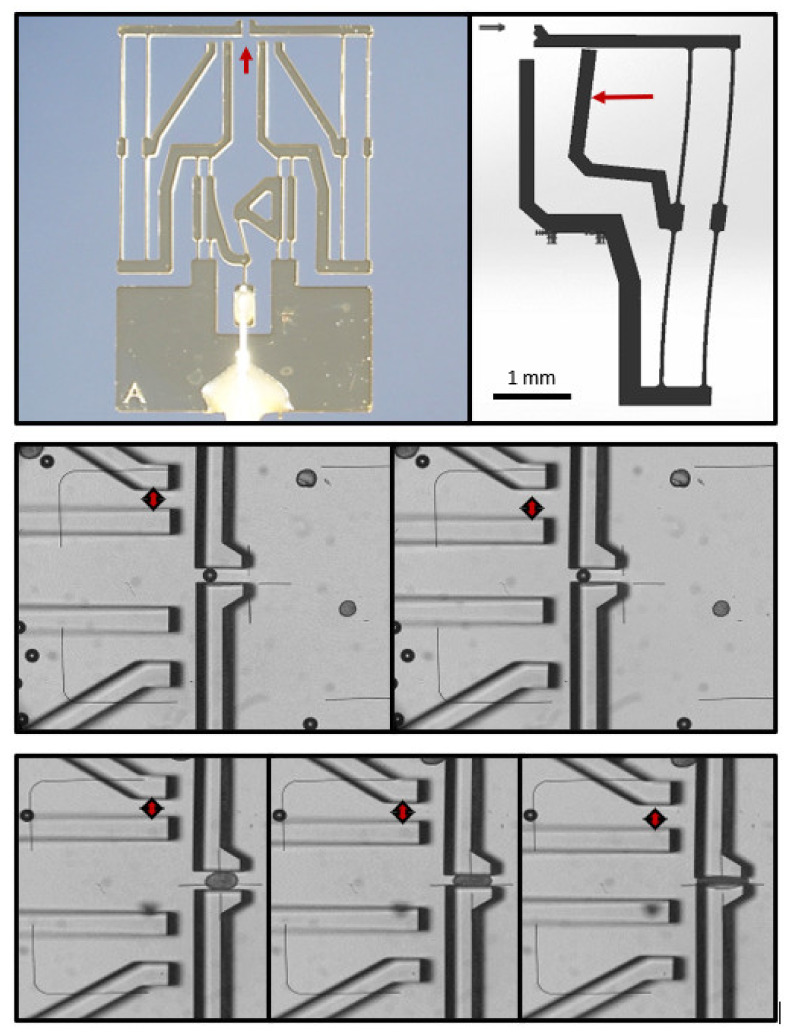
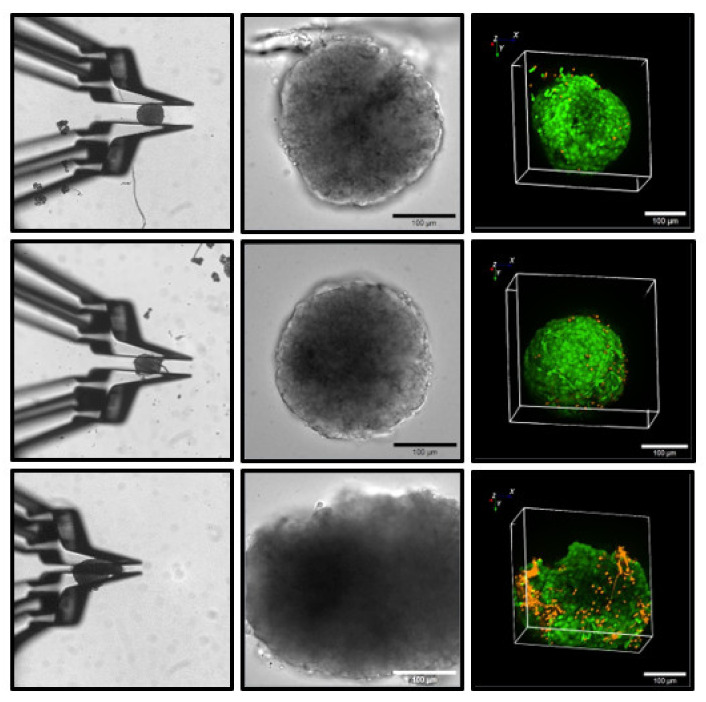
To improve the predictive value of in vitro experimentation, the use of 3D cell culture models, or organoids, is becoming increasingly popular. However, the current equipment of life science laboratories has been developed to deal with cell monolayers or cell suspensions. To handle 3D cell aggregates and organoids in a well-controlled manner, without causing structural damage or disturbing the function of interest, new instrumentation is needed. In particular, the precise and stable positioning in a cell bath with flow rates sufficient to characterize the kinetic responses to physiological or pharmacological stimuli can be a demanding task. Here, we present data that demonstrate that microgrippers are well suited to this task. The current version is able to work in aqueous solutions and was shown to position isolated pancreatic islets and 3D aggregates of insulin-secreting MIN6-cells. A stable hold required a gripping force of less than 30 μN and did not affect the cellular integrity. It was maintained even with high flow rates of the bath perfusion, and it was precise enough to permit the simultaneous microfluorimetric measurements and membrane potential measurements of the single cells within the islet through the use of patch-clamp electrodes.
为提高体外实验的预测价值,使用三维细胞培养模型或类器官正变得越来越普遍。然而,生命科学实验室的现有设备是为处理细胞单层或细胞悬液而开发的。为了以良好控制的方式处理三维细胞聚集体和类器官,且不造成结构损伤或干扰感兴趣的功能,需要新的仪器。特别是,在具有足以表征对生理或药理刺激的动力学响应的流速的细胞浴中进行精确且稳定的定位可能是一项艰巨的任务。在此,我们展示的数据表明微夹钳非常适合这项任务。当前版本能够在水溶液中工作,并已证明能够对分离的胰岛和胰岛素分泌MIN6细胞的三维聚集体进行定位。稳定夹持所需的夹持力小于30 μN,且不影响细胞完整性。即使在浴灌注流速很高的情况下也能保持,并且精确到足以通过使用膜片钳电极对胰岛内的单个细胞同时进行微荧光测量和膜电位测量。