Faculty of Medicine, University of Toronto, Toronto, ON M5S 1A1, Canada.
Division of Medical Oncology and Hematology, Princess Margaret Cancer Centre, Toronto, ON M5G 2C1, Canada.
Curr Oncol. 2022 Feb 7;29(2):892-900. doi: 10.3390/curroncol29020076.
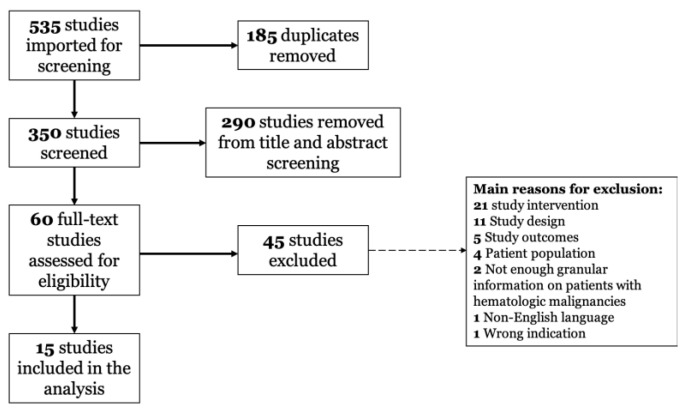
There is increasing interest from cancer patients and their healthcare providers in the use of virtual care in routine clinical practice. In the setting of hematologic malignancy, where patients often undergo complex and immunodepleting treatments, understanding how to use virtual care safely and effectively is critically important. We aimed to describe the use of virtual care in patients with hematologic malignancies and to examine physician- and patient-reported outcomes in the form of a systematic scoping review. An electronic search of PubMed, Ovid MEDLINE, Elsevier Embase, Scopus, and EBSCO CINAHL was conducted from January 2000 to April 2021. A comprehensive search strategy was used to identify relevant articles, and data were extracted to assess the study design, population, setting, patient characteristics, virtual care platform, and study results. Studies were included if they described the use of virtual care for patients with hematologic malignancies; commentaries were excluded. Fifteen studies met the inclusion criteria after abstract and full-text review. Three studies found that app-based tools were effective in monitoring patient symptoms and triggering alerts for more urgent follow-up. Four studies described the use of phone-based interventions. Five studies found that videoconferencing, with both physicians and oncology nurses, was highly rated by patients. Emerging themes included high levels of patient satisfaction across all domains of virtual care. Provider satisfaction scores were rated lower than patient scores, with concerns about technical issues leading to challenges with virtual care. Four studies found that virtual care allowed providers to promptly respond to patient concerns, especially when patients were experiencing side-effects or had questions about their treatment. Overall, the use of virtual care in patients with hematologic malignancies appears feasible, and resulted in high patient satisfaction. Further research is needed in order to evaluate the optimal method of integrating virtual care into clinical practice.
越来越多的癌症患者及其医疗保健提供者对在常规临床实践中使用虚拟护理感兴趣。在血液恶性肿瘤的情况下,患者通常接受复杂且免疫抑制的治疗,因此了解如何安全有效地使用虚拟护理至关重要。我们旨在描述血液恶性肿瘤患者中虚拟护理的使用情况,并通过系统范围审查检查以医生和患者报告的结果的形式进行评估。从 2000 年 1 月到 2021 年 4 月,对 PubMed、Ovid MEDLINE、Elsevier Embase、Scopus 和 EBSCO CINAHL 进行了电子检索。使用全面的搜索策略来识别相关文章,并提取数据以评估研究设计、人群、设置、患者特征、虚拟护理平台和研究结果。如果研究描述了血液恶性肿瘤患者虚拟护理的使用情况,则纳入研究;评论文章被排除在外。经过摘要和全文审查,有 15 项研究符合纳入标准。三项研究发现,基于应用程序的工具可有效监测患者症状并触发更紧急随访的警报。四项研究描述了基于电话的干预措施。五项研究发现,视频会议(包括医生和肿瘤护士)受到患者的高度评价。出现的主题包括虚拟护理各个领域的患者满意度均很高。提供者满意度评分低于患者评分,对技术问题的关注导致虚拟护理面临挑战。四项研究发现,虚拟护理使提供者能够及时响应患者的关注,尤其是当患者出现副作用或对治疗有疑问时。总体而言,血液恶性肿瘤患者中使用虚拟护理似乎是可行的,并且患者满意度很高。需要进一步研究,以评估将虚拟护理纳入临床实践的最佳方法。