Department of Ophthalmology, The Jikei University School of Medicine, Tokyo, Japan.
Center for Information and Neural Networks (CiNet), Advanced ICT Research Institute, National Institute of Information and Communications Technology, Suita, Japan.
Invest Ophthalmol Vis Sci. 2022 Feb 1;63(2):29. doi: 10.1167/iovs.63.2.29.
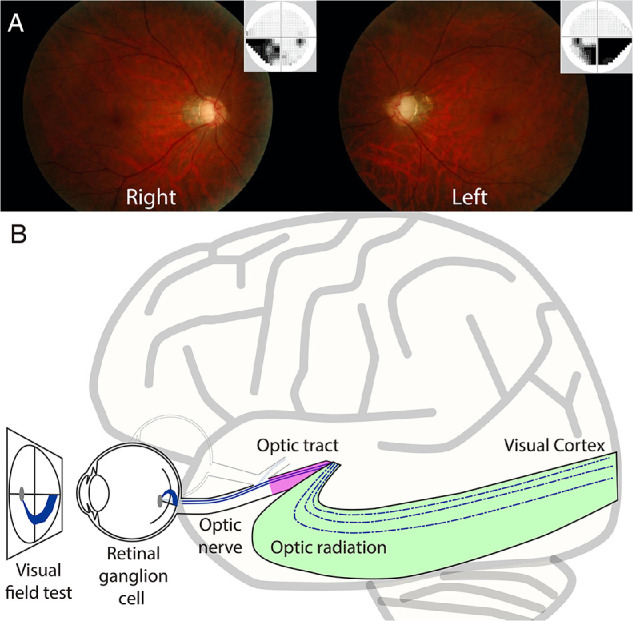
Glaucoma is a disorder that involves visual field loss caused by retinal ganglion cell damage. Previous diffusion magnetic resonance imaging (dMRI) studies have demonstrated that retinal ganglion cell damage affects tissues in the optic tract (OT) and optic radiation (OR). However, because previous studies have used a simple diffusion tensor model to analyze dMRI data, the microstructural interpretation of white matter tissue changes remains uncertain. In this study, we used a multi-contrast MRI approach to further clarify the type of microstructural damage that occurs in patients with glaucoma.
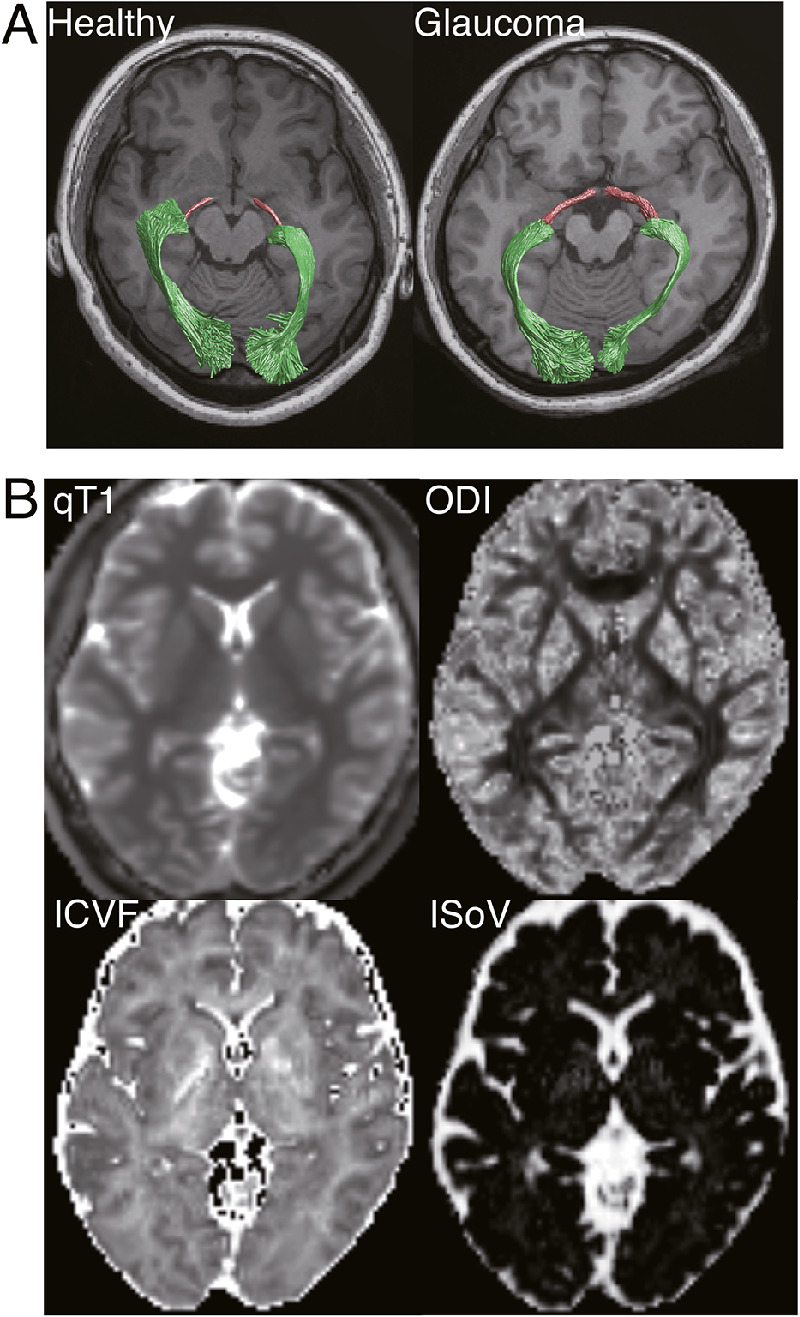
We collected dMRI data from 17 patients with glaucoma and 30 controls using 3-tesla (3T) MRI. Using the dMRI data, we estimated three types of tissue property metrics: intracellular volume fraction (ICVF), orientation dispersion index (ODI), and isotropic volume fraction (IsoV). Quantitative T1 (qT1) data, which may be relatively specific to myelin, were collected from all subjects.
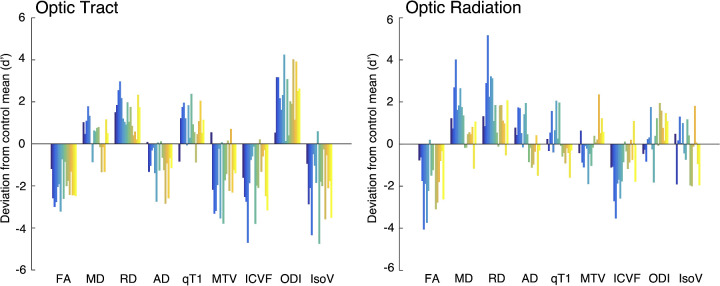
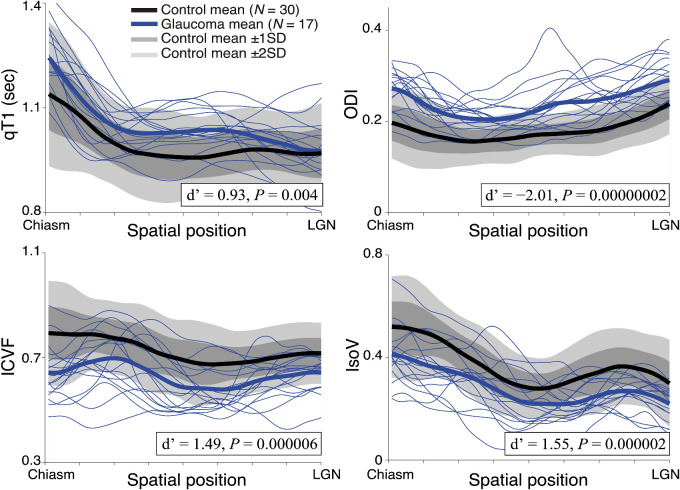
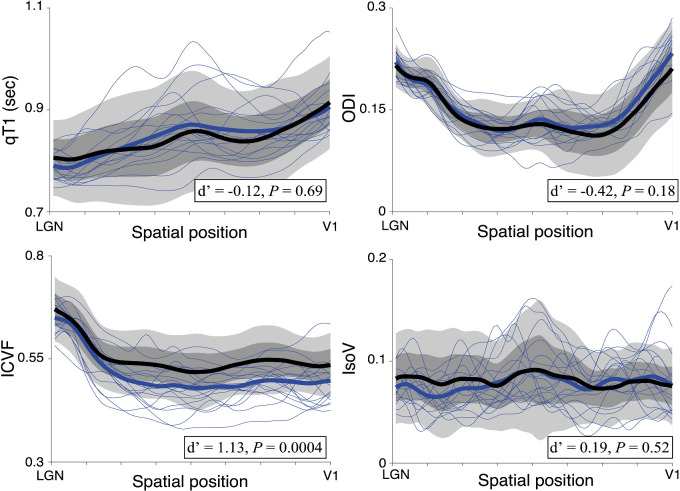
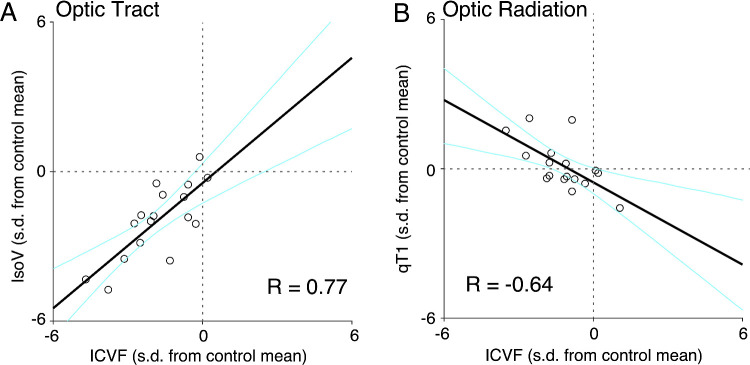
In the OT, all four metrics showed significant differences between the glaucoma and control groups. In the OR, only the ICVF showed significant between-group differences. ICVF was significantly correlated with qT1 in the OR of the glaucoma group, although qT1 did not show any abnormality at the group level.
Our results suggest that, at the group level, tissue changes in OR caused by glaucoma might be explained by axonal damage, which is reflected in the intracellular diffusion signals, rather than myelin damage. The significant correlation between ICVF and qT1 suggests that myelin damage might also occur in a smaller number of severe cases.
青光眼是一种涉及视网膜神经节细胞损伤导致视野丧失的疾病。先前的扩散磁共振成像(dMRI)研究表明,视网膜神经节细胞损伤会影响视束(OT)和视辐射(OR)中的组织。然而,由于先前的研究使用简单的扩散张量模型来分析 dMRI 数据,因此对白质组织变化的微观结构解释仍不确定。在这项研究中,我们使用多对比度 MRI 方法进一步阐明青光眼患者中发生的微观结构损伤的类型。
我们使用 3 特斯拉(3T)MRI 从 17 名青光眼患者和 30 名对照者中收集了 dMRI 数据。使用 dMRI 数据,我们估计了三种组织属性指标:细胞内体积分数(ICVF)、方向分散指数(ODI)和各向同性体积分数(IsoV)。从所有受试者中收集了定量 T1(qT1)数据,该数据可能与髓鞘相对特异。
在 OT 中,四项指标在青光眼组和对照组之间均显示出显著差异。在 OR 中,只有 ICVF 显示出组间差异。尽管 qT1 在组水平上没有显示任何异常,但 ICVF 与青光眼组 OR 中的 qT1 呈显著相关。
我们的结果表明,在组水平上,青光眼引起的 OR 中的组织变化可能是由轴突损伤引起的,这反映在细胞内扩散信号中,而不是髓鞘损伤。ICVF 与 qT1 之间的显著相关性表明,髓鞘损伤也可能在少数严重病例中发生。