Hanekamp Sandra, Ćurčić-Blake Branislava, Caron Bradley, McPherson Brent, Timmer Anneleen, Prins Doety, Boucard Christine C, Yoshida Masaki, Ida Masahiro, Hunt David, Jansonius Nomdo M, Pestilli Franco, Cornelissen Frans W
Department of Psychological and Brain Sciences, Indiana University, Bloomington, IN, USA.
Department of Intelligent Systems Engineering, Luddy School of Informatics and Engineering, Indiana University, Bloomington, IN, USA.
Sci Rep. 2021 Mar 25;11(1):6866. doi: 10.1038/s41598-021-85602-x.
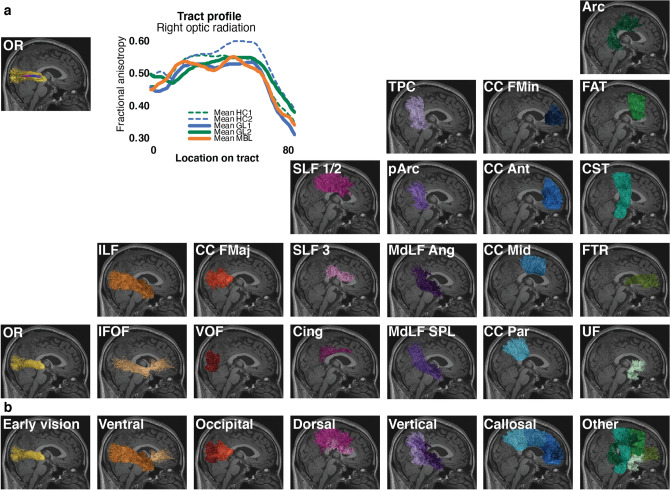
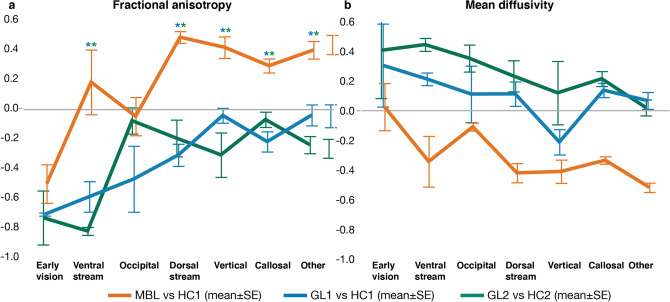
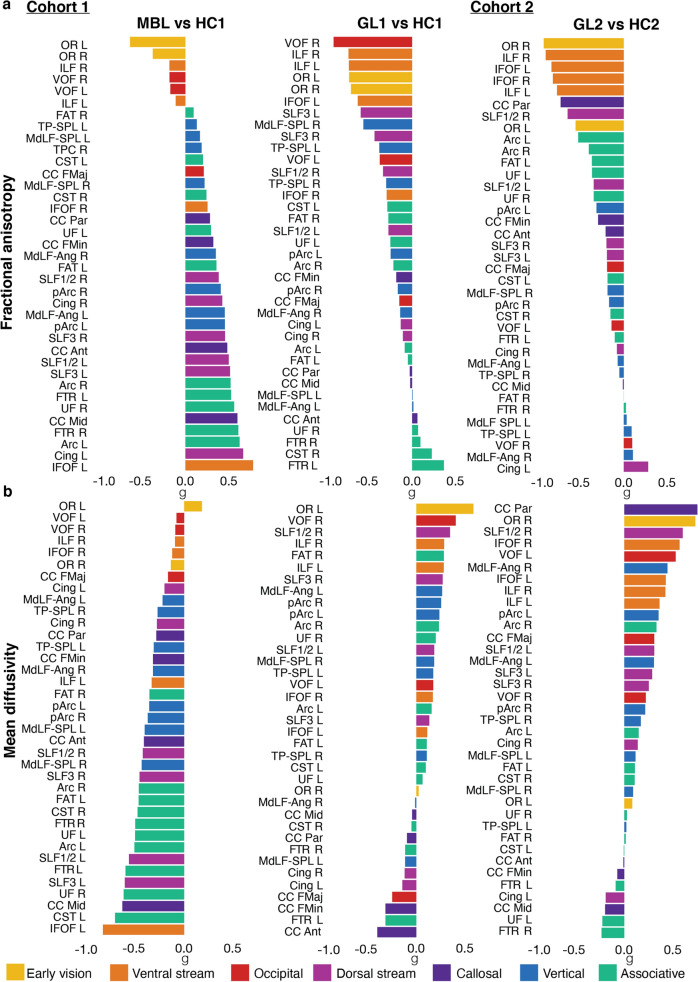
The degree to which glaucoma has effects in the brain beyond the eye and the visual pathways is unclear. To clarify this, we investigated white matter microstructure (WMM) in 37 tracts of patients with glaucoma, monocular blindness, and controls. We used brainlife.io for reproducibility. White matter tracts were subdivided into seven categories ranging from those primarily involved in vision (the visual white matter) to those primarily involved in cognition and motor control. In the vision tracts, WMM was decreased as measured by fractional anisotropy in both glaucoma and monocular blind subjects compared to controls, suggesting neurodegeneration due to reduced sensory inputs. A test-retest approach was used to validate these results. The pattern of results was different in monocular blind subjects, where WMM properties increased outside the visual white matter as compared to controls. This pattern of results suggests that whereas in the monocular blind loss of visual input might promote white matter reorganization outside of the early visual system, such reorganization might be reduced or absent in glaucoma. The results provide indirect evidence that in glaucoma unknown factors might limit the reorganization as seen in other patient groups following visual loss.
青光眼对大脑的影响程度,超出眼睛和视觉通路的情况尚不清楚。为了阐明这一点,我们研究了青光眼患者、单眼失明患者和对照组37个脑区的白质微观结构(WMM)。我们使用brainlife.io来确保结果的可重复性。白质束被细分为七类,从主要参与视觉的(视觉白质)到主要参与认知和运动控制的。在视觉束中,与对照组相比,青光眼和单眼失明受试者的分数各向异性测量显示白质微观结构减少,提示由于感觉输入减少导致神经变性。采用重测方法来验证这些结果。单眼失明受试者的结果模式不同,与对照组相比,他们视觉白质以外区域的白质微观结构属性增加。这种结果模式表明,在单眼失明中,视觉输入的丧失可能会促进早期视觉系统以外的白质重组,而在青光眼中这种重组可能会减少或不存在。结果提供了间接证据,表明在青光眼中,未知因素可能会限制像其他视觉丧失患者群体那样的重组。