Korzets Yasmin, Yariv Orly, Mutai Raz, Moore Assaf, Shochat Tzippy, Yerushalmi Rinat, Goldvaser Hadar
Institute of Oncology, Tel Aviv Sourasky Medical Center, Weizmann St 6, Tel Aviv, Israel.
Sackler Faculty of Medicine, Tel Aviv University, Chaim Levanon St 30, Tel Aviv, Israel.
Discov Oncol. 2021 Aug 17;12(1):26. doi: 10.1007/s12672-021-00420-x.
Menstrual and parity history might impact the risk for breast cancer. Data on the impact of these factors on other tumor characteristics are limited.
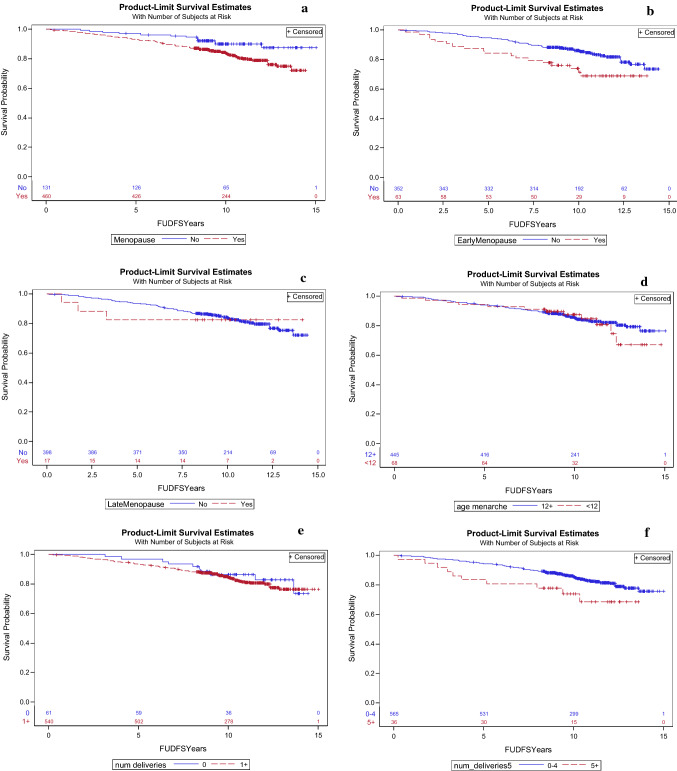
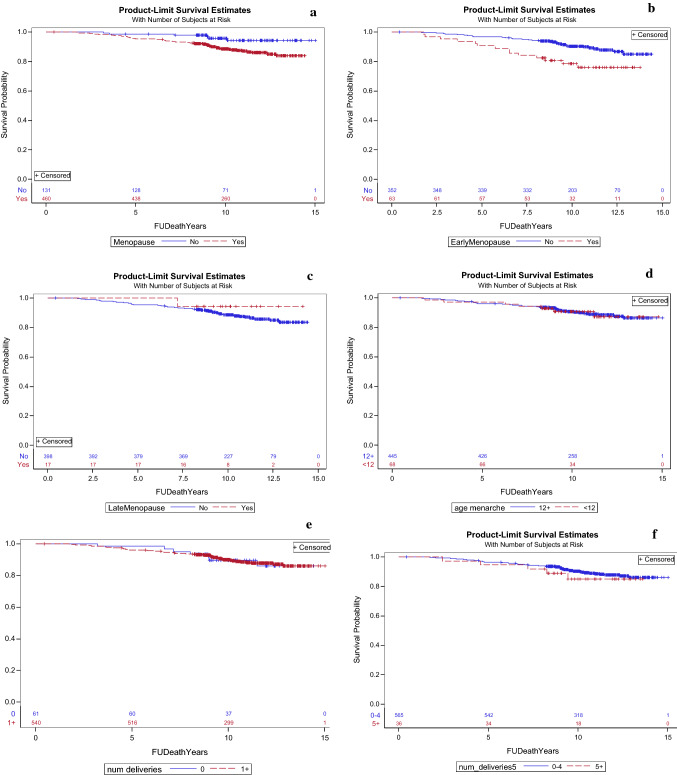
A single center retrospective cohort study comprising all women with estrogen receptor (ER) positive, human epidermal growth factor receptor 2 (HER2) negative, early breast cancer whose tumors were sent to OncotypeDX analysis. The prespecified subgroups were investigated: age of menarche (< 12 vs. ≥ 12 years), number of deliveries (0 vs. ≥ 1 childbirth and ≥ 5 childbirth vs. other), age of first delivery (≥ 30 years vs. younger age) and postmenopausal compared to premenopausal. The impact of age of menopause was also assessed categorically, using early (< 45 years) and late age of menopause (> 55 years). Differences in tumor characteristics were evaluated using T-test or Mann Whitney for continuous variables or Fisher's exact test for categorical variables. Outcomes were assessed by Kaplan-Meier survival analysis, with the log-rank test.
A total of 620 women were included. After median follow-up of 10.4 years, early menopause was associated with significantly worse disease-free survival (HR = 2.26, p = 0.004) and overall-survival (HR = 2.60, p = 0.004), and multiparity was associated with significant worse disease-free survival (HR = 2.16, p = 0.026). These differences remain significant in multivariate analyses. Post-menopausal women were more likely to have stronger ER intensity (p = 0.002) but progesterone receptor (PR) positivity was less frequent (p = 0.009(. Early age of menarche was associated with PR positivity (p = 0.039). No other associations were found between the evaluated subgroups and tumor characteristics.
The impact of endogenous estrogen exposure had little effect on breast cancer characteristics of early stage, luminal disease. Early menopause and multiparity were associated with worse outcome.
月经史和生育史可能会影响患乳腺癌的风险。关于这些因素对其他肿瘤特征影响的数据有限。
一项单中心回顾性队列研究,纳入所有雌激素受体(ER)阳性、人表皮生长因子受体2(HER2)阴性的早期乳腺癌女性患者,其肿瘤样本均进行了OncotypeDX分析。研究预设的亚组包括:初潮年龄(<12岁与≥12岁)、分娩次数(0次与≥1次分娩以及≥5次分娩与其他情况)、首次分娩年龄(≥30岁与较年轻年龄)以及绝经后与绝经前情况。还对绝经年龄进行了分类评估,分为早期绝经(<45岁)和晚期绝经(>55岁)。使用T检验或Mann-Whitney检验评估连续变量的肿瘤特征差异,使用Fisher精确检验评估分类变量的差异。通过Kaplan-Meier生存分析和对数秩检验评估预后。
共纳入620名女性。中位随访10.4年后,早期绝经与无病生存率显著降低(HR = 2.26,p = 0.004)和总生存率显著降低(HR = 2.60,p = 0.004)相关,多胎妊娠与无病生存率显著降低相关(HR = 2.16,p = 0.026)。在多变量分析中,这些差异仍然显著。绝经后女性更有可能具有更强的ER强度(p = 0.002),但孕激素受体(PR)阳性率较低(p = 0.009)。初潮年龄早与PR阳性相关(p = 0.039)。在评估的亚组与肿瘤特征之间未发现其他关联。
内源性雌激素暴露对早期管腔型疾病乳腺癌特征的影响较小。早期绝经和多胎妊娠与较差的预后相关。