Vadla May Sissel, Mdoe Paschal, Moshiro Robert, Haug Ingunn Anda, Gomo Øystein, Kvaløy Jan Terje, Oftedal Bjørg, Ersdal Hege
Faculty of Health Sciences, University of Stavanger, 4021 Stavanger, Norway.
Haydom Lutheran Hospital, Haydom P.O. Box 9000, Mbulu, Tanzania.
Children (Basel). 2022 Jan 20;9(2):134. doi: 10.3390/children9020134.
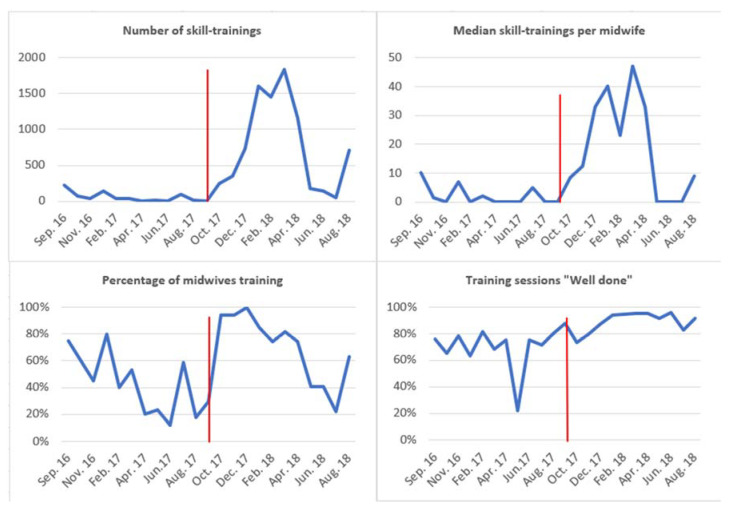
Globally, intrapartum-related complications account for approximately 2 million perinatal deaths annually. Adequate skills in neonatal resuscitation are required to reduce perinatal mortality. NeoNatalie Live is a newborn simulator providing immediate feedback, originally designed to accomplish Helping Babies Breathe training in low-resource settings. The objectives of this study were to describe changes in staff participation, skill-training frequency, and simulated ventilation quality before and after the introduction of "local motivators" in a rural Tanzanian hospital with 4000-5000 deliveries annually. Midwives ( = 15-27) were encouraged to perform in situ low-dose high-frequency simulation skill-training using NeoNatalie Live from September 2016 through to August 2018. Frequency and quality of trainings were automatically recorded in the simulator. The number of skill-trainings increased from 688 (12 months) to 8451 (11 months) after the introduction of local motivators in October 2017. Staff participation increased from 43% to 74% of the midwives. The quality of training performance, measured as "well done" feedback, increased from 75% to 91%. We conclude that training frequency, participation, and performance increased after introduction of dedicated motivators. In addition, the immediate constructive feedback features of the simulator may have influenced motivation and training quality performance.
在全球范围内,与分娩相关的并发症每年导致约200万例围产期死亡。为降低围产期死亡率,需要具备足够的新生儿复苏技能。NeoNatalie Live是一种能提供即时反馈的新生儿模拟器,最初设计用于在资源匮乏地区开展“帮助婴儿呼吸”培训。本研究的目的是描述在坦桑尼亚一家每年有4000 - 5000例分娩的农村医院引入“当地激励措施”前后,工作人员参与度、技能培训频率和模拟通气质量的变化。2016年9月至2018年8月,鼓励15 - 27名助产士使用NeoNatalie Live进行现场低剂量高频模拟技能培训。培训的频率和质量在模拟器中自动记录。2017年10月引入当地激励措施后,技能培训次数从688次(12个月)增加到8451次(11个月)。助产士的工作人员参与度从43%提高到74%。以“做得好”反馈衡量的培训表现质量从75%提高到91%。我们得出结论,引入专门的激励措施后,培训频率、参与度和表现均有所提高。此外,模拟器即时的建设性反馈功能可能影响了积极性和培训质量表现。