Takei Shogo, Kawazoe Akihito, Shitara Kohei
Department of Gastrointestinal Medical Oncology, National Cancer Center Hospital East, Chiba 277-8577, Japan.
Cancers (Basel). 2022 Feb 18;14(4):1054. doi: 10.3390/cancers14041054.
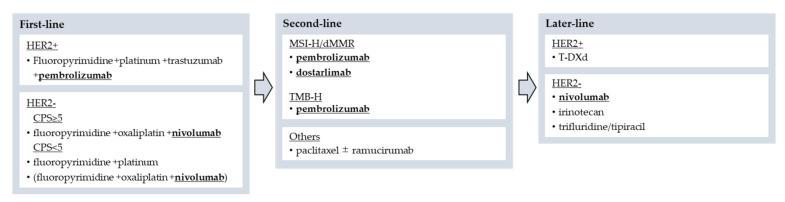
Immune checkpoint inhibitors (ICIs) such as anti-programmed cell death-1 (PD-1) or programmed cell death ligand-1 (PD-L1) monoclonal antibodies have prolonged survival in various types of malignancies, including advanced gastric cancer (AGC). Nivolumab, a monoclonal anti-PD-1 antibody, showed an improvement in overall survival at a later-line therapy in unselected AGC patients in the ATTRACTION-2 study or in combination with chemotherapy as first-line therapy in the global CheckMate-649 study. Another monoclonal anti-PD-1 antibody, pembrolizumab, showed single agent activity in tumors with high microsatellite instability or high tumor mutational burden. Furthermore, a recent KEYNOTE-811 study demonstrated significant improvement in response rate with pembrolizumab combined with trastuzumab and chemotherapy for HER2-positive AGC. Based on these results, ICIs are now incorporated into standard treatment for AGC patients. As a result of pivotal clinical trials, three anti-PD-1 antibodies were approved for AGC: nivolumab combined with chemotherapy as first-line treatment or nivolumab monotherapy as third- or later-line treatment in Asian countries; pembrolizumab for previously treated microsatellite instability-high (MSI-H) or tumor mutational burden-high AGC, or pembrolizumab combined with trastuzumab and chemotherapy for HER2-positive AGC in the United States; and dostarlimab for previously treated MSI-H AGC in the United States. However, a substantial number of patients have showed resistance to ICIs, highlighting the importance of the better selection of patients or further combined immunotherapy. This review focused on molecular and immunological profiles, pivotal clinical trials of ICIs with related biomarkers, and investigational immunotherapy for AGC.
免疫检查点抑制剂(ICI),如抗程序性细胞死亡蛋白1(PD-1)或程序性细胞死亡配体1(PD-L1)单克隆抗体,已延长了包括晚期胃癌(AGC)在内的各种恶性肿瘤患者的生存期。纳武利尤单抗是一种抗PD-1单克隆抗体,在ATTRACTION-2研究中,其用于未经选择的AGC患者的后线治疗可改善总生存期;在全球CheckMate-649研究中,其与化疗联合作为一线治疗也有同样效果。另一种抗PD-1单克隆抗体帕博利珠单抗,在微卫星高度不稳定或肿瘤突变负荷高的肿瘤中显示出单药活性。此外,最近的KEYNOTE-811研究表明,帕博利珠单抗联合曲妥珠单抗和化疗用于HER2阳性AGC时,缓解率有显著提高。基于这些结果,ICI现已纳入AGC患者的标准治疗方案。由于关键临床试验的结果,三种抗PD-1抗体被批准用于AGC治疗:在亚洲国家,纳武利尤单抗联合化疗作为一线治疗,或纳武利尤单抗单药治疗作为三线或后线治疗;在美国,帕博利珠单抗用于先前治疗过的微卫星高度不稳定(MSI-H)或肿瘤突变负荷高的AGC,或帕博利珠单抗联合曲妥珠单抗和化疗用于HER2阳性AGC;在美国,多斯塔利单抗用于先前治疗过的MSI-H AGC。然而,相当多的患者对ICI表现出耐药性,这凸显了更好地选择患者或进一步联合免疫治疗的重要性。本综述重点关注分子和免疫特征、ICI相关生物标志物的关键临床试验以及AGC的研究性免疫治疗。