Gil-Lacruz Marta, Gil-Lacruz Ana Isabel, Navarro-López Jorge, Aguilar-Palacio Isabel
Bienestar y Capital Social (BYCS), Department of Psychology and Sociology, Health Science Faculty, University of Zaragoza, 50009 Zaragoza, Spain.
Bienestar y Capital Social (BYCS), Department of Management, School of Engineering and Architecture, University of Zaragoza, 50018 Zaragoza, Spain.
Healthcare (Basel). 2022 Feb 13;10(2):365. doi: 10.3390/healthcare10020365.
The relationship between self-rated health and gender differs across countries and generations. The aim of this study is to analyze the effect of socioeconomic conditions on self-rated health from a generational perspective, its differential effect on gender, and its influence on the gender gap in order to explore health diversity using a multidisciplinary approach and considering policy implications in Eastern European countries.
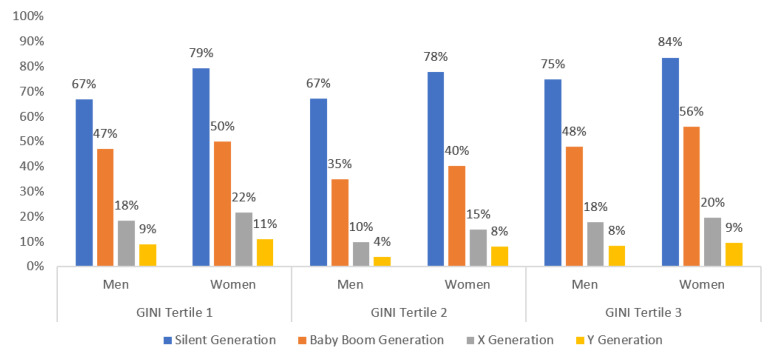
We used data drawn from the European Health Interview Survey for eight Eastern European countries and EUROSTAT from 2006 through to 2009. We conducted multilevel analyses to understand the individual and national health determinants of self-rated health by gender and to determine whether national differences remain after controlling for micro variables. In order to analyze the role of equity (Gini quartile) in gender differences, Oaxaca analyses were used.
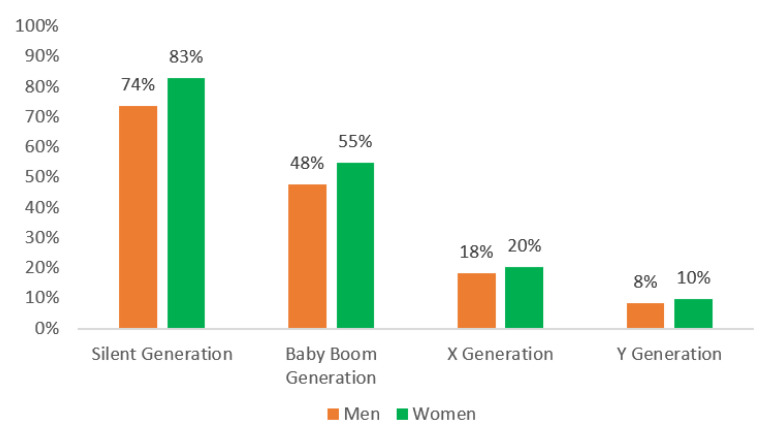
The self-rated health gender gap increases with age. Individual characteristics, such as educational level or smoking, influence citizens' perceived health, and have a stronger effect on women than on men. Knowing both the characteristics (endowment effects) and the effects of individual characteristics (coefficient effects) on health is important in order to understand gender gaps among people from the silent generation.
Our research indicates that random effects are greater for men than for women. Moreover, random effects might be explained to a certain extent by economic equity (Gini index). The combined effects of gender, cohort, and geographical differences on self-rated health have to be taken into account to develop public health policies.
自我评估健康状况与性别的关系在不同国家和代际间存在差异。本研究旨在从代际视角分析社会经济状况对自我评估健康的影响、其对性别的差异影响以及对性别差距的影响,以便采用多学科方法并考虑东欧国家的政策影响来探索健康多样性。
我们使用了来自八个东欧国家的欧洲健康访谈调查以及欧盟统计局2006年至2009年的数据。我们进行了多层次分析,以了解按性别划分的自我评估健康的个体和国家健康决定因素,并确定在控制微观变量后国家差异是否仍然存在。为了分析公平性(基尼四分位数)在性别差异中的作用,我们使用了瓦哈卡分析。
自我评估健康的性别差距随年龄增长而增大。个体特征,如教育水平或吸烟情况,会影响公民对自身健康的感知,且对女性的影响比对男性更强。了解特征(禀赋效应)以及个体特征对健康的影响(系数效应)对于理解沉默一代人群中的性别差距很重要。
我们的研究表明,男性的随机效应大于女性。此外,随机效应在一定程度上可能由经济公平性(基尼指数)来解释。在制定公共卫生政策时,必须考虑性别、队列和地理差异对自我评估健康的综合影响。