Souza Leonel Cardozo de Menezes E, Faletti Anderson, Veríssimo Carla Pires, Stelling Mariana Paranhos, Borges Helena Lobo
Instituto de Ciências Biomédicas, Universidade Federal do Rio de Janeiro, Rio de Janeiro 21941-902, Brazil.
Instituto Federal de Educação, Ciência e Tecnologia do Rio de Janeiro, Rio de Janeiro 20260-100, Brazil.
Membranes (Basel). 2022 Feb 9;12(2):202. doi: 10.3390/membranes12020202.
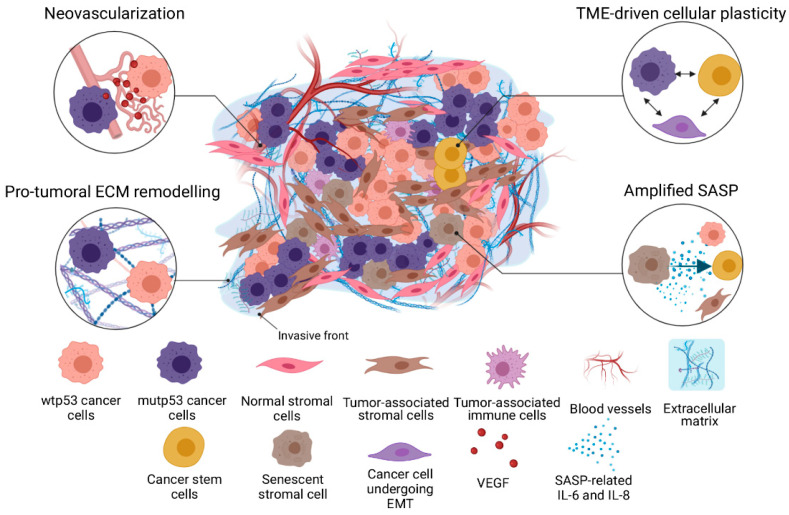
Chemoresistance persists as a significant, unresolved clinical challenge in many cancer types. The tumor microenvironment, in which cancer cells reside and interact with non-cancer cells and tissue structures, has a known role in promoting every aspect of tumor progression, including chemoresistance. However, the molecular determinants of microenvironment-driven chemoresistance are mainly unknown. In this review, we propose that the tumor suppressor, found mutant in over half of human cancers, is a crucial regulator of cancer cell-microenvironment crosstalk and a prime candidate for the investigation of microenvironment-specific modulators of chemoresistance. Wild-type p53 controls the secretion of factors that inhibit the tumor microenvironment, whereas altered secretion or mutant p53 interfere with p53 function to promote chemoresistance. We highlight resistance mechanisms promoted by mutant p53 and enforced by the microenvironment, such as extracellular matrix remodeling and adaptation to hypoxia. Alterations of wild-type p53 extracellular function may create a cascade of spatial amplification loops in the tumor tissue that can influence cellular behavior far from the initial oncogenic mutation. We discuss the concept of chemoresistance as a multicellular/tissue-level process rather than intrinsically cellular. Targeting p53-dependent crosstalk mechanisms between cancer cells and components of the tumor environment might disrupt the waves of chemoresistance that spread across the tumor tissue, increasing the efficacy of chemotherapeutic agents.
在许多癌症类型中,化疗耐药仍然是一个重大的、尚未解决的临床挑战。肿瘤微环境是癌细胞赖以生存并与非癌细胞及组织结构相互作用的环境,已知在促进肿瘤进展的各个方面发挥作用,包括化疗耐药。然而,微环境驱动的化疗耐药的分子决定因素主要尚不清楚。在本综述中,我们提出,这种在超过半数人类癌症中发生突变的肿瘤抑制因子,是癌细胞与微环境相互作用的关键调节因子,也是研究微环境特异性化疗耐药调节剂的主要候选对象。野生型p53控制抑制肿瘤微环境的因子的分泌,而分泌改变或突变型p53会干扰p53功能以促进化疗耐药。我们重点介绍了由突变型p53促进并由微环境强化的耐药机制,如细胞外基质重塑和对缺氧的适应。野生型p53细胞外功能的改变可能在肿瘤组织中形成一系列空间放大环,从而影响远离初始致癌突变的细胞行为。我们讨论了化疗耐药是一个多细胞/组织水平过程而非内在细胞过程的概念。针对癌细胞与肿瘤环境成分之间依赖p53的相互作用机制可能会破坏在肿瘤组织中传播的化疗耐药波,提高化疗药物的疗效。