Curthoys Ian S, Smith Paul F, de Miguel Angel Ramos
Vestibular Research Laboratory, School of Psychology, The University of Sydney, Sydney, NSW 2006, Australia.
Department of Pharmacology and Toxicology, School of Biomedical Sciences, University of Otago, Dunedin 9016, New Zealand.
J Clin Med. 2022 Feb 21;11(4):1132. doi: 10.3390/jcm11041132.
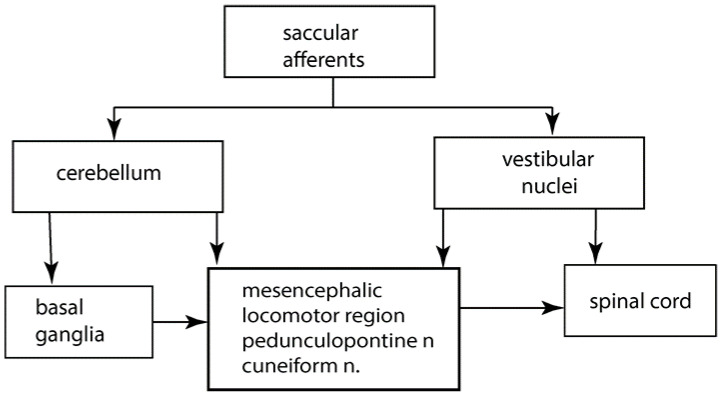
An ongoing EU Horizon 2020 Project called BionicVEST is investigating the effect of constant electrical stimulation (ES) of the inferior vestibular nerve in patients with bilateral vestibular dysfunction (BVD). The evidence is that constant ES results in improved postural stability and gait performance, and so the question of central importance concerns how constant ES of mainly saccular afferents in these BVD patients could cause this improved performance. We suggest that the constant ES substitutes for the absent saccular neural input to the vestibular nuclei and the cerebellum in these BVD patients and indirectly via these structures to other structures, which have been of great recent interest in motor control. One target area, the anterior midline cerebellum (the uvula), has recently been targeted as a location for deep-brain stimulation in human patients to improve postural stability and gait. There are projections from midline cerebellum to basal ganglia, including the striatum, which are structures involved in the initiation of gait. It may be that the effect of this activation of peripheral saccular afferent neurons is analogous to the effect of deep-brain stimulation (DBS) by electrodes in basal ganglia acting to help alleviate the symptoms of patients with Parkinson's disease.
欧盟正在进行的一个名为“仿生背心”的“地平线2020”项目,正在研究对双侧前庭功能障碍(BVD)患者的前庭下神经进行持续电刺激(ES)的效果。有证据表明,持续电刺激可改善姿势稳定性和步态表现,因此,一个至关重要的问题是,在这些BVD患者中,主要针对球囊传入神经的持续电刺激是如何导致这种表现改善的。我们认为,持续电刺激替代了这些BVD患者前庭核和小脑中缺失的球囊神经输入,并通过这些结构间接作用于其他结构,这些结构最近在运动控制方面引起了极大关注。一个目标区域,即小脑前中线(蚓垂),最近已被确定为人类患者进行脑深部刺激以改善姿势稳定性和步态的部位。从小脑中线到基底神经节,包括纹状体,存在投射,而纹状体是参与步态起始的结构。外周球囊传入神经元的这种激活作用,可能类似于通过电极在基底神经节进行脑深部刺激(DBS)的作用,有助于缓解帕金森病患者的症状。