Wang Shoujian, Zaitoun Ismail S, Darjatmoko Soesiawati R, Sheibani Nader, Sorenson Christine M
Department of Ophthalmology and Visual Sciences, University of Wisconsin School of Medicine and Public Health, Madison, WI 53705, USA.
McPherson Eye Research Institute, University of Wisconsin School of Medicine and Public Health, Madison, WI 53705, USA.
Life (Basel). 2022 Jan 29;12(2):208. doi: 10.3390/life12020208.
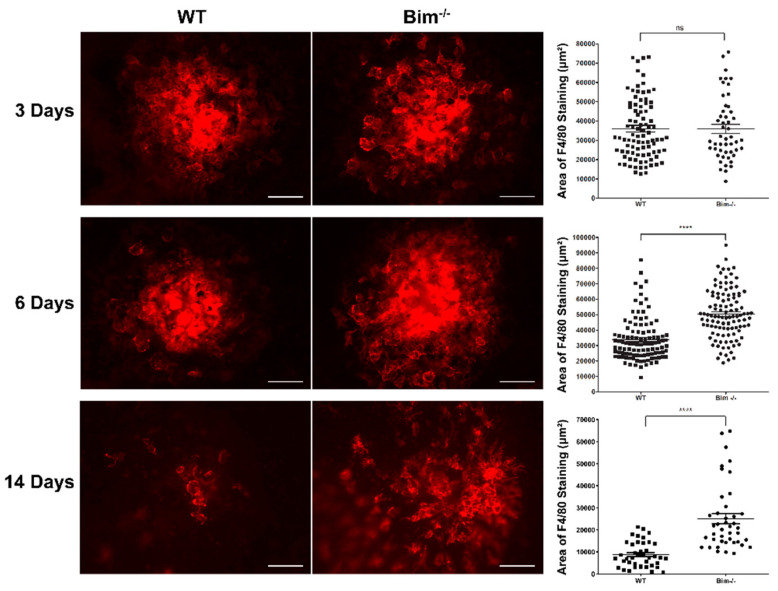
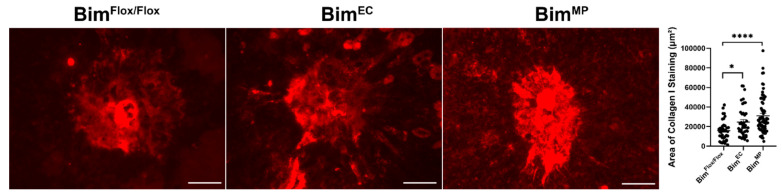
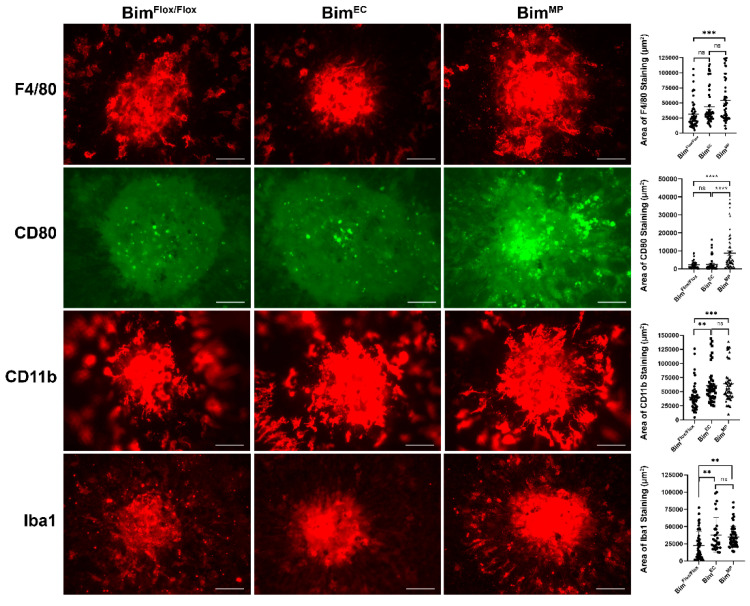
Inflammation is increasingly recognized as an important modulator in the pathogenesis of neovascular age-related macular degeneration (nAMD). Although significant progress has been made in delineating the pathways that contribute to the recruitment of inflammatory cells and their contribution to nAMD, we know little about what drives the resolution of these inflammatory responses. Gaining a better understanding of how immune cells are cleared in the choroid will give a novel insight into how sustained inflammation could influence the pathogenesis of nAMD. The pro-apoptotic Bcl-2 family member Bim is a master regulator of immune cell homeostasis. In its absence, immune cell lifespan and numbers increase. Most therapeutic regimes that squelch inflammation do so by enhancing immune cell apoptosis through enhanced Bim expression and activity. To test the hypothesis that Bim expression tempers inflammation during the pathogenesis of nAMD, we used the mouse laser-induced choroidal neovascularization (CNV) model in which inflammation acts as a facilitator of CNV. Here, we showed minimal to no change in the recruitment of F4/80-, CD80-, CD11b-, and Iba1-positive myeloid-derived mononuclear phagocytes to the site of laser photocoagulation in the absence of Bim expression. However, the resolution of these cells from the choroid of Bim-deficient (Bim -/-) mice was significantly diminished following laser photocoagulation. With time, we noted increased scar formation, demonstrated by collagen I staining, in Bim -/- mice with no change in the resolution of neovascularization compared to wild-type littermates. We also noted that mice lacking Bim expression in mononuclear phagocytes (Bim; Lyz2-Cre (Bim) mice) had delayed resolution of F4/80-, CD80-, CD11b-, and Iba1-positive cells, while those lacking Bim expression in endothelial cells (Bim; Cad5-Cre (Bim) mice) had delayed resolution of only CD11b- and Iba1-positive cells. Both Bim and Bim mice demonstrated increased scar formation, albeit to differing degrees. Thus, our studies show that resolving inflammation plays an important role in moderating scar formation in nAMD, and it is impacted by Bim expression in both the endothelium and mononuclear phagocyte lineages.
炎症日益被认为是新生血管性年龄相关性黄斑变性(nAMD)发病机制中的重要调节因子。尽管在描绘促成炎症细胞募集及其对nAMD的作用途径方面已取得重大进展,但我们对驱动这些炎症反应消退的因素知之甚少。更好地了解脉络膜中免疫细胞是如何清除的,将为持续炎症如何影响nAMD的发病机制提供新的见解。促凋亡Bcl-2家族成员Bim是免疫细胞稳态的主要调节因子。在其缺失时,免疫细胞的寿命和数量会增加。大多数抑制炎症的治疗方案都是通过增强Bim的表达和活性来促进免疫细胞凋亡。为了验证Bim表达在nAMD发病机制中调节炎症这一假设,我们使用了小鼠激光诱导脉络膜新生血管(CNV)模型,其中炎症是CNV的促进因素。在此,我们发现,在缺乏Bim表达的情况下,F4/80、CD80、CD11b和Iba1阳性骨髓来源的单核吞噬细胞向激光光凝部位的募集变化极小或没有变化。然而,激光光凝后,Bim缺陷(Bim -/-)小鼠脉络膜中这些细胞的清除明显减少。随着时间的推移,我们注意到,与野生型同窝小鼠相比,Bim -/-小鼠中I型胶原染色显示瘢痕形成增加,而新生血管的清除没有变化。我们还注意到,在单核吞噬细胞中缺乏Bim表达的小鼠(Bim;Lyz2-Cre(Bim)小鼠)中,F4/80、CD80、CD11b和Iba1阳性细胞的清除延迟,而在内皮细胞中缺乏Bim表达的小鼠(Bim;Cad5-Cre(Bim)小鼠)中,只有CD11b和Iba1阳性细胞的清除延迟。Bim -/-和Bim小鼠均显示瘢痕形成增加,尽管程度不同。因此,我们的研究表明,炎症消退在调节nAMD的瘢痕形成中起重要作用,并且它受到内皮细胞和单核吞噬细胞谱系中Bim表达的影响。