Meier Jeremy A, Savoldo Barbara, Grover Natalie S
Lineberger Comprehensive Cancer Center, The University of North Carolina at Chapel Hill, Chapel Hill, NC 27599, USA.
Department of Medicine, Division of Hematology, The University of North Carolina at Chapel Hill, Chapel Hill, NC 27599, USA.
J Pers Med. 2022 Feb 1;12(2):197. doi: 10.3390/jpm12020197.
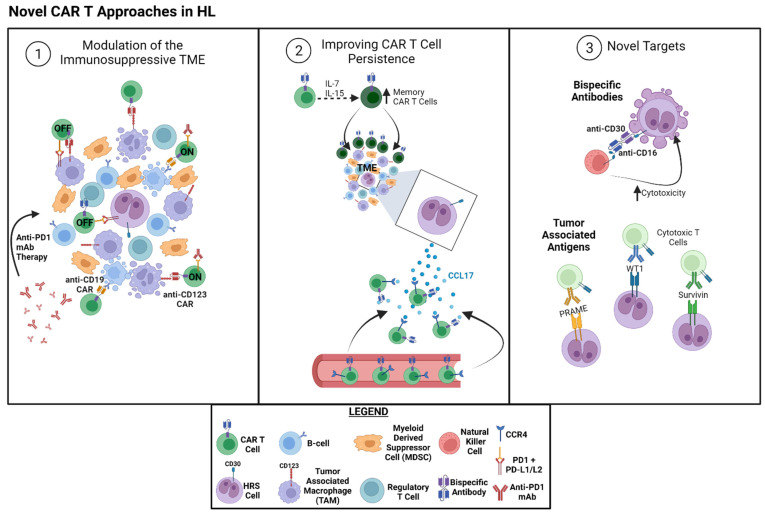
Treatment for Hodgkin lymphoma (HL) has evolved considerably from the time it was originally described in the 19th century with many patients now being cured with frontline therapy. Despite these advances, upwards of 10% of patients experience progressive disease after initial therapy with an even higher percentage relapsing. Until recently there had been limited therapeutic options for relapsed and/or refractory HL outside of highly intensive chemotherapy with stem cell rescue. Improved understanding of the pathophysiology of HL, coupled with the emergence of more targeted therapeutics, has reshaped how we view the treatment of relapsed/refractory HL and its prognosis. With this, there has been an increased focus on immunotherapies that can reprogram the immune system to better overcome the immunosuppressive milieu found in HL for improved cancer cell killing. In particular, chimeric antigen receptor (CAR) T cells are emerging as a valuable therapeutic tool in this area. Building on the success of antibody-drug conjugates directed against CD30, CAR T cells engineered to recognize the same antigen are now reaching patients. Though still in its infancy, CAR T therapy for relapsed/refractory HL has shown exceptional promise in early-stage clinical trials with the potential for durable responses even in patients who had progressed through multiple lines of prior therapy. Here we will review currently available data on the use of CAR T cells in HL, strategies to optimize their effectiveness, and how this therapy may fit into the treatment paradigm of HL going forward.
霍奇金淋巴瘤(HL)的治疗自19世纪首次被描述以来已经有了很大的发展,现在许多患者通过一线治疗得以治愈。尽管取得了这些进展,但仍有超过10%的患者在初始治疗后出现疾病进展,复发率甚至更高。直到最近,除了采用高强度化疗联合干细胞救援外,复发和/或难治性HL的治疗选择仍然有限。对HL病理生理学的深入了解,加上更具针对性的治疗方法的出现,重塑了我们对复发/难治性HL治疗及其预后的看法。由此,人们越来越关注免疫疗法,这种疗法可以重新编程免疫系统,以更好地克服HL中存在的免疫抑制环境,从而提高癌细胞杀伤能力。特别是,嵌合抗原受体(CAR)T细胞正在成为这一领域有价值的治疗工具。基于针对CD30的抗体药物偶联物的成功,设计用于识别相同抗原的CAR T细胞现在正在应用于患者。尽管CAR T细胞疗法用于复发/难治性HL仍处于起步阶段,但在早期临床试验中已显示出巨大的前景,即使是经过多线先前治疗后病情进展的患者也有可能获得持久缓解。在此,我们将回顾目前关于CAR T细胞在HL中应用的可用数据、优化其有效性的策略,以及这种疗法在未来HL治疗模式中的适用方式。